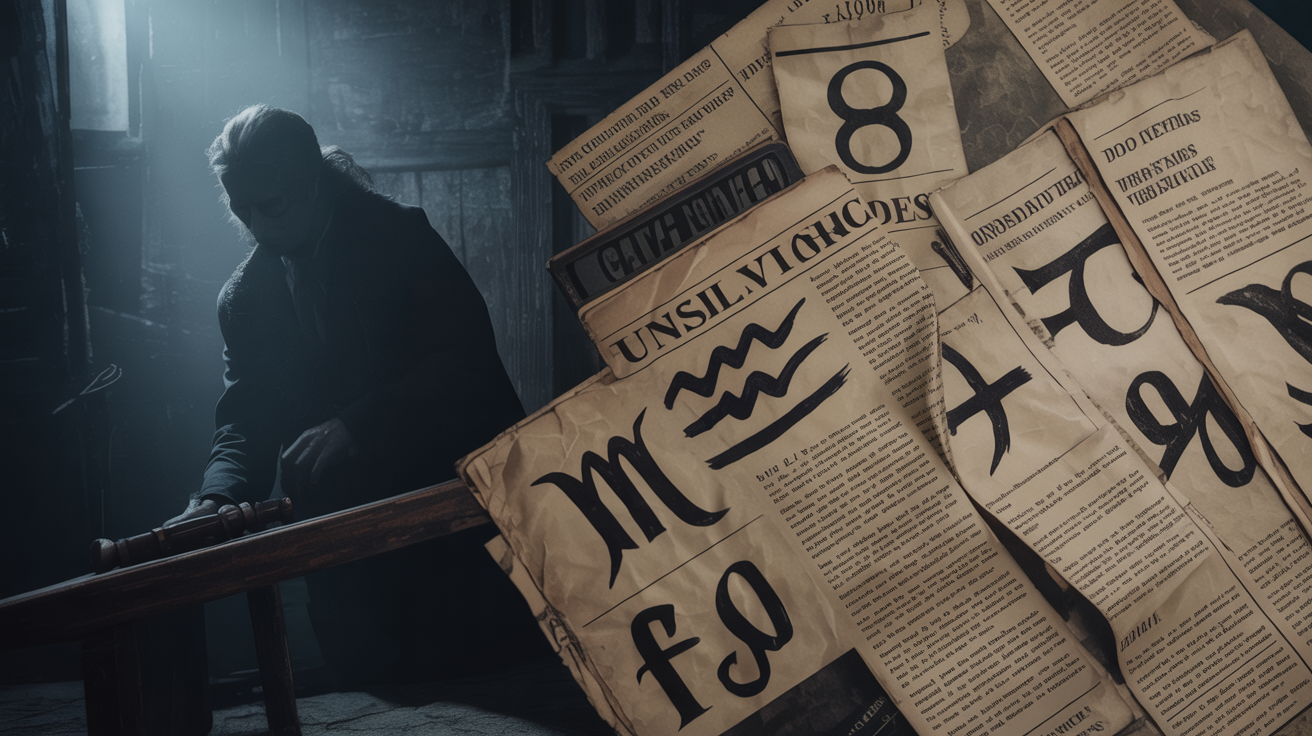
The Zodiac Killer Ciphers: The Message That Refused to Die
There are mysteries that survive because they are truly difficult, and then there are mysteries that endure because they are performative. The Zodiac Killer’s ciphers belong to both categories. They were not random doodles left behind by a careless criminal. They were deliberate artifacts, designed to be seen, copied, mailed, published, and debated. In that sense, the ciphers were not merely clues. They were part of the crime.
That distinction matters. From an intelligence perspective, a message intended for public consumption is never just a message. It is an operation. It has an audience, a timing mechanism, and a psychological objective. The Zodiac understood this instinctively. He used letters, symbols, and threats to create a pattern of fear larger than the body count alone. The murders frightened Northern California. The ciphers frightened the public imagination.
A Killer Who Wanted an Audience
The Zodiac case began in the late 1960s, when a series of attacks in the San Francisco Bay Area drew law enforcement into a widening and increasingly bizarre investigation. Unlike many serial offenders, Zodiac did not remain content with anonymity. He cultivated identity. He sent letters to newspapers, enclosed details only the killer would supposedly know, and used crossed-circle symbols to brand his communications. The ciphers were the most audacious expression of that branding.
Three of the early ciphers were mailed to the press in 1969. One was a 408-character cipher, another a shorter 340-character cipher, and a third was the so-called “my name is” cipher, which was never convincingly solved. The 408-character cipher was cracked within days by Donald and Bettye Harden, a schoolteacher and his wife, using hand analysis rather than computers. Its solution was revealing, if not in the way the public hoped. The decoded text was boastful, angry, and chillingly theatrical. It did not identify the killer. It identified his mindset.
That is a key point often lost in the mythology. A solved cipher does not automatically solve a case. It can also function as counterintelligence, giving the illusion of access while withholding the one fact everyone wants. The Zodiac’s first deciphered message confirmed that he was willing to use simple substitution methods and that he was willing to lie, taunt, and manipulate. In practical terms, that put investigators on notice: the man was less a master cryptographer than a violent showman.
The 340-Cipher and the Problem of False Closure
For decades, the 340-character cipher sat as a kind of talisman of frustration. It was more complex than the first, and it resisted numerous attempts at solution. In 2020, a team led by David Oranchak, Sam Blake, and Jarl Van Eycke announced a plausible resolution. Their decoding suggested that the Zodiac was once again taunting police and the public, mocking efforts to identify him, and ending with a line that made headlines around the world.
Even then, the case did not close. A cipher can be solved and still remain ambiguous. A decoded message can be meaningful and yet not definitive. That is because the value of the Zodiac letters has always rested on a tension between authenticity and performance. Some statements appear self-incriminating. Others feel carefully staged to maximize notoriety. The killer may have been telling the truth in fragments and inventing the rest. From an investigative standpoint, that is exactly the kind of material that creates analytical traps.
The most important question is not whether the 340 cipher was solved. It is whether the solution tells us anything materially useful about the offender. My view is that it tells us something modest but important: Zodiac enjoyed the process of being pursued. He wanted institutional attention. He understood that cryptic communication produces endurance. A crude threat may be forgotten; a code invites reproduction. Every newspaper that printed one of his ciphers became an amplifier.
That amplification helped the case escape its own era. Even as the murders stopped, the letters continued to move through libraries, case files, documentaries, and online forums. The ciphers became a self-sustaining object of study. And once that happened, the line between investigation and legend began to blur.
What the Ciphers Reveal, and What They Do Not
If you approach the Zodiac ciphers expecting hidden genius, you may miss the more interesting conclusion. They may reflect a competent amateur with a flair for deception rather than a brilliant cryptologist. That possibility is not disappointing. It is instructive. Many criminal communications are designed less to conceal information than to project control. The Zodiac’s writing style, symbol use, and escalating threats all support that interpretation.
Yet there is another layer worth considering. The persistence of the Zodiac puzzle says as much about us as it does about him. We are drawn to pattern, especially when the pattern is incomplete. A code invites the mind to participate. Every attempted solution becomes a small act of collaboration with the unknown. That is why the case never really disappears. It keeps recruiting new analysts.
As someone who spent years in intelligence work, I am wary of stories that promise revelation through obsession alone. Obsession can produce insight, but it can also generate confirmation bias, where the investigator sees only what fits the preferred theory. The Zodiac case has produced a long history of that problem. Suspects have come and gone. Interpretations have multiplied. Some are compelling. Many are not.
And yet the ciphers still matter. They are among the clearest examples of a criminal using language as leverage. The murders established fear; the letters converted fear into mythology. That is why the Zodiac remains more than a homicide case. He is a case study in how a killer can engineer his own afterlife.
The final irony is that the ciphers may never yield the kind of certainty the public wants. No decoded string is likely to hand investigators a neat confession, a full victim list, and a clean resolution. Real cases rarely end that way. More often, they end with a collection of partial truths, damaged records, and one or two artifacts that outlive the man who made them. The Zodiac ciphers are exactly that: fragments of intent preserved in paper and ink.
So the mystery is not simply what the Zodiac wrote. It is why he believed writing would matter. The answer, I think, is that he understood the power of unresolved questions. He did not need us to know everything. He only needed us to keep looking.
🔍 Video: Zodiac Killer Ciphers The
A Knight Phenomena Investigation