The Utsuro-bune: Japan's Strange Drifting Vessel and the Woman Who Wouldn't Open the Box
On a winter shoreline in Japan, something drifted in from the sea
If the Utsuro-bune story were a single, cleanly documented event, it would be easy to classify. A shipwreck. A hoax. A folk tale with a moral attached. But the case survives in a more unsettling form: fragmented, retold, and just strange enough to keep slipping through every category we try to pin it to.
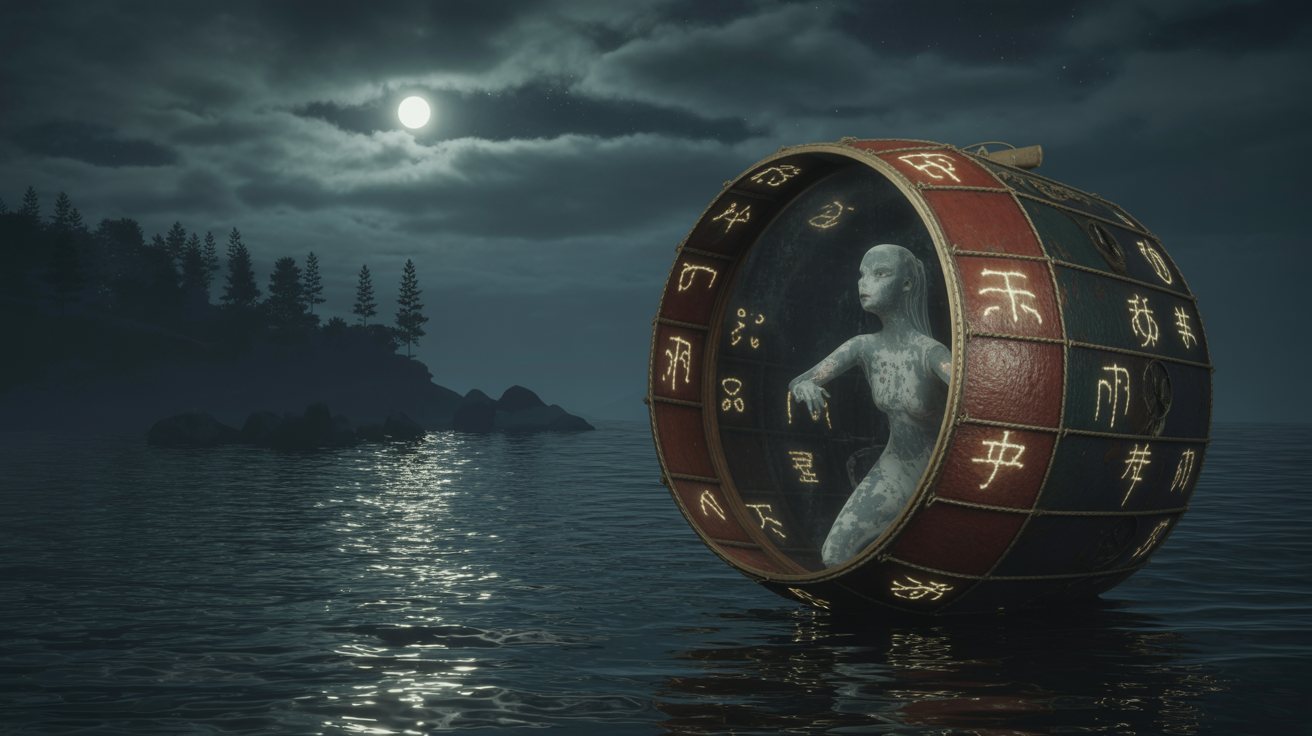
The name most often used today, Utsuro-bune, translates roughly as a hollow boat or empty vessel. The surviving accounts place the incident in the early nineteenth century, usually in 1803, along the coast of Hitachi Province in Japan. Fishermen are said to have found a circular craft washed ashore. It was unlike the local boats they knew. The hull was described as rounded, partly covered in metal plates or lacquered panels, with windows made of glass or polished material. Inside was a young woman with pale skin, unusual clothing, and a small box she would not allow anyone to open.
That is the core of the story. Everything else depends on which retelling you read.
What the accounts actually describe
In some versions, the vessel was large enough for several men to inspect. In others, it was roughly eight meters across. Some descriptions say it had iron-like plating on top and a reddish lacquered lower section. Others emphasize an odd script or symbolic markings etched across the interior. The woman, often portrayed as unusually beautiful, is said to have spoken a language the fishermen could not understand.
One detail recurs with remarkable consistency: the box. The woman clutched it, guarded it, and according to the story, refused to explain what was inside. In some tellings, the locals eventually returned her and the vessel to the sea because they did not know what else to do. In others, she vanished from the record almost immediately, leaving only the object and the questions behind.
The vessel was strange enough to inspire awe, but the silence surrounding it is what made it survive.
That silence matters. When a mystery arrives with no official paperwork, no eyewitness statements recorded at the time, and no physical evidence preserved for inspection, the investigator has to slow down. The temptation is to fill the gaps with whatever theory is most dramatic. That is usually where bad analysis begins.
The paper trail is late, layered, and unstable
The first problem is chronology. The story is not generally traced to a contemporaneous government report or a ship captain's log. Instead, it appears in later collections of odd tales and miscellanies from the Edo period, compiled years after the alleged event. That does not make the account worthless, but it does change how we should read it. A late source can preserve an older memory. It can also distort one, embellish it, or absorb older folklore into a newer narrative.
There is also the matter of variation. The location changes slightly depending on the source. The woman's appearance changes. The vessel changes. Even the foreign marks on the hull are inconsistently rendered. To an investigator, that is a warning light. Real events get retold, yes, but the degree of inconsistency here suggests either a story repeatedly adapted for readers or a tradition that was never fixed to begin with.
In other words, Utsuro-bune may not be a case in the modern evidentiary sense at all. It may be a narrative container, a way for different writers and communities to package uncertainty.
Why skeptics do not need to force an extraterrestrial answer
Whenever Utsuro-bune surfaces in popular culture, it quickly acquires a modern costume. The vessel becomes a flying saucer. The woman becomes an alien visitor. The box becomes a device, a specimen, or a forbidden artifact. But these interpretations usually tell us more about modern anxieties than about early nineteenth-century Japan.
The country was under the restrictions of sakoku, a period of limited foreign contact. Coastal communities still encountered drift vessels, castaways, and occasional outsiders, but such encounters could be deeply disorienting. A woman with unfamiliar clothing, an unknown language, and a foreign-looking vessel would have stood out immediately. In that setting, a strange story could easily grow around a real but poorly understood encounter.
There is also a practical explanation for the vessel itself. Drift craft from foreign waters were not unknown in East Asia. Shipwreck debris, stranded passengers, and unusual construction details could all be interpreted through local expectations. If the fishermen had never seen a rounded foreign lifeboat or modified hull, the object might have seemed unnatural even when it was entirely terrestrial.
And then there is the box, the most cinematic element of all. In folklore, a sealed object is rarely just a container. It is a test, a warning, or a symbol of knowledge that should not be disturbed. Once a tale includes a forbidden box, the story starts to behave less like a news report and more like a myth.
The symbols on the hull and the problem of interpretation
One of the more intriguing details is the set of strange symbols reported on the vessel. Some enthusiasts have claimed they resemble Russian, Sanskrit, or even extraterrestrial writing. That claim is easy to make and very hard to prove. Early Japanese texts often used stylized renderings of unfamiliar scripts, decorative marks, or simply invented characters to indicate foreignness. To a reader centuries later, those marks can look like a code. Sometimes they are just the visual language of strangeness.
This is a recurring issue in anomaly research. We tend to overvalue the strange detail and undervalue the medium that delivered it. A copied illustration is not a photograph. A woodblock print is not a forensic exhibit. A later anthology is not a field report. Once those distinctions are restored, the mystery becomes more legible, even if it does not become solved.
Could there have been a real woman in a real vessel?
That remains the most grounded possibility. A foreign or semi-foreign woman may have drifted ashore after a maritime incident. The locals may have miscommunicated with her. The vessel may have been damaged or unusual in construction. Over time, the event could have been stylized into a cautionary tale about contact with the unknown.
It is also possible that no single event sits at the center of the story. Utsuro-bune may be a composite built from multiple coastal encounters, each remembered imperfectly and later merged into one remarkable narrative. That would explain the recurring structure without requiring every detail to be literal.
Here is the sober reading: we do not have enough contemporary evidence to identify the vessel, confirm the woman's identity, or establish the event as anything beyond a historically persistent account. That is not a dismissal. It is the boundary line between history and legend.
Why the story still matters
Utsuro-bune endures because it sits at a crossroads where folklore, maritime history, and unexplained phenomena all overlap. It invites the same questions every good mystery does: what was seen, who recorded it, and how did the story change as it passed from hand to hand? Those are documentary questions, not supernatural ones. But they are often the only questions that lead anywhere useful.
In the modern paranormal imagination, the story has been recruited into UFO lore because it has the right silhouette: an unusual craft, an otherworldly visitor, an unreadable inscription, and a sealed container. Yet the presence of mystery-shaped details does not automatically mean the source is nonhuman. It may simply mean the original storytellers were describing a confusing event in the language available to them.
That is where I land after examining the available material. Not on certainty, but on restraint. Utsuro-bune is compelling not because it proves aliens, but because it shows how easily a real-world encounter can acquire layers of myth until the edge between fact and folklore becomes impossible to see cleanly.
And perhaps that is the more durable mystery. Not whether a woman from the sea came from another world, but how a society turns an unclassifiable event into a story that survives for generations. The box remains sealed. The vessel remains strange. The evidence remains incomplete. In a field crowded with bold claims, that kind of uncertainty is often the most honest answer we have.
🚣 Video: Utsuro Bune Japans Strange
A Knight Phenomena Investigation