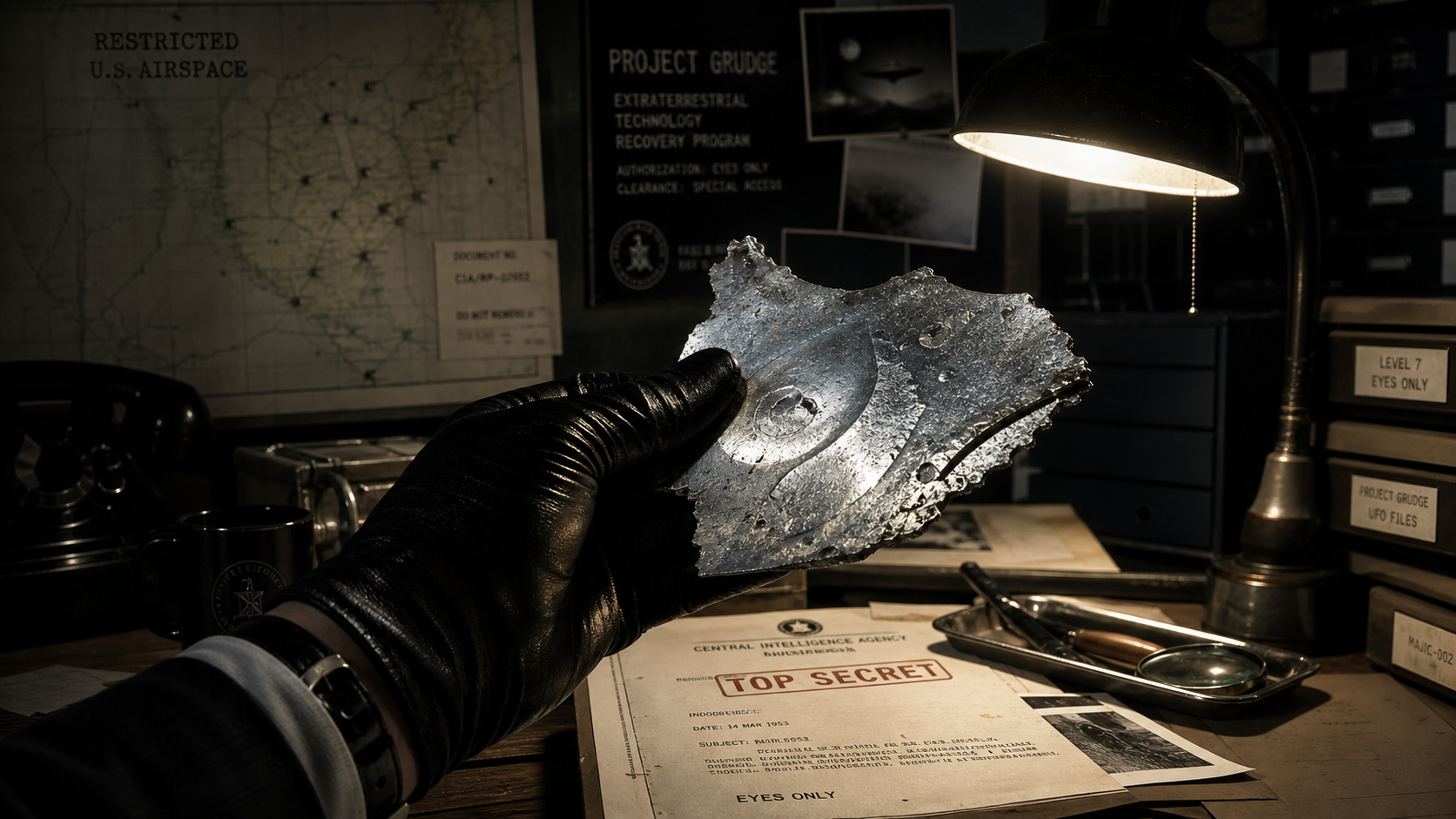
The Ubatuba UFO Fragments: Brazil’s Most Intriguing Sample, or a Well-Travelled Hoax?
On paper, the Ubatuba case should have been easy to dismiss.
In September 1957, fragments of a silvery metal reportedly arrived in the United States with a letter claiming they had broken off a flying saucer over Ubatuba, a coastal city in Brazil. The sender was anonymous. The chain of custody was murky. The story behind the material was already being retold and embellished within weeks. Yet the sample itself did not disappear into folklore. It was examined, discussed, and argued over by scientists, journalists, and UFO investigators for decades.
That is what gives the Ubatuba fragments their lasting power. Not the claim, which is easy to mock, but the fact that the physical sample kept the argument alive.
What was allegedly found
The basic narrative is straightforward. A Brazilian newspaper, O Cruzeiro, published a letter describing a bright object seen over the sea near Ubatuba. According to the account, the craft exploded or disintegrated, and pieces of its structure rained down. One of those pieces, the letter said, was a lightweight metal fragment later sent to the United States for analysis.
At the center of the story was magnesium. Early testing suggested the sample contained a very high percentage of magnesium and was unusually pure. That detail mattered. In the late 1950s, purity at that level seemed hard to explain with ordinary industrial production, at least to some observers. If the fragment was real, and if the analysis was accurate, then the material looked unusual enough to invite speculation.
But that is where the clean narrative starts to break apart.
The evidence problem
The first question is always the hardest: what, exactly, was tested?
The Ubatuba fragments were not recovered under controlled conditions. They were mailed. Their provenance depends on testimony, translations, newspaper reporting, and later recollections. That does not make them worthless, but it does make them fragile as evidence. In intelligence work, weak provenance is a warning light. In anomalistic claims, it is often the whole story.
The second problem is interpretation. A high magnesium content is not, by itself, proof of extraterrestrial origin. Magnesium was widely used in military, industrial, and pyrotechnic applications. Pure or nearly pure magnesium could be produced by conventional means, especially if the sample was small or specialized. The real issue is whether the fragment’s composition and physical properties were unusual for its time and context. The answer, frustratingly, depends on which analysis you trust and how much confidence you place in the sample’s history.
Then there is the matter of contamination. If a fragment passes through multiple hands, gets stored improperly, or is handled without strict controls, the chance of introducing outside material rises quickly. Even a legitimate sample can be compromised if the chain of custody is weak enough.
The role of investigators
The Ubatuba case gained traction because respected investigators took it seriously. Some saw the material as one of the stronger physical traces in UFO history. Others pointed out that serious attention to a sample does not make the sample extraordinary. It only means the sample is worth examining.
That distinction matters.
UFO history is full of cases where the story outran the evidence. Ubatuba is different in one respect: it includes something tangible, something you can place under a microscope. But tangible does not mean decisive. A piece of metal can be weighed, measured, and analyzed, yet still fail to answer the central question of origin.
It is also worth noting how the story evolved. Over time, the narrative around the fragments became more dramatic, more definite, and in some retellings more sensational. That pattern is familiar. When hard evidence is sparse, the surrounding mythology tends to harden. People stop describing uncertainty and start describing certainty. The record, however, rarely cooperates.
What makes the case persist
The Ubatuba fragments endure for the same reason many unresolved cases endure: they offer just enough specificity to resist easy dismissal.
There is a date. There is a location. There is a newspaper account. There is a sample. There are lab results, or at least reported lab results. None of that proves the extraordinary claim, but it does create a trail. And once a trail exists, people keep following it.
From a skeptical standpoint, the most likely explanation is also the most mundane: a piece of conventional material, mailed into a sensationalized environment, then elevated by repetition, selective testing, and the human appetite for a mystery with a physical artifact attached. That explanation is not glamorous, but it fits the evidence better than a shredded flying saucer over the Atlantic.
Still, the Ubatuba fragments remain interesting because they sit in the narrow space between bad evidence and unresolved questions. They are not nothing. They are also not enough.
Final assessment
If you approach Ubatuba with certainty, you will likely overstate the case in one direction or another. The believer sees a rare material trace of an extraordinary event. The skeptic sees a weakly sourced sample elevated by narrative and wishful thinking. The truth may be less theatrical than either side prefers.
My assessment is simple: the Ubatuba fragments are a fascinating example of how physical evidence can become more mysterious the more it is discussed. The sample may be real. The story around it almost certainly changed over time. And the claim that it came from a UFO remains unproven.
That, in the end, is the lesson. In investigations like this, the artifact is never the whole story. It is only the place where the story becomes visible.