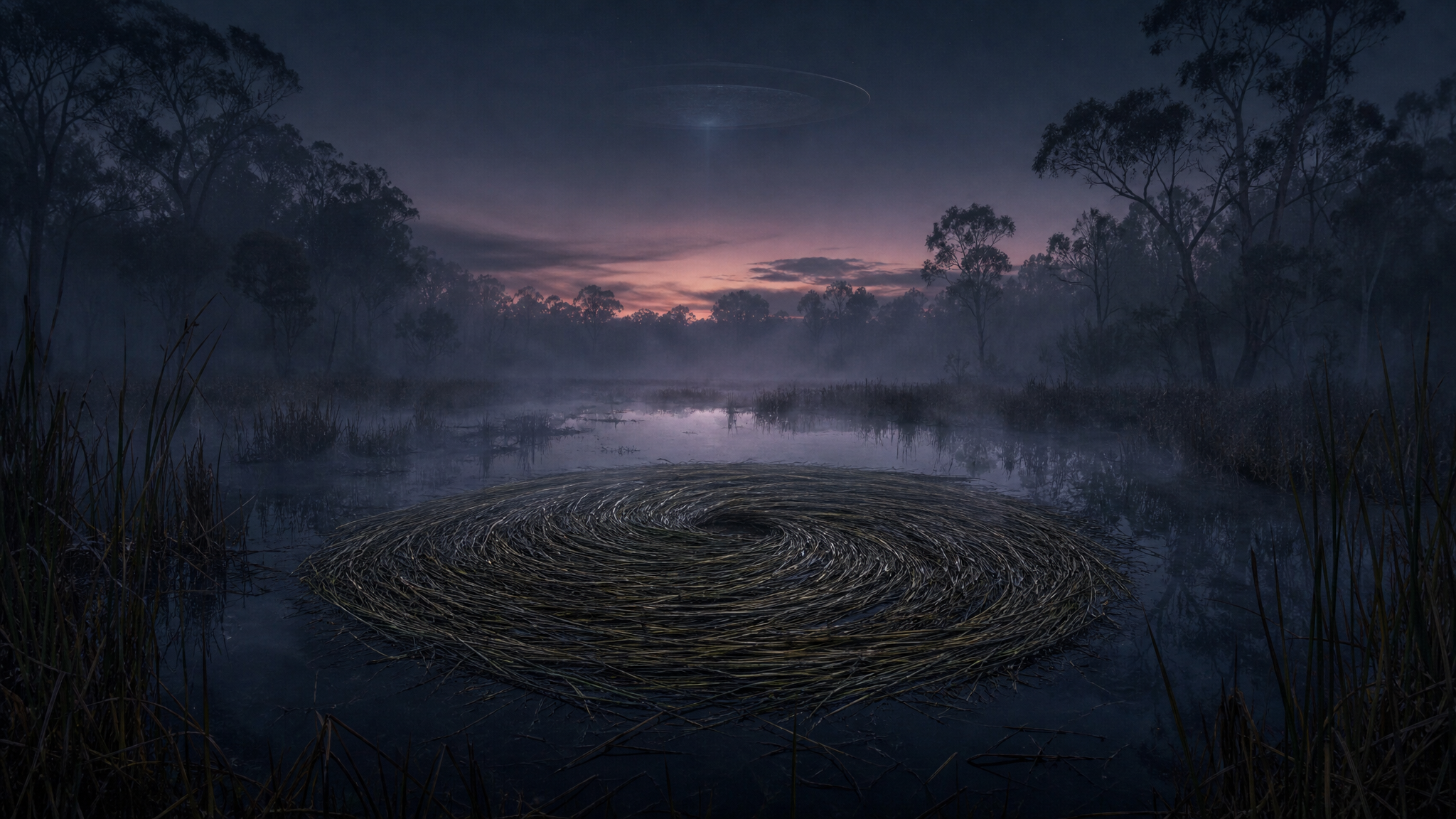
The Tully Saucer Nest: Australia's Physical Evidence That Refused to Be Explained Away
A Quiet Morning on Horseshoe Lagoon
January 19, 1966. George Pedley was 28 years old, a banana farmer working land near Euramo in Far North Queensland, Australia. At approximately 9:00 a.m., he was driving his tractor along the edge of Horseshoe Lagoon — a shallow, reed-choked wetland about a mile from the town of Tully — when he heard a loud hissing sound rising above the engine noise. He described it as similar to air escaping from a tire, but vastly amplified.
What he saw next would define the rest of his life. A large, grey, saucer-shaped object — which he estimated at roughly 25 feet in diameter and 9 feet high — rose from the surface of the lagoon, spinning rapidly. The reeds beneath it were swirling in a circular motion. The craft climbed at a steep angle, banked, and disappeared into the sky within seconds. The entire observation lasted no more than 20 seconds.
When Pedley approached the lagoon, he found something that would draw investigators, journalists, and researchers from across the world: a perfectly circular mat of flattened, interwoven reeds approximately 30 feet in diameter. The reeds had been uprooted from the lagoon floor and were floating on the surface, pressed flat in a radial, clockwise pattern. The water beneath was clear — the sediment had been disturbed and then resettled.
The Physical Evidence: What Made Tully Different
In the long history of UFO reports, physical trace cases are extraordinarily rare. Eyewitness testimony is common. Photographs are debated. But ground impressions, biological changes, and material disturbances that can be measured, sampled, and analyzed — those are the cases that serious investigators pay attention to. Tully was one of them.
The nest was examined within hours by Tully police officer Ron Sullivan, who confirmed the circular formation and noted the unusual way the reeds had been woven together in a tight, flat mat rather than simply crushed downward. Botanist Dr. Allen Yerbury later examined the site and noted that the reeds — predominantly Cyperus gymnocaulos — had been uprooted cleanly from the lagoon bed, not broken or torn. The root systems were intact. Whatever had lifted them had done so with a kind of uniform, rotational force.
The Royal Australian Air Force investigated and ultimately classified the event as unexplained. Their report, released under file reference 580/1/1 Part 3, acknowledged the physical evidence but offered no definitive conclusion. The RAAF's standard explanation for UFO reports — misidentification of aircraft, weather phenomena, or hoax — did not comfortably fit what Pedley had described or what the lagoon had left behind.
The Hoax Question
Any serious investigation has to start with the simplest explanation: could George Pedley have fabricated this? I've spent time reviewing the original police statements, the RAAF file, and contemporary newspaper accounts from The Cairns Post and The Australian. What strikes me is the consistency of Pedley's account across multiple interviews over several decades. He never sought financial gain from the story. He gave interviews reluctantly, often expressing frustration at being associated with something he couldn't explain. He died in 2014, and by all accounts from those who knew him, he remained a straightforward, credible man who simply reported what he saw.
The physical nest itself is harder to dismiss as a hoax. Creating a 30-foot circular mat of interwoven, uprooted reeds in a remote lagoon — before dawn, without leaving any evidence of human activity on the muddy banks — would have required significant effort and planning. For what purpose? Pedley had no history of attention-seeking behavior and no apparent motive.
"I'm not saying it was a spaceship. I'm saying something was there, something lifted off, and it left that mark. I saw it with my own eyes and I've never changed my story because there's nothing to change." — George Pedley, interview with Australian journalist, 1980s
The Subsequent Nests: A Pattern Emerges
What many people don't know about the Tully case is that it didn't end with Pedley's sighting. Between 1966 and 1969, at least eight additional nests were discovered in the Tully region, varying in diameter from 10 to 30 feet. Some were found in the same Horseshoe Lagoon. Others appeared in nearby wetlands. Not all were accompanied by eyewitness sightings, but several were.
In one notable follow-up case from 1969, a local farmer reported seeing a similar object hovering over a cane field at night before departing rapidly. The following morning, a circular depression was found in the crop. The pattern of affected plants showed the same radial, clockwise rotation that had characterized Pedley's original nest.
Researcher Bill Chalker, one of Australia's most rigorous UFO investigators, documented these subsequent cases in detail and noted that the geographic clustering around Tully was statistically significant. This wasn't a single anomalous event — something was repeatedly interacting with the wetlands of Far North Queensland over a three-year period.
The Plasma Vortex Theory
In the 1980s and 1990s, as crop circle research intensified in the United Kingdom, atmospheric physicist Dr. Terence Meaden proposed the plasma vortex hypothesis — the idea that certain meteorological conditions could generate spinning columns of ionized air capable of flattening vegetation in circular patterns. Some researchers retroactively applied this theory to the Tully nests.
It's a legitimate scientific hypothesis and I won't dismiss it. But it has problems when applied to Tully specifically. Plasma vortices don't uproot reeds cleanly from a lagoon floor. They don't interweave vegetation into a floating mat. And they don't produce the kind of sharp, defined circular boundary that multiple witnesses described at Horseshoe Lagoon. Pedley also described a solid, structured object — not a luminous atmospheric phenomenon. These are meaningfully different things.
What the Evidence Actually Tells Us
Here is what I can say with confidence after reviewing the available documentation. George Pedley was a credible witness with no apparent motive to fabricate. The physical evidence at Horseshoe Lagoon was real, documented by police and examined by a botanist. The RAAF investigated and reached no satisfying conclusion. The subsequent nests in the same region suggest a repeating phenomenon rather than a one-time anomaly.
What I cannot tell you is what Pedley saw. The honest answer — the one that serious investigators have to be willing to give — is that we don't know. The plasma vortex theory doesn't fully account for the physical characteristics of the nest or the structured craft Pedley described. A conventional aircraft doesn't match the behavior or the physical trace. A hoax doesn't survive scrutiny of motive, logistics, or the witness's long-term consistency.
The Tully Saucer Nest sits in that uncomfortable space that defines the best unexplained cases: too well-documented to dismiss, too incomplete to resolve. The lagoon is still there. The reeds still grow. And somewhere in the RAAF archives, a file marked unexplained has been sitting for nearly sixty years, waiting for an answer that hasn't come.
Some cases stay open not because investigators gave up, but because the evidence genuinely points somewhere we don't yet have the tools to follow.
🛸 Video: Tully Saucer Nest Australia
Narrated by Steven Knight
A Knight Phenomena Investigation