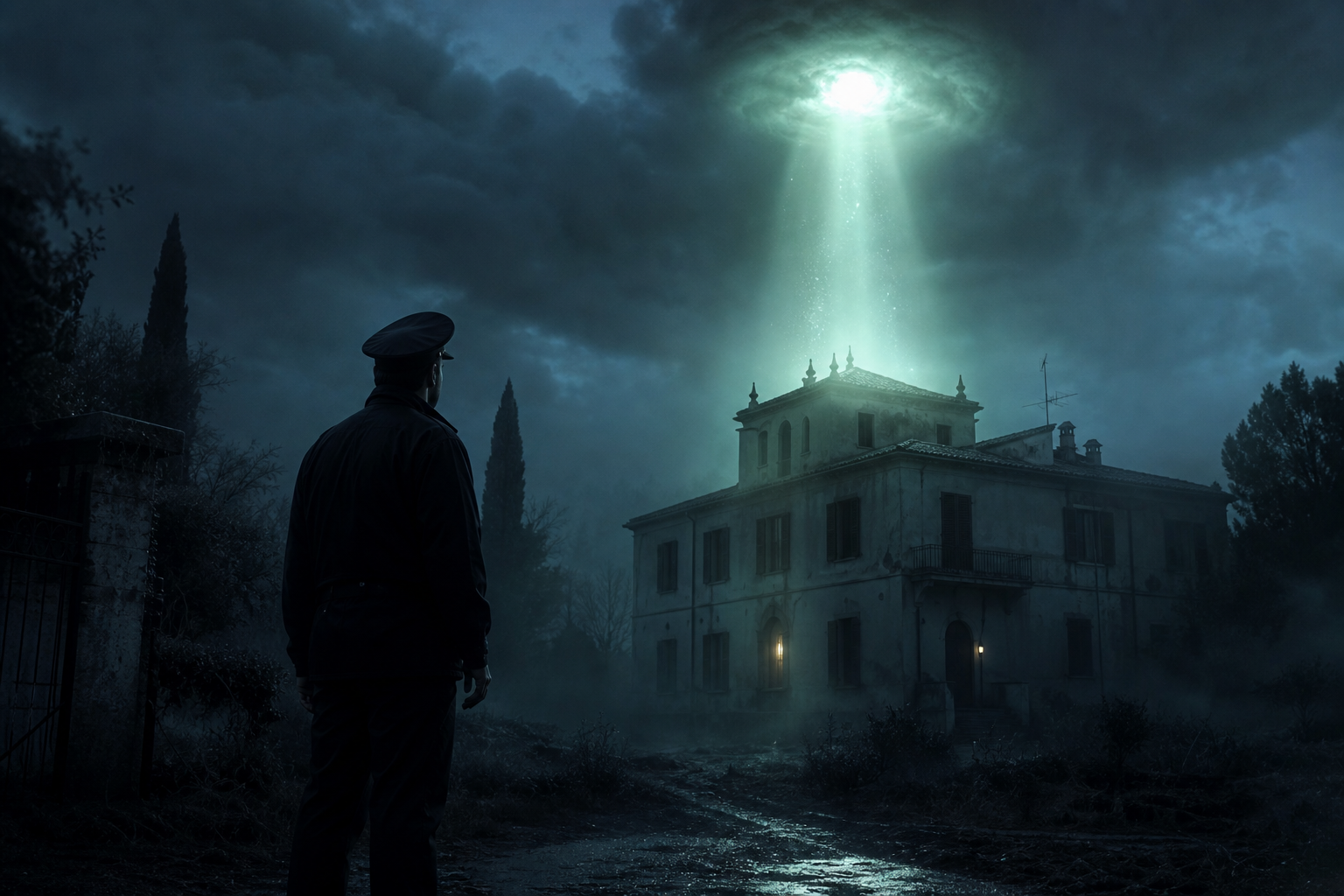
The Zanfretta Abduction: Italy's Most Disturbing Close Encounter and the Man Who Remembered Too Much
I have spent a career inside institutions that traffic in uncomfortable truths. The CIA does not reward imagination. The Army does not promote officers who see things that aren't there. What I learned in those years — what I carry into every investigation I conduct on this site — is that the most dangerous thing an analyst can do is decide what the answer is before the evidence is assembled. I try to apply that discipline here, even when the subject matter strains every rational framework I possess.
The Zanfretta case strains mine considerably.
The Night of December 6, 1978
Pier Fortunato Zanfretta was a 26-year-old security guard employed by the Italian private security firm Securpol. He was, by all accounts, an ordinary man — married, a father, with no history of psychiatric illness, no known interest in UFOs, and no apparent motive to fabricate one of the most elaborate and sustained alien contact narratives in European history.
On the night of December 6, 1978, Zanfretta was dispatched to check on the Barghe family home in Marzano, a residential district outside Genoa, after the property's alarm system triggered. He arrived at approximately 11:30 PM and radioed his dispatch center to confirm his arrival. That was the last normal communication anyone had with him for nearly four hours.
When Zanfretta's colleagues went looking for him after he failed to check in, they found his patrol car with the engine running, the door open, and the radio still active. The man himself was gone. The temperature that night was well below freezing. There were no signs of struggle, no blood, no forced entry into the property he had been sent to check.
At approximately 12:15 AM, Zanfretta was found roughly 200 meters from his vehicle, lying face-down in the mud, in a field he had no logical reason to have entered. He was conscious but incoherent, his uniform scorched in places, his body temperature dangerously elevated despite the freezing conditions. He was clutching his gun. He had no memory of how he got there.
What the Physical Evidence Showed
This is where I want to slow down, because physical evidence is the foundation of any credible investigation, and the Zanfretta case produced more of it than most.
- Thermal anomaly: Zanfretta's body temperature was recorded as abnormally high upon discovery — a paradox given the ambient temperature and the duration of his exposure. Medical personnel who examined him noted this without explanation.
- Uniform damage: His clothing showed scorch marks inconsistent with any environmental cause present at the scene. No fire had been reported in the area. No accelerant was detected.
- Ground impressions: Investigators documented unusual impressions in the frozen ground near the Barghe property — large, symmetrical depressions arranged in a pattern inconsistent with any known vehicle or equipment.
- Psychological state: Zanfretta exhibited acute distress consistent with trauma, not performance. He was not telling a story. He was reacting to something.
His employer, Securpol, took the incident seriously enough to conduct its own internal investigation. The company's director, Antonio Nucchi, later stated publicly that he believed Zanfretta was telling the truth — a remarkable position for a private security firm to take, given the professional liability involved.
The Hypnotic Regression Sessions
In the weeks following the December incident, Zanfretta began experiencing fragmented memories — images, sounds, physical sensations — that he could not contextualize. He was referred to Dr. Mauro Moretti, a psychiatrist, and later worked extensively with hypnotherapist Dr. Emilio Lombardi and criminologist Dr. Rino Di Stefano, who became the primary investigator of the case.
Under hypnotic regression, Zanfretta described being approached by tall, reptilian entities — creatures he estimated at over ten feet in height, with large triangular heads, yellow eyes, and skin described as rough and scaled. He described being taken aboard a craft, subjected to painful physical examinations, and communicated with through a form of direct mental transmission rather than spoken language.
I want to be precise about how I'm treating this material. Hypnotic regression is not a reliable forensic tool. Memory is reconstructive, not reproductive, and hypnosis can amplify confabulation as easily as it surfaces genuine recollection. I do not present Zanfretta's regression testimony as verified fact. What I present it as is consistent testimony — because across multiple sessions, conducted by different practitioners over several years, the core details did not change in the ways fabricated stories typically change.
Fabricators elaborate. They add color. They respond to the expectations of their audience. Zanfretta's accounts remained structurally stable in ways that are difficult to manufacture across years of repeated questioning.
The Pattern Continues: Multiple Encounters
What separates the Zanfretta case from a single-incident anomaly is what happened next. Between 1978 and 1981, Zanfretta reported being taken at least eleven times — a frequency that is either evidence of an extraordinary ongoing contact phenomenon or evidence of a psychological condition that no examining physician was able to diagnose or document.
Several of these subsequent encounters were corroborated, at least partially, by external witnesses or physical evidence:
- In August 1979, Zanfretta disappeared again while on duty. Colleagues reported seeing a bright light in the area where he was later found. He was again discovered in a state of thermal anomaly and psychological distress.
- During one encounter, Zanfretta reportedly returned with a strange triangular object he could not account for. The object was examined and found to be composed of materials that investigators at the time could not readily identify — though I note that the chain of custody on this evidence is not airtight by any standard I would apply professionally.
- Multiple polygraph examinations were administered to Zanfretta over the course of the investigation. He passed them. Polygraphs are not infallible — I know this better than most — but consistent passage across multiple administrations by a subject describing the same events is a data point that cannot simply be discarded.
The Institutional Response
Italy in 1978 was not a country with robust official UFO investigation infrastructure. There was no Italian equivalent of Project Blue Book. The Carabinieri — Italy's national military police — documented the initial incident as an unexplained disappearance and conducted a cursory investigation that produced no conclusions.
What is notable is what didn't happen. Zanfretta was not dismissed by his employer. He was not institutionalized. He was not prosecuted for filing a false report. The official response was, essentially, silence — which in my experience is sometimes the loudest response of all.
Dr. Di Stefano, who spent years investigating the case and eventually wrote a book about it, was a credentialed criminologist with no prior interest in UFO phenomena. His conclusion — that Zanfretta was not lying and that something genuinely anomalous had occurred — was not the conclusion of a true believer. It was the conclusion of a professional investigator who followed the evidence where it led and found himself in uncomfortable territory.
The Skeptical Arguments
Intellectual honesty requires that I lay these out clearly.
Sleep paralysis and temporal lobe phenomena can produce vivid, terrifying experiences of paralysis, presence, and even physical sensation. They do not, however, produce scorched uniforms or ground impressions.
Confabulation under hypnosis is well-documented and must be weighted heavily against any regression testimony. The consistency of Zanfretta's accounts is notable, but consistency alone does not establish truth.
Hoax or fabrication cannot be entirely ruled out, but the sustained nature of the case — spanning years, involving multiple witnesses to secondary phenomena, and producing no financial benefit to Zanfretta — makes deliberate fabrication an increasingly expensive explanation the longer the timeline extends.
Psychological disorder is the most clinically respectable alternative explanation. But Zanfretta was examined repeatedly by mental health professionals who did not diagnose a condition that would account for his experiences. Absence of diagnosis is not proof of anomalous experience, but it is a relevant data point.
What the Intelligence Methodology Tells Me
When I was working analysis, we used a framework called ACH — Analysis of Competing Hypotheses. You list every plausible explanation, then systematically test each one against the available evidence, looking not for what confirms a hypothesis but for what fails to eliminate it.
Applied to Zanfretta:
- Hoax: Not eliminated, but increasingly implausible given duration, corroboration, and absence of motive.
- Psychological disorder: Not eliminated, but unsupported by clinical examination.
- Misidentification of conventional phenomena: Cannot account for the physical evidence.
- Anomalous encounter of unknown origin: Not confirmed, but also not eliminated by any available evidence.
That last category is where the honest analyst has to sit, uncomfortably, when the other categories fail to close the case.
The Knight Assessment
Pier Fortunato Zanfretta did not become famous. He did not profit from his experiences in any meaningful way. He did not seek the spotlight — by most accounts, the attention his case generated caused him significant personal and professional distress. He passed polygraphs. He maintained consistent testimony across years of questioning by multiple investigators. He produced physical anomalies that were documented by people with no stake in confirming his story.
I cannot tell you what happened to Zanfretta on the night of December 6, 1978, or on the subsequent occasions when he reported being taken. I do not have that answer, and I am professionally suspicious of anyone who claims they do — in either direction.
What I can tell you is this: the Zanfretta case is one of the most thoroughly documented close encounter reports in European history. It involves a credible witness, corroborating physical evidence, independent investigative confirmation, and a pattern of events that resists the standard dismissals more stubbornly than almost any comparable case I have examined.
The man remembered too much for it to be nothing. And what he remembered was too consistent, too strange, and too costly to him personally for it to be a comfortable lie.
In intelligence work, we have a phrase for cases that cannot be closed and cannot be ignored: unresolved with significance. That is where the Zanfretta file sits on my desk. The folder is thick. The answers are not in it. And that, in my experience, is precisely when a case deserves the most attention.
— Steven Knight, knightphenomena.com