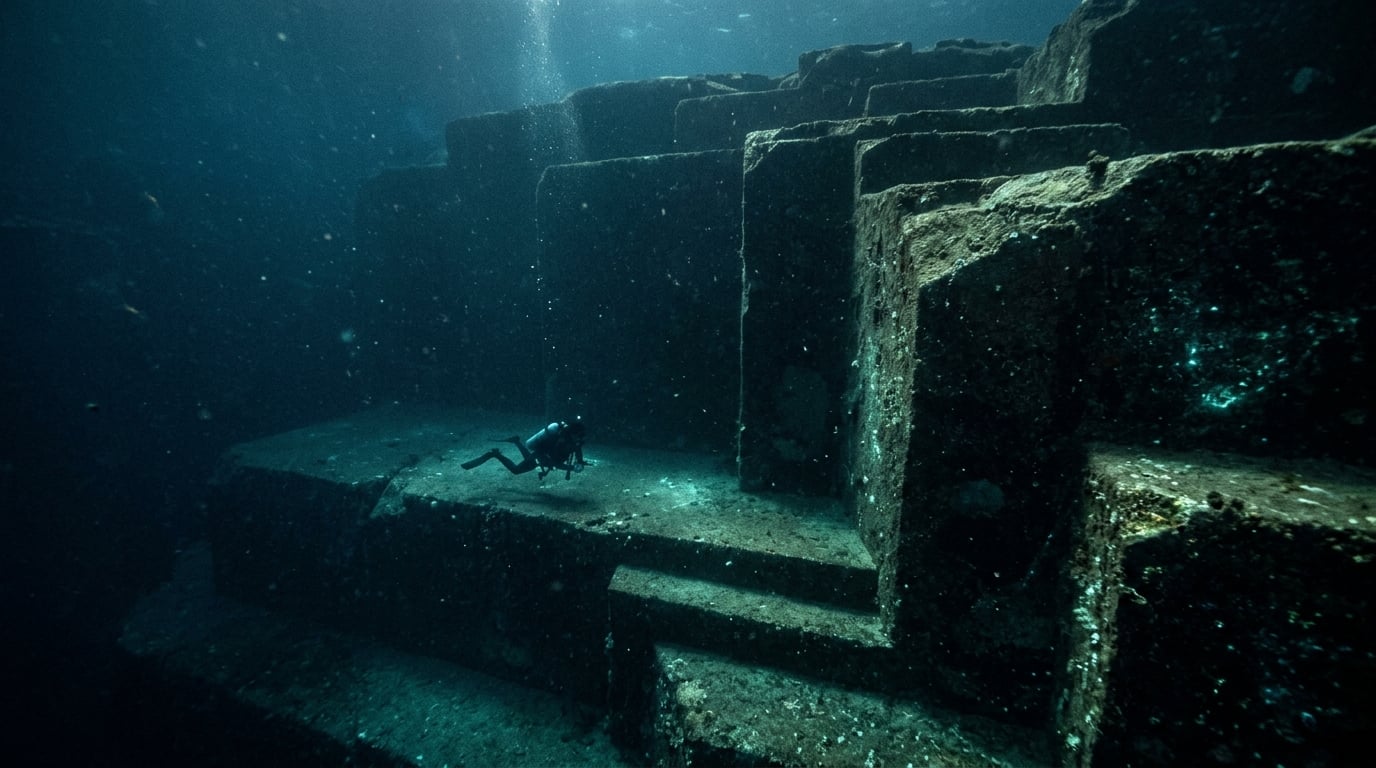
The Yonaguni Monument: Sunken City or Nature's Perfect Accident?
During my years at the CIA, I learned that the most compelling mysteries aren't always the ones involving classified documents or covert operations. Sometimes, they're hiding in plain sight—or in this case, hiding beneath 25 meters of Pacific Ocean water. The Yonaguni Monument represents exactly the kind of puzzle that intelligence analysts dream about: physical evidence that doesn't fit neatly into established narratives, competing expert interpretations, and implications that could rewrite our understanding of human history.
Let me be clear from the outset: I'm not here to sell you ancient aliens or Atlantis fantasies. What interests me about Yonaguni is the methodology we should apply when confronted with anomalous data. This is an exercise in analytical thinking, and the lessons apply far beyond underwater archaeology.
The Discovery
In 1987, Kihachiro Aratake was diving off the southern coast of Yonaguni Island, Japan's westernmost territory, searching for new spots to observe hammerhead sharks. What he found instead would consume the next three decades of debate: a massive stone structure featuring flat planes, sharp edges, and what appeared to be carved steps, terraces, and even a five-layer platform.
The main formation stretches approximately 150 meters long and 40 meters wide, rising about 27 meters from the seafloor. The structure includes features that proponents of the artificial origin theory point to as smoking guns: right-angle corners, symmetrical staircases, post holes, a star-shaped platform, and what some interpret as road-like features connecting different sections.
Marine geologist Masaaki Kimura of the University of the Ryukyus has spent years studying and mapping the site. He's identified what he believes are tool marks, quarry marks, and even primitive hieroglyphic-like carvings. Kimura argues that the structure represents the remains of a 10,000-year-old civilization, submerged when sea levels rose at the end of the last Ice Age.
The Skeptical Counter-Analysis
In intelligence work, we have a saying: extraordinary claims require extraordinary evidence. The burden of proof lies with those making the claim that challenges conventional understanding. So what does the skeptical analysis reveal?
Professor Robert Schoch, a geologist from Boston University who has examined the site firsthand, concludes that the Yonaguni Monument is almost certainly a natural formation. His analysis focuses on several key points:
- The rock is medium to very fine sandstones and mudstones of the Lower Miocene Yaeyama Group, known to contain well-defined parallel bedding planes and vertical fracture systems
- The 'steps' and 'terraces' align with natural bedding planes in the sedimentary rock
- The right angles correspond to natural joint systems—perpendicular fractures common in this type of geology
- No evidence of tool marks has been definitively established under rigorous geological examination
- Similar natural formations exist above water on Yonaguni Island itself, showing the same angular features
Schoch doesn't completely dismiss human interaction with the site. He suggests that ancient peoples may have modified or utilized a natural formation, perhaps cutting steps into existing terraces or clearing debris. But the fundamental structure? Natural geology shaped by tectonic activity, erosion, and wave action over millions of years.
The Intelligence Analyst's Approach
Here's where my training becomes relevant. When analyzing competing claims, we look for several key factors:
Physical Evidence: What can be independently verified? The structure exists—that's not in dispute. The question is interpretation. The 'tool marks' Kimura identifies have not been confirmed by independent geological analysis. No artifacts, pottery, tools, or other archaeological evidence has been recovered from the site despite extensive diving operations. This absence is significant.
Comparative Analysis: Do similar phenomena exist elsewhere? Yes. The Tessellated Pavement in Tasmania, the Giant's Causeway in Ireland, and numerous other sites demonstrate that nature can create remarkably geometric formations. Conversely, we have no confirmed examples of 10,000-year-old architectural sites of this sophistication anywhere in the world. The oldest known megalithic structures—like Göbekli Tepe in Turkey—date to around 9,600 BCE and look nothing like Yonaguni.
Contextual Plausibility: Does the claim fit with what we know about the time period? Ten thousand years ago, human civilization was just beginning to experiment with agriculture. The idea that a culture capable of massive stone construction existed in this period, left no other trace, and has no connection to any known archaeological tradition requires us to rewrite everything we understand about human development.
The Confirmation Bias Problem
One pattern I observed repeatedly in intelligence analysis is confirmation bias—the tendency to interpret ambiguous evidence in ways that confirm pre-existing beliefs. The Yonaguni Monument is a perfect case study.
When you approach the site believing it's artificial, every right angle becomes proof of human design. Every flat surface is a plaza or terrace. Shadows in photographs become hieroglyphs. The human brain is extraordinarily good at finding patterns, even where none exist—a survival mechanism that served our ancestors well but can lead us astray when analyzing complex data.
Conversely, if you approach with the assumption that ancient civilizations couldn't have built such structures, you might dismiss legitimate anomalies too quickly. The key is to remain genuinely agnostic and follow the evidence.
What the Evidence Actually Supports
After reviewing the available data, here's my assessment:
The Yonaguni Monument is most likely a natural geological formation, possibly with minor human modification. The structure's features are consistent with known geological processes affecting the local sandstone. The absence of any supporting archaeological evidence—tools, pottery, organic remains, or cultural artifacts—is damning for the artificial origin theory.
However, I would not assign this conclusion 100% certainty. Perhaps 85-90% confidence that the primary structure is natural. The possibility remains that ancient peoples utilized, modified, or built upon natural formations. Some of the smaller features may indeed be artificial.
What would change my assessment? Discovery of unambiguous tool marks confirmed by multiple independent geologists. Recovery of artifacts from sealed contexts within the structure. Identification of quarrying techniques or construction methods. Evidence of similar structures from the same time period elsewhere. Any of these would require a significant revision of the analysis.
The Broader Lesson
The Yonaguni Monument reminds us that mystery and wonder don't require supernatural or revolutionary explanations. Nature itself is capable of creating structures that challenge our assumptions and inspire our imagination. The geological processes that shaped these underwater formations are no less fascinating than ancient civilizations—they simply operate on different timescales.
As a former intelligence analyst, I've learned to be comfortable with uncertainty while still drawing conclusions based on the best available evidence. The Yonaguni Monument probably isn't a lost city. But the debate around it reveals something important about how we process information, evaluate claims, and construct narratives about our past.
The site remains worth studying, worth diving, worth documenting. Not because it will rewrite human history, but because it represents a natural laboratory for understanding both geological processes and human perception. Sometimes the most valuable mysteries are the ones that teach us how to think more clearly about evidence, probability, and the stories we tell ourselves about the world.
And who knows? I've been wrong before. That's why we keep investigating, keep questioning, and keep diving beneath the surface—both literally and figuratively—to see what truths might be waiting in the depths.