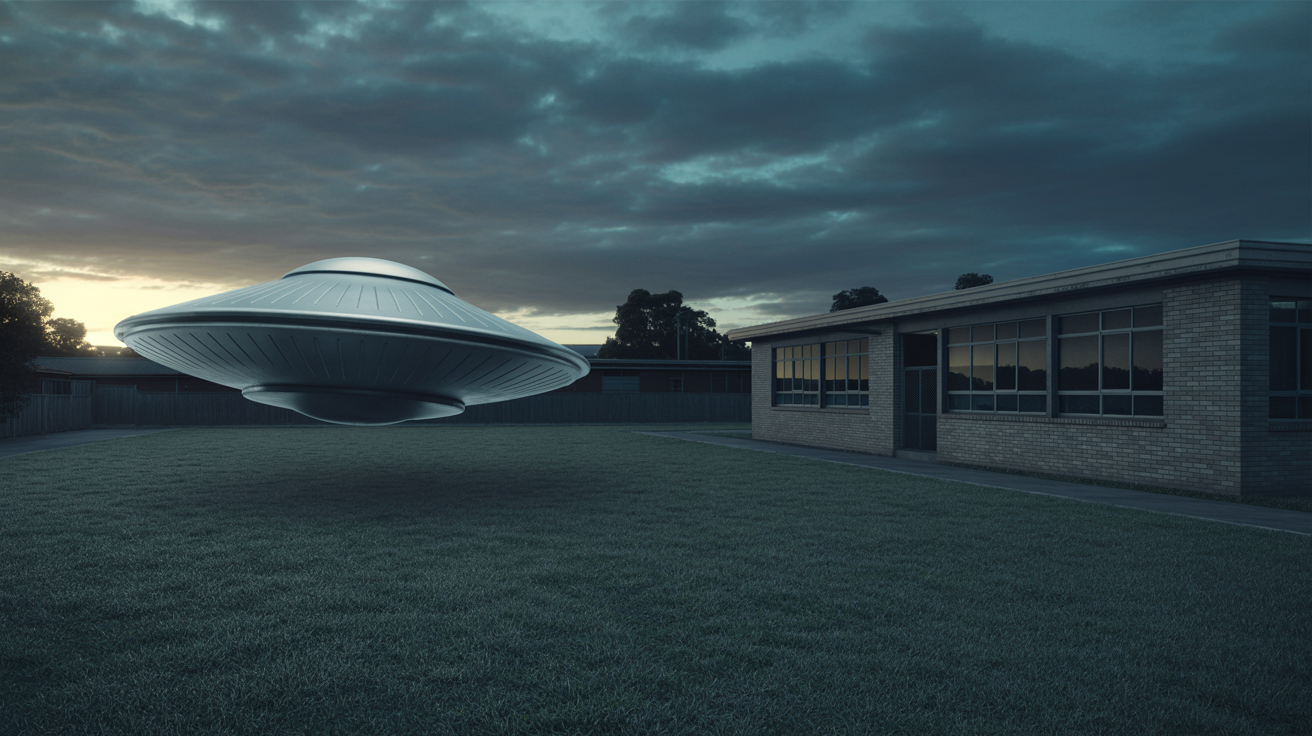
The Westall UFO Encounter: 200 Witnesses, One Schoolyard, Zero Answers
At 11:00 AM on April 6, 1966, a physical education class at Westall High School in Clayton South, Melbourne, was interrupted by something in the sky. What began as a few students pointing upward became a mass sighting involving more than 200 witnesses—students, teachers, and nearby residents—who watched as multiple silver, disc-shaped objects maneuvered over their school before descending into an adjacent field known as The Grange.
Within hours, military personnel and men in dark suits had cordoned off the area. Witnesses were questioned, some intimidated, and told in no uncertain terms to keep quiet about what they'd seen. Photographs were confiscated. The press was fed conflicting explanations. And then, as quickly as it had begun, the official interest evaporated—leaving behind a community of traumatized witnesses and a case that remains one of the most compelling mass UFO sightings in history.
I've spent years analyzing pattern anomalies, and the Westall case presents a pattern that's difficult to dismiss: too many witnesses, too much consistency, and a response that suggests someone knew exactly what they were dealing with.
The Event: What They Saw
The initial sighting occurred during morning recess. Students playing outside noticed a silver disc-shaped object moving across the sky. According to multiple witnesses, the craft was metallic, about the size of two family cars, and moved with deliberate, controlled precision—nothing like conventional aircraft.
What makes Westall unique is that this wasn't a fleeting glimpse. The sighting lasted approximately twenty minutes, during which time witnesses observed:
- A primary disc-shaped craft performing maneuvers over the school
- Two smaller objects, described as either accompanying craft or possibly aircraft pursuing the main object
- The main craft descending into The Grange, a grassy area bordered by pine trees
- The object ascending rapidly and departing at high speed
- A circular pattern of flattened grass where the object had landed
Science teacher Andrew Greenwood was among the staff witnesses. He described the object as silver-grey, with a slight purple hue, and noted that it moved unlike any aircraft he'd ever seen. His account is particularly valuable because he observed the object through binoculars and attempted to approach the landing site before being turned away.
Student Joy Tighe, then thirteen years old, was among a group who ran toward The Grange to get a closer look. She described the craft as being "about the size of two cars" and noted that it appeared to be sitting in the grass before taking off. Decades later, she would recall the fear and confusion of that day—and the even greater confusion when authorities arrived and began their cleanup operation.
The Response: Containment and Silence
What happened after the sighting is, in many ways, more disturbing than the sighting itself.
Within hours, military personnel arrived at The Grange. Witnesses reported seeing men in uniform examining the landing site, taking samples, and photographing the area. The circular depression in the grass—approximately 20 feet in diameter—was documented by multiple witnesses before the area was sealed off.
At the school, the response was swift and coordinated. The headmaster, Frank Samblebe, called a special assembly and instructed students not to discuss what they'd seen. According to witness accounts, he appeared shaken and told students that talking about the incident could result in serious consequences.
Several students reported being pulled from class and questioned by men in suits—not police, but officials who never properly identified themselves. One witness, Shane Ryan, recalled being told by these men that he hadn't seen what he thought he'd seen, that it was likely a weather balloon or experimental aircraft.
Local photographer James J. Kibel had taken photographs of the object from his nearby home. He contacted the media and his photos were published in the Dandenong Journal. Shortly afterward, he was visited by officials who confiscated his negatives. The photographs have never been returned, and only low-quality newspaper reproductions survive.
The official explanation, when one was finally offered, was that witnesses had seen a weather balloon. This explanation satisfied no one who had actually been present.
The Evidence: What Remains
More than fifty years after the event, the physical evidence has long since disappeared. The landing site was quickly disturbed, first by curious witnesses and then by official personnel. No samples were preserved for independent analysis. The photographs were confiscated. The official records, if they exist, remain classified or have been destroyed.
What remains is witness testimony—and there's a lot of it.
In 2006, researcher Shane Ryan began conducting extensive interviews with Westall witnesses for a documentary project. He located more than 30 witnesses willing to go on record, and many more who confirmed the events but preferred to remain anonymous. The consistency of their accounts is remarkable:
- The object was metallic and disc-shaped
- It performed maneuvers impossible for conventional aircraft of the era
- It landed in The Grange, leaving physical traces
- Military and government personnel responded rapidly and aggressively
- Witnesses were intimidated into silence
Several witnesses reported experiencing health effects after the sighting—nausea, headaches, and in some cases, radiation-like burns. These reports were never officially investigated.
The psychological impact on witnesses has been profound. Many describe being traumatized not by the sighting itself, but by the response—the sense that they had witnessed something significant and were being forced to pretend it hadn't happened. Some were ridiculed by family members who didn't believe them. Others internalized the fear and didn't speak about the incident for decades.
The Analysis: Conventional Explanations
From an analytical standpoint, I approach cases like Westall by eliminating conventional explanations first. Let's examine the official and unofficial theories:
Weather Balloon: The official explanation doesn't withstand scrutiny. Weather balloons don't perform controlled maneuvers, don't land and take off again, and don't generate the kind of official response seen at Westall. Multiple witnesses, including a science teacher, were familiar with weather balloons and adamant that this was something else entirely.
Experimental Aircraft: This is more plausible, particularly given the rapid military response. Australia was hosting American military operations during the Vietnam War era, and classified testing was certainly possible. However, the described flight characteristics—hovering, rapid acceleration, silent operation—don't match any known aircraft technology from 1966. Additionally, testing experimental craft over a populated suburban area during school hours would be extraordinarily reckless.
Mass Hallucination: With over 200 witnesses observing the same object over a 20-minute period, mass hallucination becomes statistically implausible. The witnesses weren't in a heightened emotional state before the sighting, they were engaged in normal school activities. The physical evidence—the landing trace—argues against a purely psychological explanation.
Hoax: There's no evidence of coordination among witnesses, no confession, and no clear motive. The witnesses were children and teachers going about their normal day. The official response—confiscating photographs, intimidating witnesses—suggests authorities took the incident very seriously, which wouldn't be the case for a simple prank.
The Pattern: What Westall Tells Us
What strikes me most about Westall isn't the sighting itself—it's the response. The rapid deployment of personnel, the confiscation of evidence, the intimidation of witnesses, and the official silence all suggest a coordinated effort to contain information about an event that someone, somewhere, understood and wanted suppressed.
This pattern appears in other cases: Rendlesham Forest, Shag Harbour, the Cash-Landrum incident. In each case, official interest is intense and immediate, followed by denial and dismissal. The pattern suggests not ignorance, but knowledge—and a decision that the public doesn't need to share that knowledge.
The Westall case also demonstrates the long-term psychological impact of official denial. Witnesses who saw something extraordinary, who had their experience validated by hundreds of others, were told they were mistaken or lying. That kind of gaslighting leaves scars.
The Conclusion: Questions Without Answers
More than fifty years later, we still don't know what happened at Westall High School on April 6, 1966. We know that over 200 people witnessed something extraordinary. We know that official personnel responded rapidly and aggressively. We know that evidence was confiscated and witnesses were silenced.
What we don't know is what the object was, where it came from, or why the response was so extreme.
The Australian government has never released any official documentation about the incident. Freedom of information requests have yielded nothing. If records exist, they remain classified. The witnesses, now in their sixties and seventies, continue to seek answers—and continue to be met with official silence.
In my years analyzing unexplained phenomena, I've learned that the absence of official explanation is often more revealing than any explanation could be. When governments confiscate evidence, intimidate witnesses, and maintain decades of silence, they're telling us something—even if they won't say it out loud.
The Westall UFO encounter remains one of the most credible mass sighting cases on record. The witnesses were there. They saw what they saw. And someone in authority knew exactly what it was—and decided we shouldn't.
🛸 Video: The Westall Ufo Encounter
A Knight Phenomena Investigation