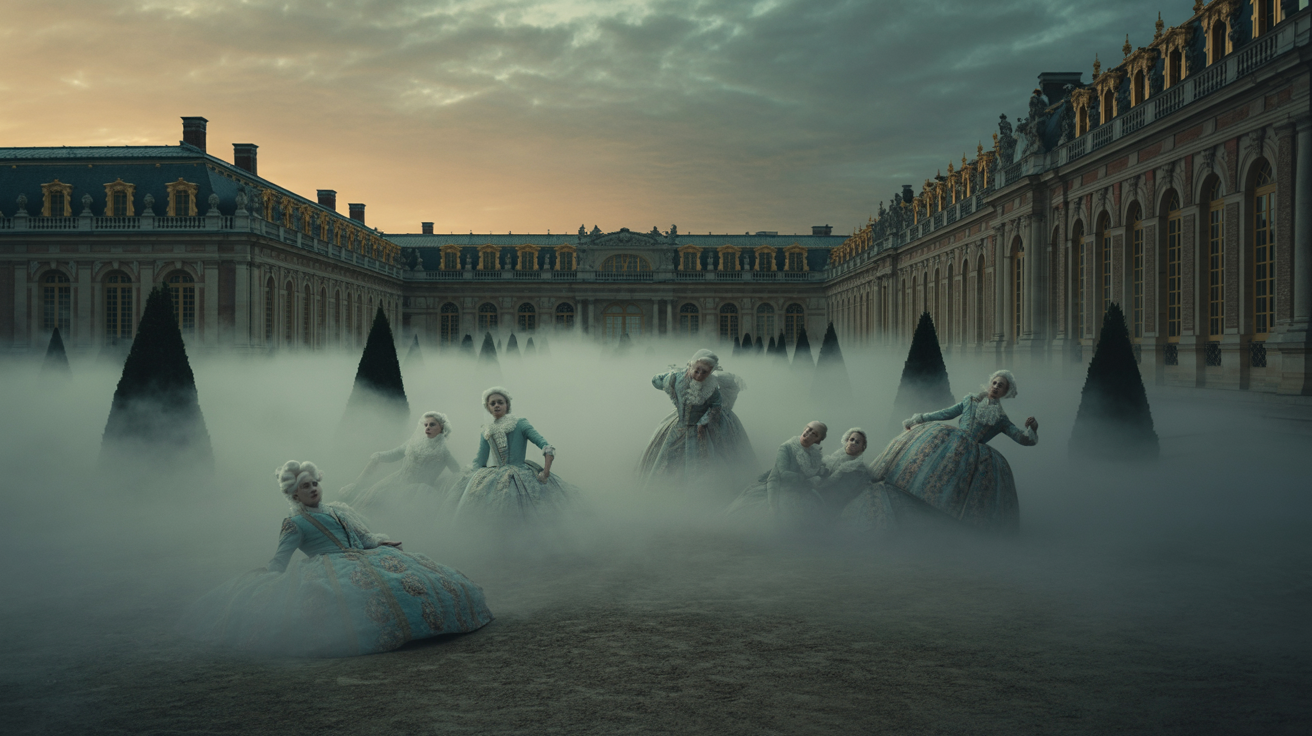
The Versailles Time Slip: Did Two Scholars Walk Into Another Century?
When a case reaches my desk, I start with the same questions every time: who saw it, when did they write it down, and what can survive scrutiny after the emotion drains away? In intelligence work, mystery is rarely the first explanation. More often it is the residue left behind when perception, expectation, and environment collide.
The Versailles time slip is different from the better-known hauntings and UFO cases. There is no crashed craft, no physical trace, no body, no radar track, no handprint in the mud. What remains is an extraordinary claim made by two respectable women, Charlotte Anne Moberly and Eleanor Jourdain, who believed that during a 1901 visit to the grounds of Versailles they had momentarily stepped out of their own century and into the French court of Marie Antoinette.
That alone would be enough to dismiss the story as folklore, were it not for the care with which the women later documented what happened. Their account, published in 1911 under the pseudonyms Miss Morison and Miss Lamont in An Adventure, has kept the case alive for more than a century. The question is not whether they told a story. They clearly did. The question is whether the story can bear the weight placed on it.
The day the world seemed to shift
Moberly and Jourdain were not thrill-seekers. They were academics, steeped in institutional life and accustomed to careful observation. In August 1901, while in France, they visited Versailles and set out to see the Petit Trianon, the retreat associated with Marie Antoinette. Somewhere along the way, they became disoriented. They later described a sequence of impressions that, taken together, they interpreted as impossible.
The air felt strangely still. The landscape seemed flattened and artificial, as if the sunlight itself had changed. They saw people in clothing that did not belong to the early twentieth century. One woman appeared in a doorway in an old-fashioned dress. A man in a cloak or coat, with a peculiar expression, crossed their path. Another figure, described as sketching or sitting near the grounds, left them with the unsettling sense that they were intruding on a scene from another era.
Most importantly, the surroundings appeared to match a historical Versailles that no longer existed in 1901. The women later believed they had wandered into the late eighteenth century, into a setting associated with Marie Antoinette and the final years before the French Revolution.
Their conclusion was not that they had seen a ghost. It was that they had crossed, however briefly, into another moment in history.
That distinction matters. A haunting suggests the past leaves an imprint. A time slip suggests the past remains accessible, if only by exception. One can be framed as folklore. The other is a direct challenge to our understanding of time, memory, and reality itself.
Why their account drew attention
What makes the Versailles case hard to ignore is not its impossibility, but the character of the witnesses. Moberly and Jourdain were not isolated eccentrics living at the fringe of respectable society. They were educated, articulate, and sufficiently disciplined to know that extraordinary claims invite ridicule. They did not publish immediately. They did not rush to the newspapers. They spent time comparing notes, reconstructing the route, and testing their own recollections before putting anything in print.
That caution gave the story a credibility it otherwise would not have had. In the language of analysis, the case had good source quality, at least on paper. The witnesses had standing. Their account was internally coherent. And their emotional tone was not one of triumph, but of confusion and unease.
Still, credibility is not the same as proof. A careful witness can be sincerely wrong. Two careful witnesses can reinforce each other’s mistake. The very fact that Moberly and Jourdain were thoughtful observers may have made them more vulnerable to a shared interpretation once the experience had passed into memory.
The intelligence problem: memory is not a recording device
This is where the case becomes interesting to me. Analysts are trained to distrust clean narratives. Human memory is not a film reel. It is a reconstruction engine. Each time a memory is recalled, it is reassembled from fragments, expectations, and later knowledge. If the original event was ambiguous, the reconstruction can become more elaborate every time it is revisited.
That does not mean the women invented the experience. It means that the experience they remembered in 1911 may not have been identical to whatever they encountered in 1901. A strange garden path, an unfamiliar route, fatigue, and a strong historical setting can produce a sense of unreality even before memory starts to work on the scene.
The authors themselves changed their explanation over time. At moments they sounded as though they had merely misread the environment. At others, they leaned toward the idea that something objective and inexplicable had happened. That ambiguity is exactly what one expects when a witness is trying to force a real but confusing event into a framework that can be explained to others.
- They may have become lost in a complex landscape where paths and buildings were altered over time.
- They may have encountered people in costume, uniforms, or period dress associated with a special event.
- They may have absorbed details from guidebooks, engravings, or prior conversations without realizing it.
- They may have experienced a genuine perceptual anomaly triggered by heat, fatigue, and expectation.
- Or, if one is willing to leave the ordinary model behind, they may have encountered a phenomenon not yet understood.
From a skeptical standpoint, the first four explanations are not only possible. They are more probable.
What the records can and cannot support
One of the problems in cases of this sort is that they often become larger than the evidence that supports them. Later writers treat the Versailles incident as though it were a solved riddle when, in reality, the documentary trail is thin. The account was not written as a field report. It was a retrospective narrative shaped by two authors with time to reflect, compare notes, and polish the telling.
That does not make it worthless. But it does limit its value. We do not have a contemporaneous log entry. We do not have independent witnesses who report the same scene from the same angle. We do not have photographs, sketches made in the moment, or a physical anomaly to test. We have testimony, recollection, and interpretation.
There are also practical considerations. Versailles is not a static environment. Paths change. Trees grow and are removed. Buildings are restored. A visitor can easily misread a route and later impose order on a confusing walk. A pair of scholars with a strong historical interest in Marie Antoinette might also be primed to notice details that fit an eighteenth-century frame while ignoring those that do not.
And yet, even after accounting for those weaknesses, the account retains a residue of strangeness. The women did not simply say the garden looked old. They described a shift in atmosphere so complete that it seemed to alter the texture of reality. Whether that was a psychological event or something more, it was meaningful to them in a way they could not dismiss.
The theories, from mundane to impossible
Every enduring mystery collects theories like dust. The Versailles case is no exception. Some are sober. Some are speculative. A few are frankly extravagant. The useful task is not to choose the most dramatic explanation, but to rank the possibilities by evidentiary strength.
The most conservative explanation is that the women were simply mistaken. Versailles was unfamiliar, the route was confusing, and their minds supplied a historical pattern to a mundane navigational problem. That theory is not glamorous, but it fits the evidence cleanly.
A second possibility is suggestion. The women were already at Versailles for the express purpose of seeing a site loaded with historical meaning. In such settings, expectation can become a force multiplier. The brain starts to organize every odd detail around the story it expects to find. A few unusual impressions can become, in retrospect, a coherent sequence of historical recognition.
A third theory is what paranormal writers call a time slip. The idea is that under rare conditions a person might momentarily perceive another layer of time. The theory is attractive because it appears to explain the entire experience without forcing it into ordinary categories. The problem is that it explains too much too easily. It offers no mechanism, no testable prediction, and no way to distinguish a time slip from a misinterpreted memory.
There are also hybrid explanations. A genuine but mundane event may have been filtered through imagination, then reinforced by historical research after the fact. In that model, the women did not lie. They interpreted. And interpretation, especially under uncertainty, can be the birthplace of legend.
Why Versailles was the perfect stage
The setting matters. Versailles is not a neutral backdrop. It is a place where history is performed through architecture. The gardens are designed to manipulate sightlines, the buildings are loaded with symbolism, and the site itself is inseparable from stories of monarchy, power, and collapse. A visitor primed for history can feel that charge immediately.
That is part of why the case still works. Even skeptics can understand how a place like Versailles might produce an encounter that feels less like sightseeing and more like trespassing into memory. The emotional truth of the experience is not in dispute. The factual interpretation is.
In intelligence analysis, the most persuasive stories are not always the best ones. They are the ones that fit too neatly. The Versailles account resists that simplicity. If you reduce it to fantasy, you miss why educated people took it seriously. If you elevate it to proof of time travel, you outrun the evidence. The case sits in the narrow strip between those extremes, and that is where it remains fascinating.
The verdict, if one is possible
After reviewing the case, I do not think Versailles gives us evidence of a literal breach in time. The data are too thin, the testimony too retrospective, and the alternate explanations too strong. If I were writing this as an assessment note, I would mark the claim as unconfirmed and the paranormal interpretation as unsupported.
But I would not mark it as trivial. The case endures because it captures something real about human experience: the sense that place can destabilize us, that memory can harden into certainty, and that an unexplained moment can survive long after the rational mind has done its best to file it away.
Moberly and Jourdain may not have crossed into another century. They may have crossed into a rare state of perception where history, expectation, and fear merged into a single vivid event. That explanation is less romantic, but it is also more consistent with the evidence.
Still, I have learned not to dismiss a mystery simply because the most likely answer is mundane. Sometimes the mundane answer is wrong. Sometimes it is only incomplete. Versailles remains compelling because it sits precisely at that fault line. The women believed they had seen another time. The record suggests they may have seen only a place powerful enough to make time feel thin. And that, in my experience, is often how the strange begins: not with a monster, a ghost, or a machine, but with a human mind trying to make sense of a moment that refused to behave.
⏰ Video: The Versailles Time Slip
A Knight Phenomena Investigation