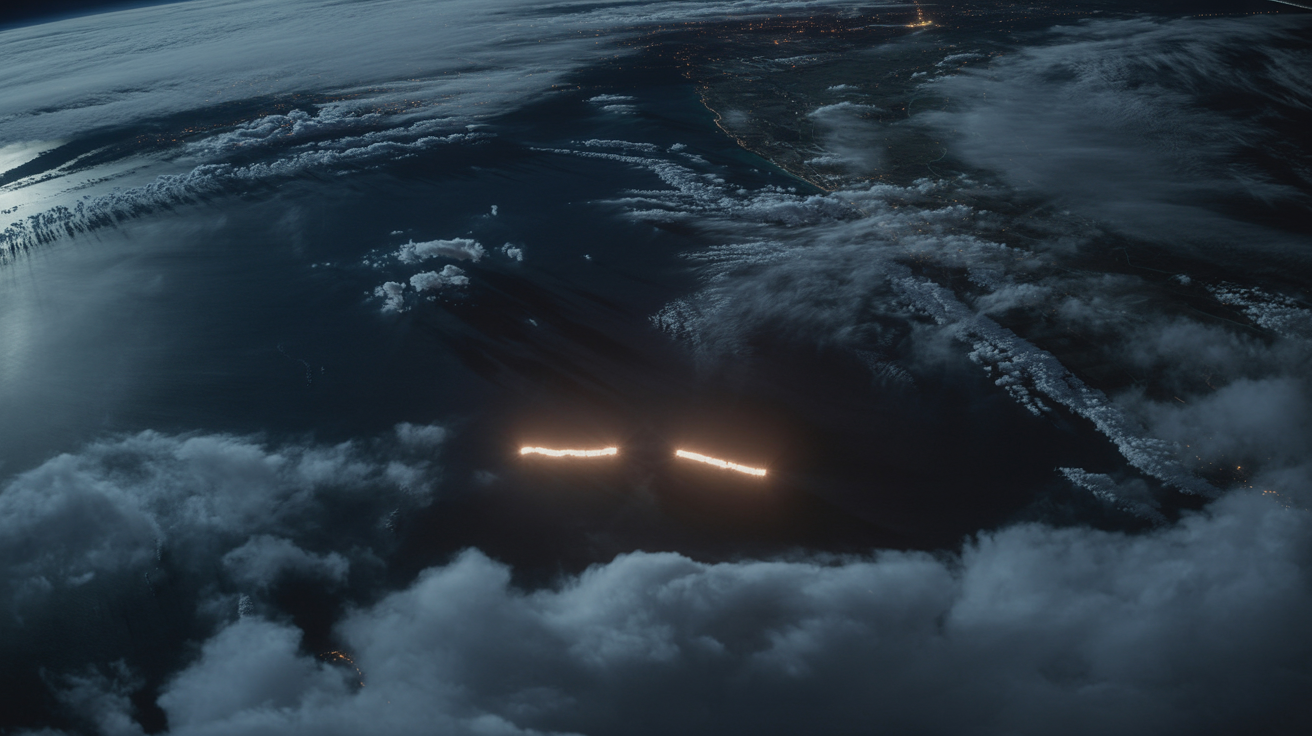
The Vela Incident: The Nuclear Flash That Never Was—Or Was It?
At 00:53 GMT on September 22, 1979, Vela 6911—an aging American surveillance satellite designed to detect nuclear weapons tests—recorded something that should have triggered immediate global alarm. Its sensors, known as bhangmeters, captured a distinctive double flash of light over the South Atlantic or Indian Ocean, somewhere near the Prince Edward Islands, roughly 1,500 miles southeast of South Africa.
The signature was unmistakable. Every nuclear explosion produces a characteristic pattern: an initial intense flash as the fireball forms, followed by a brief dimming as the shockwave creates a temporary opacity, then a second, longer flash as the fireball expands. This double-pulse pattern is as unique to nuclear detonations as a fingerprint is to a human being. The Vela satellites had been watching for exactly this signature since 1963, successfully detecting 41 atmospheric nuclear tests before the Limited Test Ban Treaty drove testing underground.
But this time, something was different. No nation claimed the test. No radioactive fallout was definitively detected. And the United States government, after months of investigation, issued a conclusion that satisfied almost no one: the signal was probably not a nuclear detonation, but rather a meteoroid strike on the satellite itself or some other technical anomaly.
Nearly forty-five years later, the Vela Incident remains one of the most significant unsolved mysteries in nuclear proliferation history—a flash of light that may have been nothing, or may have been everything.
The Bhangmeter's Tale
The Vela satellites were marvels of Cold War engineering. Launched in pairs into high orbits of approximately 70,000 miles, they formed a constellation designed to monitor compliance with nuclear test ban treaties. Their bhangmeters—named after the Hindi word for hemp, a reference to the intoxicating effect of discovering a nuclear test—were optical sensors calibrated to detect the specific light signature of nuclear explosions across vast distances.
By 1979, Vela 6911 was old by satellite standards, having been in orbit since 1969. But its systems were still functional, and its detection algorithms had been refined through a decade of successful monitoring. When it recorded Event 747 (as the incident was officially designated), the satellite's data showed a classic double flash with characteristics consistent with a low-yield nuclear explosion in the 2-3 kiloton range—small by Cold War standards, but still roughly one-sixth the power of the Hiroshima bomb.
The light intensity curves, the timing between flashes, and the spectral characteristics all matched the expected profile. Naval Research Laboratory scientists who first analyzed the data had little doubt: this was a nuclear detonation.
The Investigation Begins
The Carter administration faced an immediate dilemma. If a nuclear test had occurred, who conducted it? And if it went unacknowledged, what did that mean for the global non-proliferation regime?
The White House convened a panel of scientists, led by MIT professor Jack Ruina, to investigate. Meanwhile, intelligence agencies scrambled to gather corroborating evidence. The Air Force dispatched WC-135 aircraft—specialized planes equipped to collect atmospheric samples and detect radioactive particles. Naval vessels searched the suspected test area. Hydroacoustic sensors that monitor underwater sounds were reviewed for any anomalous signals.
The results were frustratingly ambiguous. Some hydroacoustic stations had recorded unusual signals around the time of the flash, but the data was inconclusive. The atmospheric sampling missions found no definitive evidence of fresh radioactive fallout, though weather patterns and the time delay between the event and the flights complicated interpretation. A sheep thyroid study in Australia—which would have detected iodine-131 from a nuclear test—showed a slight anomaly, but not enough to be conclusive.
The Official Conclusion
In July 1980, the Ruina panel released its findings. The majority opinion concluded that the Vela signal was "probably not from a nuclear explosion" but more likely the result of a meteoroid striking the satellite or sunlight reflecting off debris. The panel noted several anomalies: the lack of clear corroborating evidence, the absence of a confirmed electromagnetic pulse detection, and some unusual characteristics in the light curve data.
The conclusion was immediately controversial. Several panel members dissented or expressed reservations. The Defense Intelligence Agency maintained its assessment that a nuclear test had occurred. Naval Research Laboratory scientists who had designed and operated the Vela system were adamant that the satellite had functioned correctly and that the signal was genuine.
Critics pointed out that the meteoroid hypothesis had significant problems. The Vela satellites had been in orbit for years without producing false alarms. The probability of a meteoroid strike producing a signal that precisely mimicked a nuclear double-flash was vanishingly small. And if the satellite had been damaged, why did it continue to function normally afterward?
The South African Connection
The most persistent theory—and the one that has gained credibility over time—is that the Vela Incident was a clandestine nuclear test conducted by South Africa, possibly with Israeli assistance.
In 1979, South Africa's apartheid government was internationally isolated and facing growing security threats. The country had developed a covert nuclear weapons program, though this was not publicly confirmed until 1993, when President F.W. de Klerk revealed that South Africa had built six nuclear devices before voluntarily dismantling them.
Israel, meanwhile, had its own undeclared nuclear arsenal and strong security ties with South Africa. Both nations had compelling reasons to test a nuclear weapon and equally compelling reasons to keep such a test secret.
Circumstantial evidence supporting this theory has accumulated over decades. In 1997, a former South African naval officer claimed that he had witnessed preparations for a nuclear test in the southern ocean. In 2000, a retired Israeli general reportedly told an interviewer that the Vela Incident was indeed a joint Israeli-South African test, though he later denied making the statement. Declassified documents have revealed that U.S. intelligence agencies believed South Africa was the most likely culprit, despite the official public conclusion.
Alternative Explanations
Other theories have emerged over the years, each with its own adherents and problems.
Some researchers have suggested a small meteorite impact in the atmosphere could have produced a double flash, though this would require an extraordinary coincidence of timing and characteristics. Others have proposed that the signal might have been from a secret Soviet test, though this seems unlikely given the location and the USSR's established testing grounds.
A more exotic theory suggests a natural phenomenon—perhaps a rare type of lightning or an unusual interaction between cosmic rays and the atmosphere. However, no known natural process produces the specific double-flash signature with the precise timing characteristics recorded by Vela 6911.
The Intelligence Community's Verdict
While the official White House panel expressed doubt, the intelligence community's assessment was notably different. Declassified documents from the period show that the Defense Intelligence Agency, the Air Force, and elements of the CIA believed a nuclear test had occurred. A 1980 DIA report stated with "high confidence" that the event was a low-yield nuclear explosion.
The divergence between the scientific panel's public conclusion and the intelligence community's classified assessment has fueled decades of speculation. Was the panel's report a genuine scientific finding, or was it a politically motivated attempt to avoid confronting allies about a treaty violation?
The Enduring Mystery
More than four decades later, the Vela Incident remains officially unresolved. The U.S. government has never definitively stated that a nuclear test occurred, nor has any nation claimed responsibility. South Africa's post-apartheid government has denied conducting a test in 1979, though it has acknowledged its former nuclear weapons program.
The incident raises profound questions about nuclear proliferation, international monitoring, and the reliability of technical intelligence. If the Vela satellite correctly detected a nuclear test, it represents a significant failure of the non-proliferation regime—a clandestine detonation that went unpunished and unacknowledged. If the satellite malfunctioned or misinterpreted a natural phenomenon, it suggests troubling vulnerabilities in our ability to monitor nuclear activities.
From my perspective as a former intelligence analyst, the weight of evidence suggests that Vela 6911 detected exactly what it was designed to detect: a nuclear explosion. The satellite had a proven track record. The signal matched known nuclear signatures. The intelligence community believed it was real. And the most plausible suspects—South Africa and Israel—had both the capability and the motive.
What we're left with is a flash of light in the southern ocean, a satellite's testimony, and a silence that has lasted nearly half a century. In the world of nuclear weapons, where verification and transparency are supposed to be paramount, the Vela Incident stands as a reminder that some secrets remain hidden even when they light up the sky.
The truth may still be locked in classified archives in Washington, Pretoria, or Tel Aviv. Or perhaps it's simpler than that—perhaps the truth was written in light on September 22, 1979, and we've simply chosen not to read it.
☢️ Video: The Vela Incident Nuclear
A Knight Phenomena Investigation