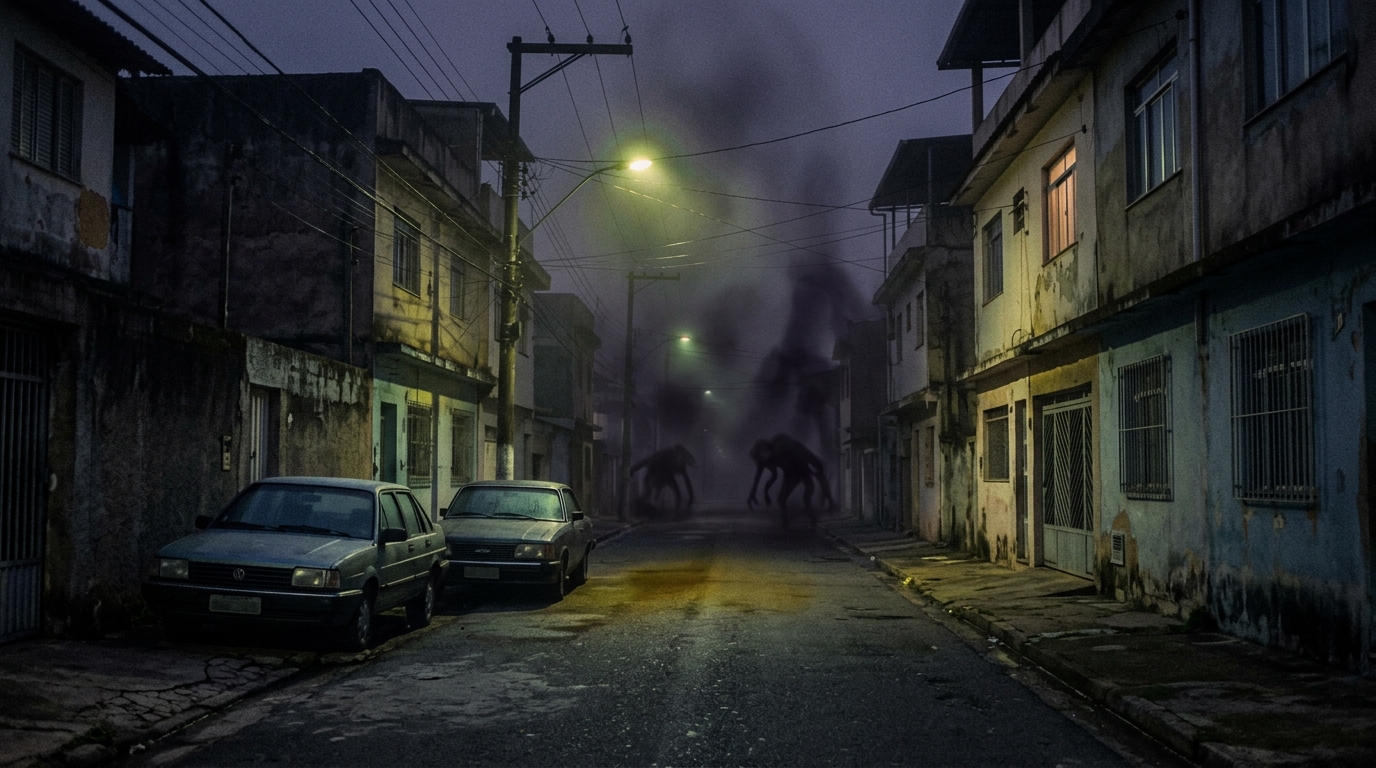
The Varginha Incident: Brazil's Roswell and the Creatures That Shook a City
The Day Varginha Stopped Being Ordinary
I have spent a significant portion of my professional life evaluating source reliability. In intelligence work, the question is never simply whether someone is lying — it is whether independent accounts, stripped of contamination, converge on the same operational picture. By that standard, the Varginha Incident of January 1996 is one of the most structurally compelling cases I have encountered outside a classified briefing room.
Varginha is a mid-sized city in the state of Minas Gerais, Brazil — a place known primarily for its coffee production and a landmark water tower shaped, with unintentional irony, like a flying saucer. On the morning of January 20, 1996, that irony became something considerably less amusing for the people who lived there.
The First Contact: Three Young Women on a Dirt Path
At approximately 3:30 in the afternoon, three young women — sisters Liliane and Valquíria Fátima Silva, along with their friend Kátia Andrade Xavier — were walking through a vacant lot in the Jardim Andere neighborhood when they encountered something crouching near a wall. What they described was not a man. It was not an animal they recognized. It was approximately four to five feet tall, with dark brown oily skin, a large rounded head, and three distinct protrusions on the crown of its skull. Its eyes were described as large and red. It appeared to be trembling, possibly injured or disoriented.
The women fled. Liliane, the youngest, reportedly told her mother she had seen the devil. The family's initial reaction was fear and silence — not the behavior of people constructing a hoax for attention.
What makes this opening account analytically significant is not the description itself, but what came before it.
The Military Timeline: Hours Before the Witnesses
Credible local reporting, later corroborated by researcher Ubirajara Franco Rodrigues and journalist Vitório Pacaccini, established that Brazilian Army units from the 6th Military Police Battalion in Campinas had been operating in Varginha since the early morning hours of January 20 — potentially as early as 4:00 AM. Witnesses reported seeing military trucks and personnel in the Jardim Andere area, and at least one account described soldiers using nets and equipment consistent with a containment or retrieval operation.
This is the detail that elevates Varginha above a simple creature-sighting story. If military assets were deployed hours before the civilian encounters, one of two things is true: either the military was responding to something that had already occurred — a crash, a landing, an incursion of some kind — or the entire military presence is itself a fabrication layered onto a mundane event. The former is harder to dismiss than the latter, because fabricating a military deployment requires fabricating a great many independent witnesses.
A Second Creature, a Captured Entity, and a Dead Soldier
Later that same day, a second creature was reportedly encountered near the Humanitas Society for the Protection of Animals. Local fire department personnel, according to multiple accounts, were involved in its capture. The creature was allegedly transported — alive — to the Regional Hospital of Varginha and subsequently to a military facility, possibly the Escola de Sargentos das Armas in Três Corações.
Then the story takes a darker turn.
Marco Eli Chereze, a 23-year-old military police officer, died on February 15, 1996 — less than a month after the incident. His family stated that he had been involved in the physical handling of one of the creatures and had fallen ill shortly afterward with an unidentified infection. His autopsy reportedly revealed unusual toxins in his system. The Brazilian military attributed his death to leptospirosis. His family disputed this explanation publicly and consistently.
I want to be precise here: a single soldier's death from infection does not confirm extraterrestrial contact. But it does represent a data point that investigators cannot responsibly ignore, particularly when the family's account of his final weeks aligns with the broader timeline of the incident.
Witness Consistency Under Scrutiny
One of the analytical tools I used repeatedly at the Agency was cross-contamination mapping — determining how much shared information existed between sources before their accounts were recorded. In Varginha, researchers Rodrigues and Pacaccini conducted early interviews with the three young women separately and found their physical descriptions of the creature to be remarkably consistent: the oily skin, the three cranial protrusions, the red eyes, the crouching posture, the apparent distress of the entity.
These women had no prior UFO interest. They were not embedded in any subculture that would reward this kind of story. Liliane and Valquíria's mother, Luiza Helena, was initially reluctant to allow her daughters to speak publicly at all. That reluctance is, in my experience, a marker of authenticity rather than performance.
Additional witnesses emerged in subsequent weeks — a taxi driver, a military officer's wife, a hospital worker — each adding fragments that fit the same general picture without obvious coordination. No single witness account is definitive. The aggregate, however, is structurally unusual.
The Official Response: Denial With Unusual Specificity
The Brazilian Army issued a denial. The Regional Hospital denied receiving any unusual patients. The fire department initially denied involvement before individual firefighters began speaking off the record to researchers.
What struck me about the official denials was their specificity. Rather than the broad dismissals typical of institutions confronting fringe claims — the kind of response you give when someone reports a ghost — the denials addressed particular operational details. The Army confirmed that units had been in the area but attributed their presence to a training exercise. The hospital confirmed that unusual security measures had been in place on the relevant dates but offered no explanation for why a routine evening would require them.
In intelligence analysis, a denial that acknowledges the operational framework while disputing the interpretation is a qualitatively different document than a denial that rejects the premise entirely. Varginha's official responses fell into the former category.
Congressional Attention and the Limits of Transparency
In 1996, Brazilian federal deputy Álvaro Lins formally requested that the Brazilian Congress investigate the Varginha incident. The request was not treated as the ravings of a fringe politician — it was entered into the congressional record and generated a formal response from the Ministry of the Army. That response denied any extraordinary events had occurred.
The fact that a sitting legislator pursued this through official channels, and that the military felt compelled to respond in writing, tells us something about the weight the incident carried within Brazil at the time. This was not a tabloid story confined to the margins. It was a matter of sufficient public concern to reach the floor of a national legislature.
What the Physical Evidence Does and Does Not Tell Us
Unlike some cases in this field, Varginha produced no confirmed physical artifacts — no recovered materials, no biological samples that entered the public domain. This is a significant evidentiary gap. The absence of physical evidence does not disprove the accounts, but it does prevent the kind of hard confirmation that would move this case from compelling to conclusive.
What we have instead is a dense network of testimonial evidence, a suggestive military timeline, one soldier's unexplained death, and an official response pattern that raises more questions than it answers. For a former analyst, that combination sits in a specific category: insufficient for a finding, but more than sufficient to keep the file open.
The Broader Context: Brazil's UFO History
It is worth noting that Varginha did not occur in a vacuum. Brazil has one of the most documented UFO histories of any nation on earth. The Colares flap of 1977, in which residents of a small island in the Amazon delta reported being physically attacked by aerial lights — and in which the Brazilian Air Force conducted a classified investigation called Operation Saucer — established a precedent for serious governmental engagement with the phenomenon in that country. In 2009, the Brazilian government declassified thousands of pages of UFO-related military documents, an act of transparency that no major Western government has matched.
This context matters. When evaluating whether the Brazilian military might have engaged in a cover-up of an extraordinary event in 1996, the relevant question is not whether such behavior is conceivable in the abstract — it is whether it is consistent with the documented institutional history. The answer, based on the declassified record, is yes.
My Assessment
I will not tell you that three young women in Varginha encountered an extraterrestrial being on a January afternoon in 1996. I cannot tell you that. The evidentiary standard for that conclusion has not been met in the public record.
What I can tell you is this: the Varginha Incident exhibits the structural characteristics of a genuine anomalous event that was subsequently managed — imperfectly — by institutional actors who had reasons to minimize public disclosure. The witness accounts are more consistent than chance would predict. The military timeline is more suggestive than the official explanation accounts for. The death of Marco Eli Chereze remains inadequately explained. And the official denials carry the specific texture of responses crafted to contain a narrative rather than to illuminate one.
In my former profession, we had a phrase for files like this: unresolved with indicators. It meant the case was not closed. It meant someone should keep looking.
Someone should keep looking.
🛸 Video: The Varginha Incident Brazils
A Knight Phenomena Investigation