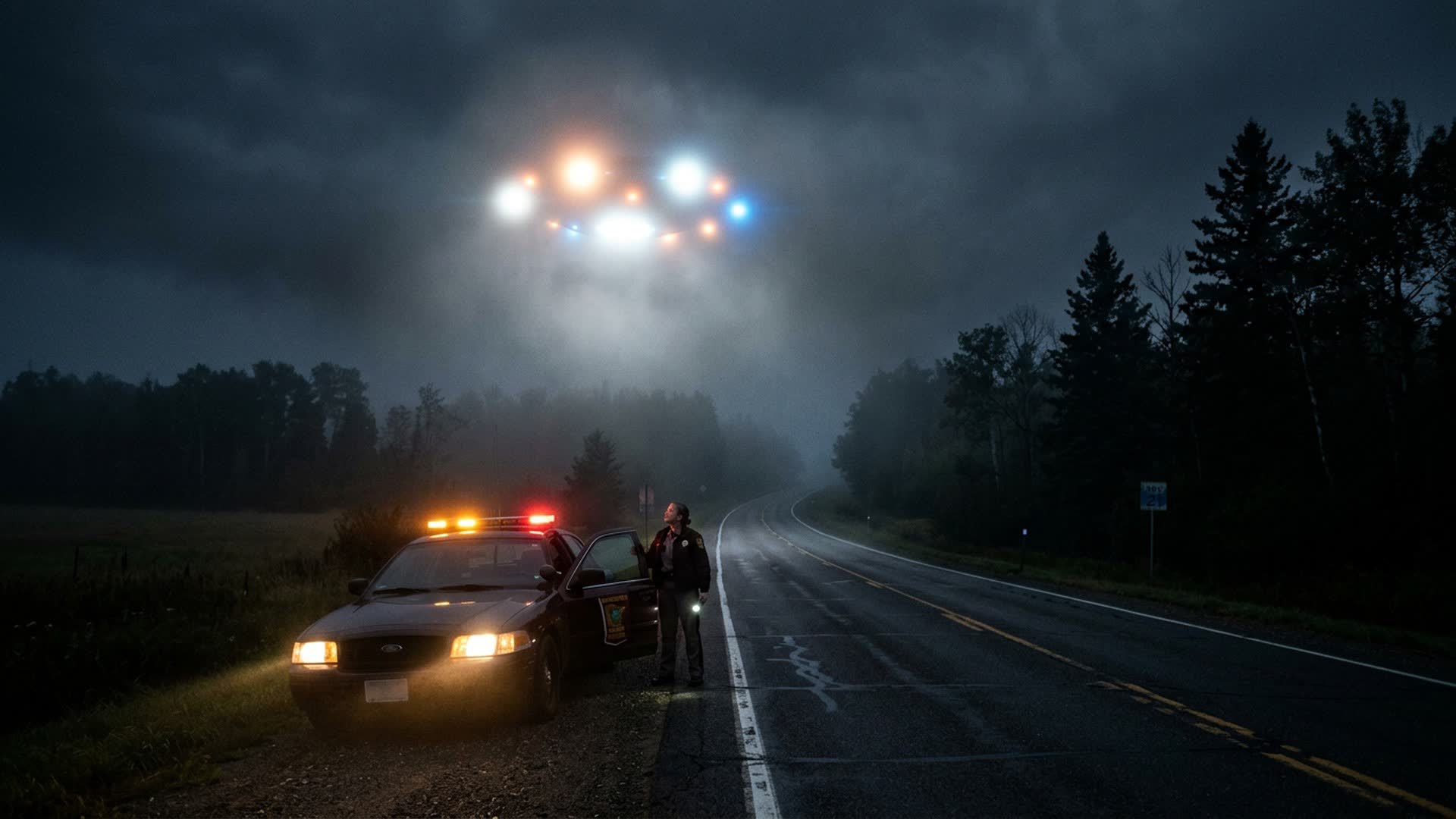
The Val Johnson Incident: Minnesota's Highway UFO
A Night on Highway 220
Some UFO cases rest entirely on eyewitness testimony — sincere, undeniable, and ultimately unprovable. The Val Johnson Incident is not one of those cases. It left physical evidence: a shattered windshield, a bent antenna, a damaged light bar, and two clocks that had each lost exactly fourteen minutes without explanation. That combination of a credible law enforcement witness and hard, documented physical damage makes August 27, 1979, one of the most compelling nights in American UFO history.
Deputy Val Johnson was a Marshall County sheriff's deputy patrolling Minnesota State Highway 220 near Warren — a flat, quiet stretch of prairie country close to the North Dakota border. It was approaching 2 a.m. when he noticed a bright light in the distance, roughly four to six inches in diameter as he perceived it from a mile away. His initial assumption was another car with its brights on, using a side road. He turned to investigate.
The Moment of Impact
What happened next lasted only seconds. The light accelerated toward Johnson's cruiser with extraordinary speed. Before he could react, the light struck. Johnson's next conscious memory was of his patrol car sitting crossways in the road, the windshield destroyed, his head resting against the steering wheel. He could not account for approximately thirty-nine minutes of time.
His eyes, when examined by medical personnel, showed a condition physicians described as consistent with "welder's burns" — the kind of retinal damage caused by exposure to intensely bright ultraviolet light. Johnson later said the pain in his eyes was significant and persistent over several days.
Physical damage documented at the scene
- The windshield was cracked in an inward-radiating pattern inconsistent with rock impact or conventional collision.
- The car's radio antenna was bent at roughly a 90-degree angle.
- One of the top warning lights had been damaged from an external force.
- The hood latch was bent in a way that suggested pressure from above or in front.
The Clock Anomaly
Two separate timepieces lost exactly fourteen minutes. Johnson's wristwatch — a spring-wound mechanical unit — had slowed by fourteen minutes relative to standard time. The patrol car's dashboard clock had done the same. These were independent devices with different mechanisms. Investigators from multiple disciplines attempted to explain the synchronization and could not do so through any mundane mechanical failure.
That detail became one of the most discussed aspects of the case. Time anomalies appear in other high-credibility UFO encounters. Whether they represent genuine distortions of local time, electromagnetic interference with mechanical devices, or simply an artifact of trauma-induced memory disruption remains an open question. In Johnson's case, however, both clocks were inspected and confirmed to be operating normally before and after the incident, except for those fourteen missing minutes.
The Forensic Investigation
What separates the Val Johnson case from hundreds of similar light-in-the-sky reports is the physical investigation that followed. Engineers from Ford Motor Company examined the patrol car and could not account for the windshield damage pattern through any conventional impact. Analysts from Honeywell, the aerospace and defense contractor, studied the evidence as well. Neither company's investigators produced a satisfying conventional explanation.
The investigation was serious, not sensational. Johnson himself was cooperative, consistent in his account, and showed no signs of fabrication in multiple interviews. Law enforcement colleagues and county officials took the case seriously enough to commission independent technical reviews. That institutional response alone says something about the quality of the evidence.
Key findings from the technical investigation
- Ford Motor Company analysts found no conventional cause for the windshield damage pattern.
- Honeywell engineers could not identify a terrestrial explanation for the overall damage profile.
- Both mechanical clocks had lost exactly fourteen minutes — a precise synchronization with no identified cause.
- Johnson's eye injuries were consistent with intense UV exposure, but no UV light source was identified at the scene.
Val Johnson as a Witness
Johnson was not a sensationalist. After the incident, he continued working as a deputy sheriff. He gave interviews carefully and without embellishment. He was direct about what he did not know and did not claim to have seen a spacecraft or alien occupants. He said he encountered a light that moved with impossible speed and that struck his vehicle. The effects on his car and his body were documented. He made no money from the story and sought no extended public profile.
From an intelligence standpoint, that profile matters. Witnesses who gain nothing from their account and who remain consistent across years of separate interviews present a very different credibility calculus than those with obvious motivations or shifting narratives. Johnson falls into the former category.
The Display at the Marshall County Historical Society
One of the most unusual aspects of this case is that the physical evidence did not simply disappear into a government file or private collection. The actual patrol car — or at least components of it — has been displayed at the Marshall County Historical Society. Visitors have been able to see the damaged vehicle firsthand. That kind of public, tangible evidence is extraordinarily rare in UFO cases and gives researchers something concrete to evaluate beyond secondhand accounts.
The car's display represents an implicit acknowledgment, at the local institutional level, that something significant happened on Highway 220 in August 1979 — significant enough to preserve and exhibit.
Proposed Explanations
Investigators have proposed several explanations over the decades, none of which fully satisfy the evidence. Ball lightning has been mentioned — a poorly understood atmospheric phenomenon that can produce brilliant light, move unexpectedly, and potentially interact with objects. The problem is that ball lightning has never been documented moving at the speed Johnson described or causing the specific damage pattern found on his car.
Military test vehicles or experimental aircraft have also been suggested. Warren, Minnesota, is not far from the Canadian border, and the area has historically seen classified military activity. A high-powered experimental drone or reconnaissance platform operating at low altitude and extreme speed could theoretically explain some elements. It could not easily explain the synchronized clock failure or the specific nature of Johnson's eye injuries.
Some researchers have proposed a simple hoax or hallucination. Given the physical evidence that was independently examined by aerospace engineers, and given Johnson's professional reputation and sustained consistency, that explanation is the weakest of the available options.
Where the File Stands
The Val Johnson Incident remains open. No conventional explanation accounts for all of the documented evidence simultaneously. The witness is credible. The physical damage is real. The clock anomaly is verified and unexplained. The medical injuries are consistent with intense light exposure.
What struck Deputy Johnson on that August night, accelerated toward him faster than any identified aircraft, disabled his patrol car, affected two independent timekeeping mechanisms, and damaged his eyes without leaving a recoverable object or trace compound at the scene. That is either a very sophisticated and so-far-unidentified human technology, a natural phenomenon we do not yet understand, or something else entirely.
I have spent time reviewing this case across multiple sources. The evidence does not close neatly. It opens questions that we do not yet have the tools to answer fully. That, in the end, is what makes Highway 220 worth remembering — not because we know what happened there, but because the evidence insists that something did.