The Tunguska Event: Asteroid Impact or Alien Technology?
The Morning the Sky Exploded
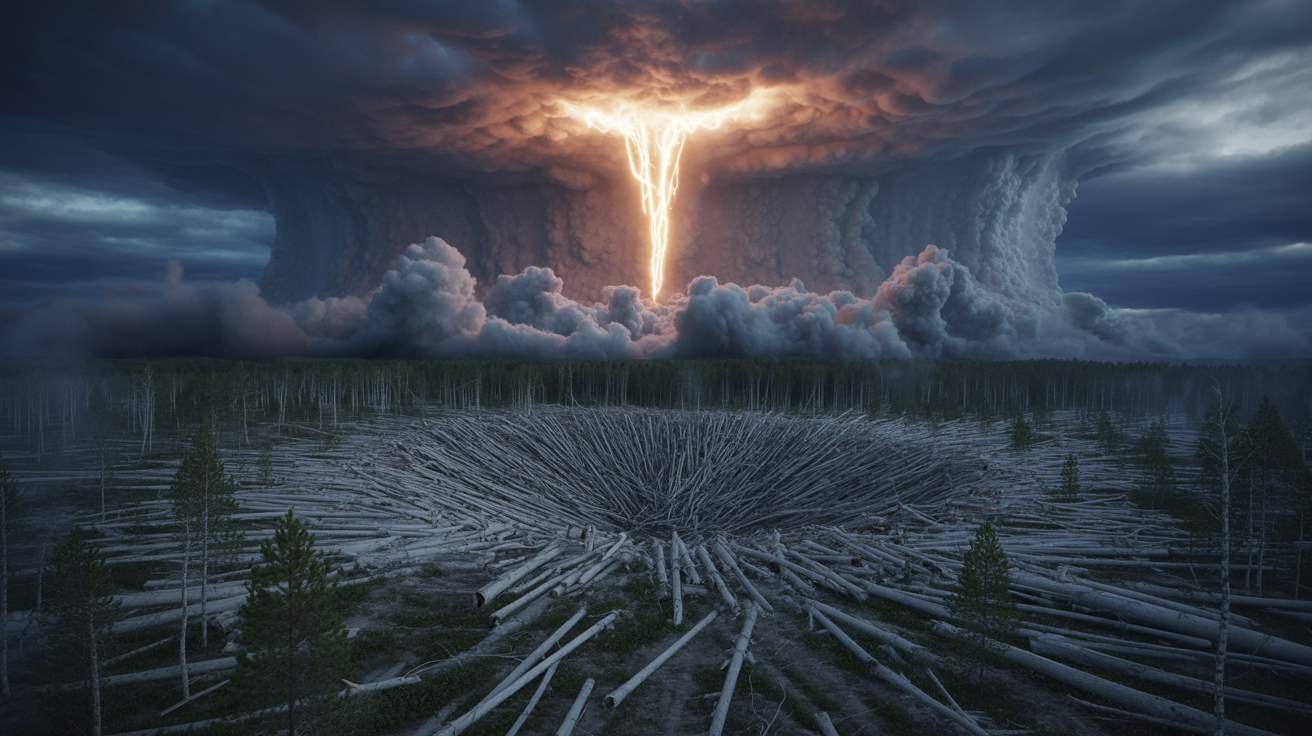
On June 30, 1908, at 7:17 AM local time, witnesses across central Siberia reported seeing a brilliant blue-white streak tear across the sky. Seconds later, an explosion of unimaginable magnitude detonated over the remote Tunguska region, releasing energy equivalent to 10-15 megatons of TNT. The blast wave circled the Earth twice, and seismic stations across Europe and Asia registered the event as a significant earthquake.
What makes this incident particularly intriguing from an intelligence perspective is the complete absence of an impact crater. During my years analyzing anomalous events for the Agency, I learned that when something doesn't fit the expected pattern, you dig deeper. The Tunguska event defies conventional explanation in ways that demand serious investigation.
The Official Narrative: Asteroid Airburst
The mainstream scientific consensus attributes the explosion to a meteor or comet fragment that disintegrated in the atmosphere before reaching the ground. This "airburst" theory explains the lack of a crater and the radial pattern of fallen trees extending outward from ground zero. Expeditions to the site found microscopic silicate and magnetite spheres consistent with extraterrestrial material.
However, this explanation has significant gaps. The object's trajectory, as reconstructed from eyewitness accounts, showed unusual characteristics—including reported course changes that would be impossible for a simple meteor. Multiple witnesses described the object as cylindrical rather than spherical, and some reported seeing it "pulsing" as it moved across the sky.
Alternative Theories: Beyond Natural Phenomena
Several researchers have proposed that the Tunguska event was not a natural occurrence at all. One hypothesis suggests it was an experimental weapon test—possibly by Nikola Tesla, who was conducting high-energy experiments at the time. Tesla had claimed his wireless energy transmission technology could be weaponized, and the timing is provocative.
More controversial theories point to an extraterrestrial spacecraft malfunction or deliberate intervention. Proponents note the absence of meteorite fragments, the unusual flight characteristics, and reports of strange lights in the area for weeks following the event. Some indigenous Evenki people who witnessed the explosion described it as their god Ogdy visiting Earth.
The Intelligence Angle
What's particularly interesting is how Soviet authorities handled the investigation. The first scientific expedition didn't reach the site until 1927—nearly two decades after the event. This delay is suspicious for a phenomenon of such magnitude. During the Cold War, both Soviet and American intelligence agencies took keen interest in the site, with classified expeditions that remain partially redacted to this day.
I've reviewed declassified documents suggesting that certain governments considered the possibility of recovered technology from the site. Whether this was serious investigation or Cold War paranoia is difficult to determine, but the pattern of secrecy is unmistakable.
The Unanswered Questions
More than a century later, the Tunguska event continues to resist definitive explanation. The lack of substantial meteorite fragments, the unusual trajectory, the delayed investigation, and the ongoing government interest all point to a mystery that transcends simple astronomical phenomena. In my experience, when official explanations leave too many loose ends, it's worth asking what isn't being said.
Was Tunguska a cosmic accident, a weapons test gone wrong, or something far stranger? The evidence remains inconclusive, but the questions it raises about what governments know—and what they're willing to share—are as relevant today as they were in 1908.
💥 Video: The Tunguska Event Asteroid
A Knight Phenomena Investigation