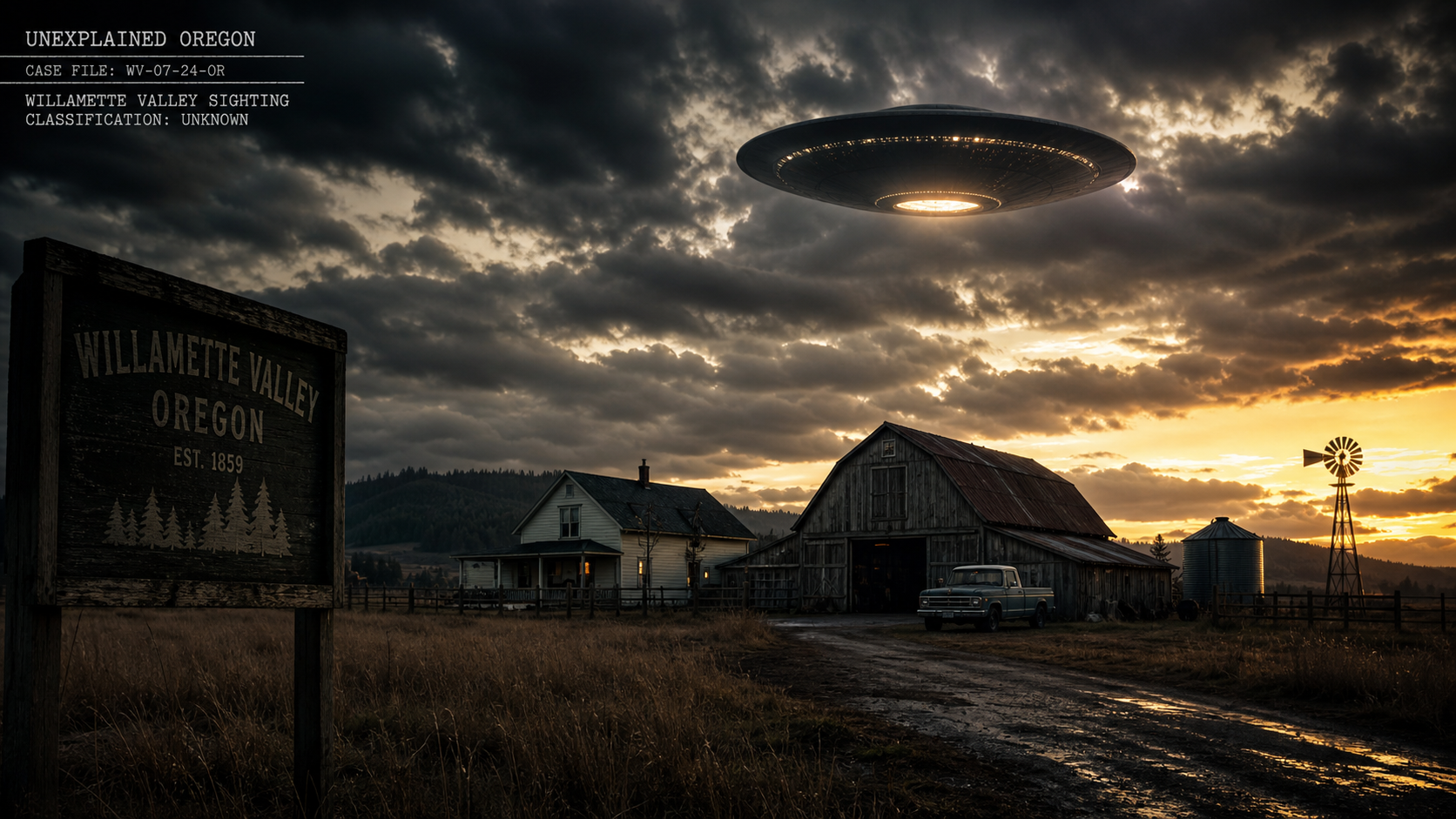
The Trent UFO Photos: McMinnville's Flying Disc and the Evidence That Won't Fade
On the evening of May 11, 1950, Evelyn Trent stepped out of her farmhouse in McMinnville, Oregon, to feed the rabbits. What she saw in the sky would produce two photographs that have survived every major photographic analysis conducted over the past seventy years. Unlike the vast majority of UFO imagery—blurred, distant, or easily explained—the Trent photos present a clear, metallic disc-shaped object hovering in broad daylight. They've been examined by the Condon Committee, analyzed by optical physicists, and scrutinized by both believers and skeptics. And they still won't go away.
I've spent years evaluating evidence through the lens of intelligence work, where the quality of a source can make or break an entire operation. The Trent case offers something rare in the UFO field: physical evidence, credible witnesses, and a paper trail that actually holds up under examination. Let's walk through what we know, what we can verify, and what still doesn't add up.
The Witnesses and the Moment
Paul and Evelyn Trent were farmers. Not UFO enthusiasts, not attention seekers—farmers. When Evelyn called Paul outside that evening, he grabbed his Roamer 63 camera and managed to snap two photos before the object accelerated and disappeared to the west. The couple didn't immediately run to the press. In fact, they didn't do much of anything. The film sat in the camera for several days until they finished the roll. When they finally developed it, they showed the images to a few friends and family members. It wasn't until a local banker saw the photos and contacted the local newspaper that the story went public.
This behavior pattern matters. In my experience, fabricators rush to capitalize. They control the narrative early. The Trents did the opposite. They were reluctant, even bemused by the attention. When reporters arrived, Paul Trent's primary concern was getting his chores done. Evelyn corroborated the account but offered no embellishments. Their story remained consistent across dozens of interviews over decades, with no significant contradictions—a rarity in witness testimony of any kind.
The Photographic Evidence
The two photographs show a disc-shaped object with a distinct superstructure on top, appearing metallic and solid. The object is positioned against a clear sky with the Trent farmhouse, garage, and a telephone wire visible in the frame. The images were taken seconds apart, showing the object in slightly different positions, consistent with movement.
In 1967, the photos were analyzed by Dr. William Hartmann, an astronomer working with the University of Colorado's Condon Committee—a group generally skeptical of UFO claims. Hartmann's conclusion was cautious but striking: "This is one of the few UFO reports in which all factors investigated, geometric, psychological, and physical, appear to be consistent with the assertion that an extraordinary flying object, silvery, metallic, disc-shaped, tens of meters in diameter, and evidently artificial, flew within sight of two witnesses."
Subsequent analyses have focused on whether the object was a small model suspended from the overhead power lines. Photometric studies, however, have consistently indicated that the object was distant and large, not close and small. Dr. Bruce Maccabee, an optical physicist with the U.S. Navy, conducted extensive computer-enhanced analysis in the 1970s and concluded the object was likely 20-30 feet in diameter and positioned at a considerable distance from the camera. Attempts to recreate the photos using models have failed to match the lighting, shadow angles, and depth-of-field characteristics present in the originals.
The Debunking Attempts
Skeptics have proposed several explanations: a truck mirror suspended from the power line, a hubcap thrown in the air, or a fabricated model. Each theory has problems. The truck mirror hypothesis fails because the object's appearance doesn't match any known mirror from that era, and the lighting analysis suggests a much larger object. The hubcap theory collapses under scrutiny of the object's symmetry and the absence of motion blur that would accompany a thrown object.
Philip Klass, a prominent UFO skeptic, argued the photos were a hoax but never provided definitive proof. His primary evidence was circumstantial: the Trents stood to gain financially. Except they didn't. The couple never profited from the photos. They gave the negatives to the newspaper, which lost them for years. When the negatives were finally returned, they were damaged. The Trents never sold their story, never wrote a book, never toured the lecture circuit. If this was a hoax, it was the least profitable one in history.
What the Pattern Tells Us
Here's what I learned in the intelligence community: when you can't break a story, when the witnesses don't crack, when the physical evidence holds up under technical scrutiny, you have to consider the possibility that the account is accurate. That doesn't mean aliens. It means something happened that doesn't fit our standard explanatory models.
The Trent photos have now been examined for over seventy years. They've survived the transition from analog to digital analysis. They've been tested against modern photographic forensics. And they remain unexplained. Paul Trent passed away in 1998, Evelyn in 1997. Both maintained until their deaths that they simply photographed what they saw.
Could this have been an experimental aircraft? Possibly. The timing—1950, early Cold War—makes that plausible. But no declassified program matches the object's appearance or reported flight characteristics. Could it have been an elaborate hoax by two farmers with no apparent motive? The evidence suggests otherwise. What we're left with is a case that refuses to resolve cleanly in either direction.
The Trent photos won't give you certainty. But they'll give you something rarer: a well-documented, technically sound piece of evidence that still demands an answer. And sometimes, in this field, that's the best you're going to get.