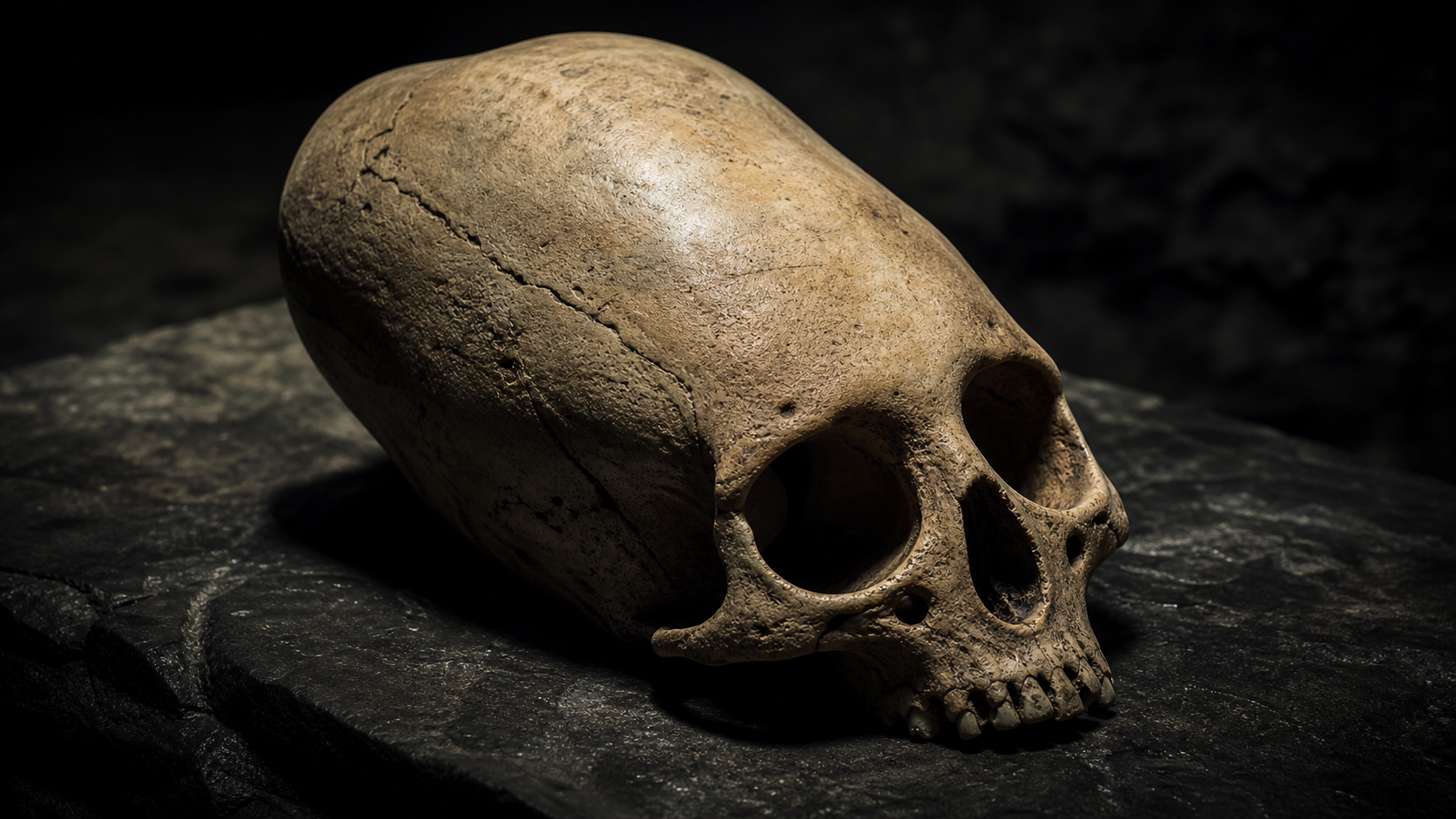
The Starchild Skull: An Anomaly, a Hoax, or a Case for Rewriting Human History?
Why the Starchild Skull Still Provokes Arguments
Some mysteries survive because they are almost impossible to verify. Others survive because they are easy to misunderstand. The so-called Starchild Skull belongs to the second category.
At first glance, it looks like the sort of artifact that belongs in a tabloid headline or a late-night special: an oddly shaped skull, allegedly discovered in a Mexican mine, later circulated among paranormal researchers as possible evidence of a nonhuman being. The story has been recycled for decades, usually stripped of context and amplified by speculation. That is precisely why it deserves a sober examination.
As someone who spent years reading incomplete reports, contradictory witness statements, and evidence that came preloaded with someone else's conclusions, I have learned to begin with a simple rule: when the legend is loud, reduce the volume and inspect the bones. In this case, literally the bones.
The Origin Story: A Discovery Wrapped in Doubt
The Starchild Skull entered public discussion through the work of Lloyd Pye, an investigator and author who presented it as an extraordinary anomaly. According to the narrative, the remains were found in an abandoned mine shaft in Chihuahua, Mexico, alongside another human skull. One of them appeared conventional. The other, elongated and unusually thin, did not.
That is the version that captivated the public. But the provenance of the skull has always been the first major problem. Chain of custody matters. Where did it come from exactly? Who recovered it? Under what conditions? What was documented at the time of discovery, and what was added later to make the story stronger?
In forensic work, a specimen without a reliable recovery record begins at a disadvantage. It may still be important, but every claim attached to it must be treated cautiously. Anomalous origin stories are fertile ground for embellishment, accidental distortion, or outright fabrication. This does not automatically make the skull a hoax. It simply means the story cannot carry more weight than the evidence itself.
What the Skull Actually Shows
The physical characteristics of the Starchild Skull are the reason it became famous. Reports describe a cranium with a reduced bone density, a pronounced elongation, enlarged eye sockets, and a jaw and facial structure unlike the average human skull. To the untrained eye, it can appear exotic, even alien.
But appearance is not diagnosis.
Medical science has long documented conditions that alter skull shape. Artificial cranial deformation, for example, was practiced in many cultures worldwide, often beginning in infancy when the bones are still pliable. Certain genetic disorders, developmental abnormalities, hydrocephalus, and other pathological conditions can also produce unusual cranial forms. Without examining the full skeletal context, soft tissue history, age, developmental markers, and confirmed lineage, any conclusion is premature.
That is the central tension in the Starchild case: the skull looks strange enough to invite extraordinary interpretation, but strange-looking anatomy is not the same thing as nonhuman anatomy.
DNA Claims and the Problem of Interpretation
The discussion intensified when claims surfaced that DNA testing had revealed odd or unidentifiable features. Here again, we enter familiar territory: partial sequences, uncertain methods, and interpretations that outrun the data.
DNA analysis can be persuasive, but only when the process is transparent and reproducible. Questions matter. Were the samples contaminated? Were they handled by independent laboratories? What markers were tested? Were the results peer-reviewed? Were the conclusions consistent across different tests, or selectively highlighted from a broader set of data?
One of the recurring patterns in controversial evidence is the leap from "not fully understood" to "therefore extraordinary." That leap is intellectually reckless. Unknown does not equal alien. Unusual does not equal impossible. And a sequence that does not neatly match expectations can reflect many things: degradation, contamination, incomplete reference databases, or simply the limitations of the test itself.
In investigations like this, the question is not whether the evidence is interesting. The question is whether it can survive hostile scrutiny.
That standard is where many paranormal claims fail. They are built to inspire, not to withstand criticism.
Pathology, Deformation, and the Human Capacity for the Unusual
The strongest skeptical explanation is not that the skull is ordinary. It is that it may be human, but profoundly atypical.
Human biology is capable of producing forms that look, at first glance, almost unbelievable. Conditions affecting bone development can create asymmetry, thinning, and cranial distortion. Nutritional deficiencies, congenital disorders, and pressure-related deformation in infancy can leave long-lasting structural changes. In some cases, the results are so severe that they become the basis for myth.
History gives us many examples of bodies and bones interpreted through superstition before medicine could explain them. The moment an artifact enters the paranormal marketplace, its interpretation becomes culturally loaded. A skull that might have been viewed as a medical curiosity becomes, instead, a relic from elsewhere.
That is not an accusation. It is a reminder of how human beings assign meaning. We do not merely see anomalies; we narrate them.
The Hidden Weakness in the Alien Hypothesis
The alien-origin theory is attractive because it resolves ambiguity with drama. It transforms uncertainty into a story with stakes. But it also creates a burden of proof that has never been met.
To argue that the Starchild Skull is nonhuman, one must do more than point to unusual shape or partial genetic oddities. One must establish that it cannot be explained by known human variation, pathology, or postmortem distortion. That is a high bar, and for good reason. Extraordinary claims are not suppressed by skepticism; they are protected by it.
Supporters often argue that the skull's features are too unusual to be purely human. Yet "too unusual" is not a scientific category. It is a reaction. Science asks whether the skull falls outside the known range of human abnormality. That requires rigorous comparative analysis against documented medical cases, not impressionistic comparison to an average skull.
And here is the hard truth: the more a case depends on speculation, the less useful it becomes as evidence for anything beyond speculation.
Why People Want the Starchild Skull to Be More Than It Is
The persistence of the Starchild Skull mystery tells us as much about us as it does about the specimen. People are drawn to physical objects that seem to preserve contact with a hidden reality. A photograph can be dismissed. A story can be doubted. But a skull feels different. It has weight. Texture. Presence.
That makes it powerful. It also makes it vulnerable to projection.
In the paranormal field, objects often become repositories for hope, fear, and identity. For some, the Starchild Skull is proof that official explanations are too narrow. For others, it is an embarrassment, a symbol of how enthusiast communities can overstate weak evidence. Both reactions are understandable. Neither, on its own, determines the truth.
The mature position is harder: acknowledge the intrigue without surrendering to it.
What We Know, What We Don't, and What We Should Admit
Here is the cleanest summary available after years of circulation and debate:
- The skull is unusual in appearance and structure.
- Its origin story has unresolved provenance issues.
- Some claims about DNA and classification have been contested or remain difficult to independently verify.
- Human developmental and pathological explanations remain plausible.
- No publicly available evidence has conclusively established a nonhuman origin.
That may not be satisfying to those who want a definitive answer. But dissatisfaction is not disproof. It is simply the emotional cost of uncertainty.
In investigations, there are three common outcomes: a case is solved, a case is disproven, or a case remains open because the evidence is insufficient. The Starchild Skull currently lives in the third category. It is not proof of extraterrestrial contact. It is not a solved medical specimen either, at least not to universal satisfaction. It is an unresolved artifact wrapped in a powerful narrative.
The Final Assessment
If I were writing this from an intelligence desk rather than a paranormal blog, my assessment would be cautious and unsentimental. The Starchild Skull is interesting, but interest is not inference. Its strongest value is not as evidence of aliens, but as a case study in how ambiguous physical evidence becomes myth.
That said, dismissing it with contempt would be equally lazy. Strange artifacts deserve disciplined analysis, not ridicule. The fact that a claim sounds impossible does not absolve us from examining it. It simply means the standard of proof must be higher.
At present, the most responsible conclusion is this: the Starchild Skull remains an unresolved anomaly in popular culture, but the available evidence does not justify a leap to the extraterrestrial hypothesis. The burden remains on those making the extraordinary claim. Until they produce clear provenance, transparent testing, and reproducible forensic results, the mystery belongs more to human interpretation than to unknown biology.
And that, in its own way, is revealing. Sometimes the most unsettling mysteries are not the ones that point beyond humanity. They are the ones that show how readily we turn uncertainty into legend.