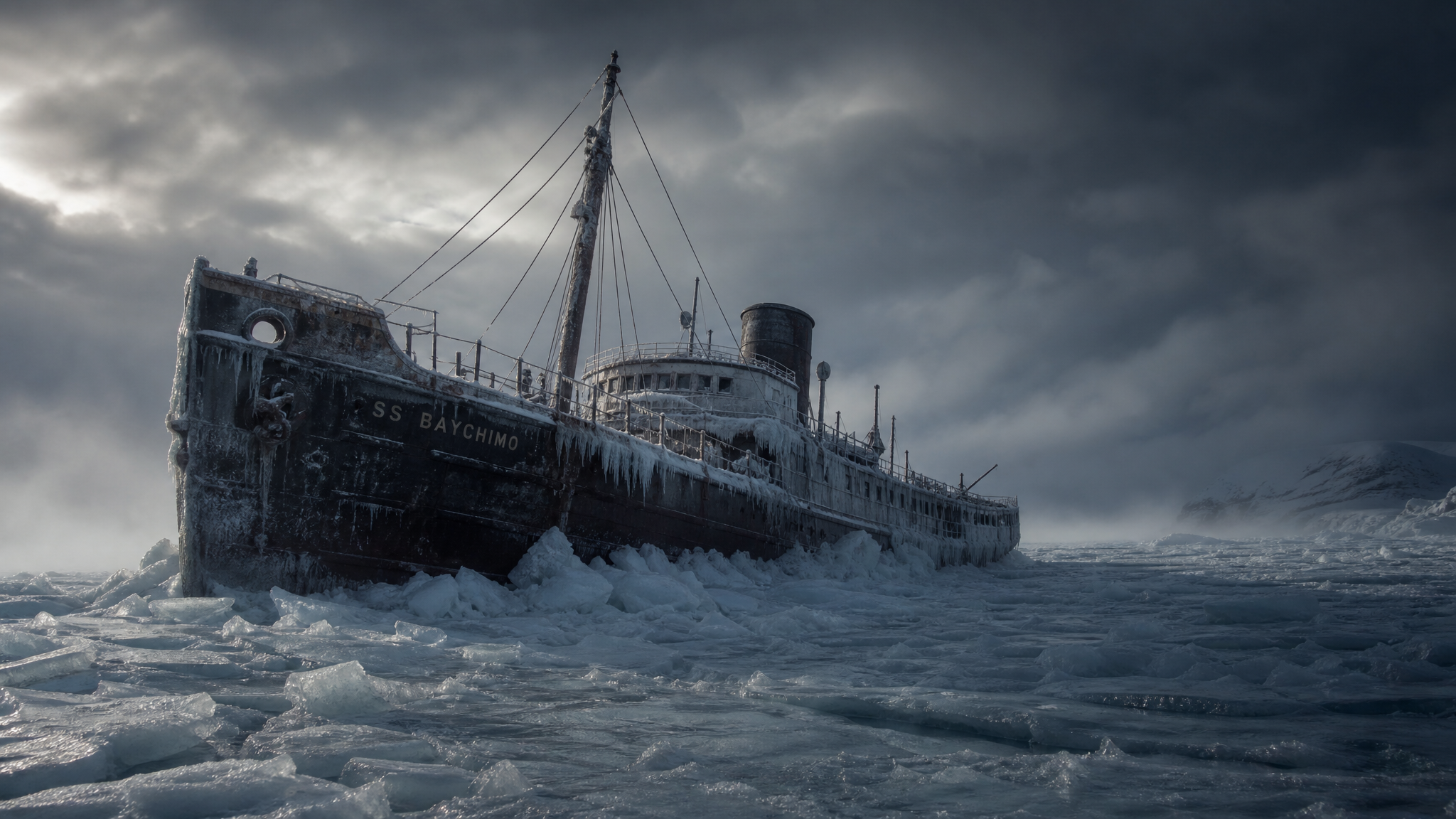
The SS Baychimo: The Ghost Ship That Wouldn’t Die
Introduction: A Ship That Refused to Stay Dead
In the catalog of maritime mysteries, few cases are as stubbornly persistent as the story of the SS Baychimo. This was not a pirate vessel, not a cursed galleon, not a theatrical apparition designed for campfire retelling. It was a real steel cargo steamer operating in the Arctic trade, abandoned in 1931 after becoming trapped in sea ice off the coast of Alaska. What followed was the sort of long, unnerving afterlife that makes even hard-headed investigators pause: multiple sightings over decades, conflicting reports of condition and location, and a final disappearance that remains unresolved.
As with most enduring mysteries, the Baychimo case thrives because it sits at the intersection of fact, neglect, and myth-making. We do not need the supernatural to explain why a ship could be seen again after abandonment. Arctic ice, shifting currents, sparse reporting, and the limits of 20th-century communication are sufficient to create confusion. But confusion is not the same as closure. The Baychimo still deserves a disciplined review because the historical record is unusually rich—and unusually incomplete.
Historical Background: Built for Commerce, Lost to the Ice
The SS Baychimo was built in Sweden in 1914 and later operated by the Hudson’s Bay Company, one of the key commercial powers in the North. She was a freight steamer, designed for trade routes that depended on seasonal access and the difficult arithmetic of Arctic logistics. In those waters, ships were not merely vehicles; they were floating supply lines for isolated communities and trading posts scattered along a harsh coast.
In late September 1931, the Baychimo became trapped in pack ice near Barrow, Alaska, after delivering cargo. The crew survived, but the vessel was immobilized. Attempts were made to free her, and some cargo was offloaded. Eventually the ship was left vulnerable to the elements, and in early October the crew abandoned her temporarily or permanently depending on the source consulted. The central facts are not in dispute: the ship was beset by ice, abandoned, and presumed lost.
What makes the case exceptional is that she was not simply lost once. She was seen again.
The First Sightings: A Ghost in Plain Daylight
Shortly after abandonment, the Baychimo was reported adrift. Local accounts and later compilations indicate that she was seen floating free of the ice, damaged but intact enough to be recognizable. This is important: the vessel did not vanish immediately under the sea. She entered the unstable, dangerous state that all abandoned Arctic ships face—no longer under control, subject to wind, current, and ice pressure.
The company had reason to believe she might still be salvageable. According to historical summaries, attempts were made to locate her for recovery. Instead, the Baychimo became harder to pin down. In some reports she was sighted, in others she was lost again. This is the first major analytic problem in the case: a sparse observational record spread across a vast area with few trained witnesses and limited navigation tools.
Even so, the sightings persisted.
Reported Encounters Over the Years
Across the 1930s and 1940s, various trappers, coastal residents, sailors, and pilots allegedly reported seeing the Baychimo. The details vary, which is what you would expect in a genuine long-duration maritime drift mystery. The ship was described at times as adrift, sometimes icebound, sometimes partially submerged, sometimes still clearly visible as a derelict hull. A vessel in Arctic waters could remain surprisingly intact for long periods if conditions were favorable. Cold temperatures preserve timber, slow decay, and reduce biological destruction. The Arctic is brutal, but it can also be a form of refrigeration.
One of the most cited events came in 1933, when the Baychimo reportedly was sighted by the schooner Louise. Later sightings allegedly occurred in the following years, including reports into the 1940s. The ship became a kind of moving landmark in a region where landmarks are sparse and the sea can erase them quickly. A derelict steamer, half-frozen and drifting in silence, would be unforgettable to anyone who saw her.
That said, not every sighting can be treated as equally reliable. Some reports are retrospective, filtered through oral tradition and secondary publication. Others lack precise coordinates. Some may refer to debris or a ship of similar silhouette. This is where skeptical analysis matters. A mystery does not become stronger because every story is repeated; it becomes stronger when the best evidence withstands scrutiny.
The Key Evidence: What We Actually Know
The evidence base for the Baychimo case consists of several layers:
- Primary historical fact: The Baychimo was trapped in ice in 1931 and abandoned by her crew.
- Contemporary reporting: The ship was reportedly seen adrift after abandonment.
- Secondary sightings: Multiple accounts over subsequent years claimed the vessel was observed again in different locations.
- Absence of recovery: No confirmed salvage or formal sinking record exists that definitively closes the case.
That last point is crucial. In many maritime cases, the mystery ends because the wreck is found, charted, or confirmed sunk. The Baychimo lacks that final administrative death certificate. She simply stops appearing in the record.
There are, however, strong reasons for caution. The Arctic is notorious for false horizons, misidentification, and the long life of rumor. A half-submerged hull, a distant schooner, a grounded wreck, or even a shift in ice can transform into a “ghost ship” in oral history. Once a story becomes legendary, each new retelling adds atmosphere while potentially stripping away precision.
“In remote environments, uncertainty travels faster than truth. A single vague sighting can survive for decades if no one can immediately disprove it.”
Witness Accounts: The Human Element in a Cold Environment
Witness testimony in the Baychimo case is both valuable and limited. Valuable because direct observation matters in an environment where formal documentation was rare. Limited because memory is vulnerable to embellishment, compression, and later influence. A person who saw a derelict steamer in an empty sea may remember the shape more clearly than the date, or the year more clearly than the position.
Some reports describe the ship as appearing suddenly in open water, like a remnant from another time. Others emphasize her eerie stillness. That language should not be dismissed outright, because it tells us how witnesses experienced the event. But experience is not identical to identification. Emotional language can coexist with factual error.
It is also worth noting the ecology of Arctic communities. In isolated regions, information spreads by direct contact, ship logs, and word of mouth. If a vessel was seen by several people independently, that does increase credibility. Yet without synchronized logs, photographs, or recovered physical evidence, the case remains probabilistic rather than conclusive.
Official Explanations: The Most Likely Path Forward
The official explanation is not a cover-up; it is ordinary maritime physics. The Baychimo likely drifted as a derelict vessel, carried by winds and currents, intermittently trapped in ice, then released again. Over time, she probably suffered progressive structural damage until she broke apart, sank, or became too degraded to be recognized. This is the simplest explanation, and in investigative work, simplicity is not a weakness when it aligns with environmental reality.
Why, then, no confirmed wreck? Because the Arctic is immense and unforgiving. A ship can sink in deep water, become embedded under ice, or be scattered into wreckage beyond immediate recognition. Search efforts in the early-to-mid 20th century were limited by the same factors that made the Baychimo famous in the first place: remoteness, weather, and incomplete observation.
There is no need to invoke the paranormal. The most conservative reading is also the most credible: the Baychimo was a real ship that escaped human control and then escaped human certainty.
What Does Not Hold Up Well
- Claims that the ship was “impossible” to move or sink ignore Arctic drift and ice dynamics.
- Assertions of supernatural preservation are unsupported by physical evidence.
- Any exact timeline of every sighting should be treated cautiously unless corroborated by logs or contemporaneous documentation.
Why the Baychimo Became a Legend
To understand the endurance of the Baychimo story, we need to look beyond the hull and into the psychology of remote observation. Human beings are pattern-seeking creatures. When a ship survives abandonment, survives winter, and survives rumor, it becomes more than transport—it becomes a symbol. The Arctic already feels like a place where nature edits reality. A vessel drifting without crew amplifies that sensation.
Ghost ship stories also satisfy a deep narrative need. They suggest continuity after disaster, motion after loss, and identity after human departure. In the Baychimo case, the emotional core is obvious: a ship does not merely die; it wanders. That is a powerful image, and powerful images are sticky.
But legend should not be mistaken for evidence. The fact that a story is compelling tells us nothing about its ontological status. It tells us only that the story will survive.
Comparative Analysis: Other Ghost Ship Cases
The Baychimo stands in a long tradition of maritime derelicts that were reported after abandonment. The sea can preserve such stories because it is a perfect machine for ambiguity. A ship seen at distance on one day may be gone the next. A wreck may drift out of a charted area. In some cases, a vessel is “rediscovered” years later under a different name or in altered condition.
That comparative lens matters. The Baychimo is unusual, but it is not alone. Ghost ship lore often begins with a mundane event: loss of crew, abandonment, violent weather, and a disappearing hull. The legend grows when the wreck is not immediately recovered. Add remote geography and a sparse communications network, and the story acquires an aura of impossibility it does not deserve.
From an intelligence perspective, the operative question is always the same: what can be independently confirmed? In the Baychimo case, we can confirm abandonment and prolonged uncertainty. We cannot confirm a supernatural survival. We can confirm the environmental plausibility of drift. We cannot confirm every later sighting as the same ship without stronger corroboration.
The Evidence We Would Need to Close the File
If the Baychimo were being investigated today with modern resources, what would close the case? Ideally one or more of the following:
- Sonar or underwater imaging locating a wreck matching the Baychimo’s dimensions
- Recovered artifacts or ship fittings with identifiable provenance
- Contemporaneous photographs from a sighting with geolocation data
- Archived navigation logs from multiple vessels confirming position and appearance
- A definitive historical record of sinking, breaking up, or salvage
Without that, the Baychimo remains in a gray zone. Not a supernatural entity, not a solved case, but a historical object whose afterlife was never fully documented.
The Knight Assessment
Here is my professional conclusion: the SS Baychimo was almost certainly a real derelict vessel that drifted for an extended period in Arctic waters after being abandoned in 1931. The sightings are plausible, but the evidence is uneven. Some reports may be accurate; others may reflect misidentification, rumor, or the natural distortion that accompanies long-distance witness memory in remote environments.
I do not see a credible basis for paranormal explanation. The Baychimo does not require one. What it requires is a disciplined acknowledgment of what the record can and cannot prove. The ship likely broke apart or sank after years of drift, but the absence of a final confirmed wreck leaves room for legend to survive.
That is the real mystery here. Not whether a ghost ship haunted the Arctic, but how a real ship can disappear so completely into the machinery of climate, distance, and time that it becomes a ghost in the historical record. In intelligence work, we learn this lesson early: sometimes the most unsettling cases are not the ones that defy physics, but the ones that reveal how little of reality we are actually able to observe.
The Baychimo did not need to be supernatural to become immortal. The sea did that part for her.