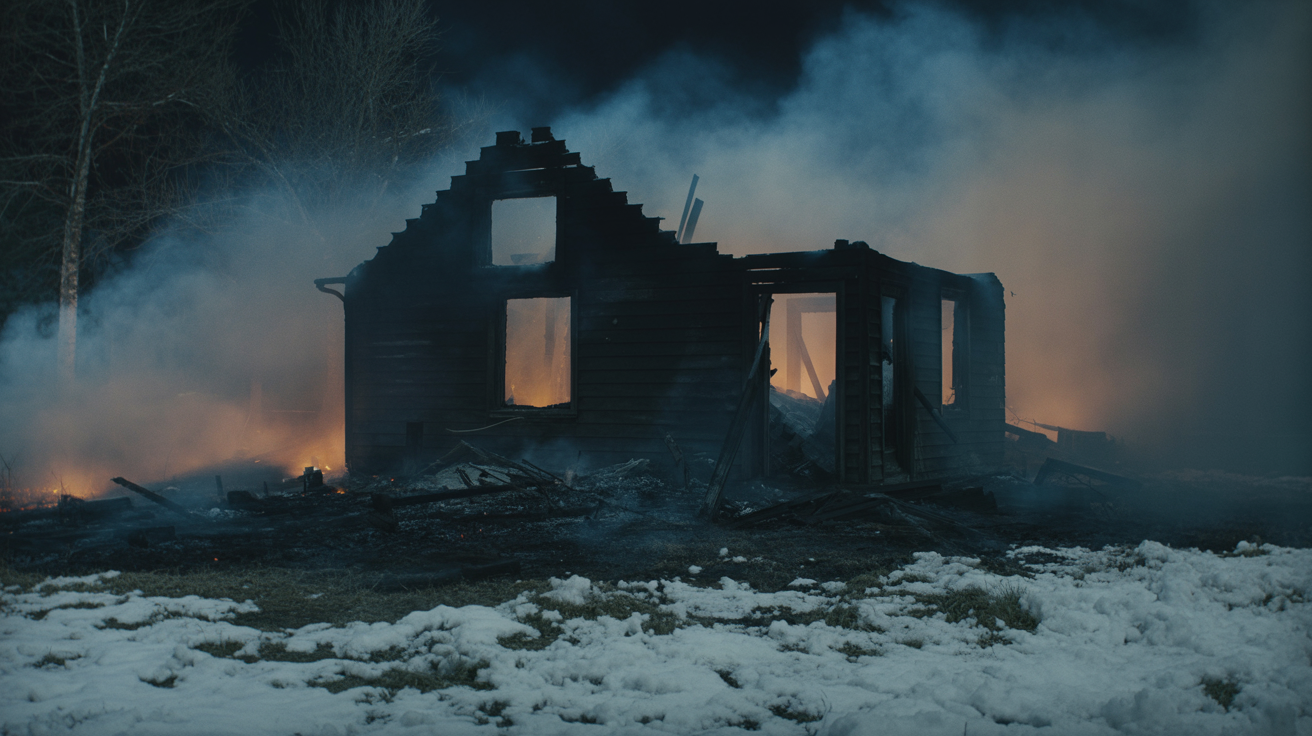
The Sodder Children: A Christmas Fire, Five Missing, and a Case That Refuses to Close
When I approach a case like the Sodder children, I try to strip away the mythology first. Start with the verified facts, build the timeline, and then test the claims against physical evidence, witness statements, and human behavior under stress. That method does not guarantee the truth. But it does reduce the chances of being led astray by coincidence, grief, or rumor.
By that standard, the Sodder case is one of the strangest missing-person mysteries in American history.
The Fire on Christmas Eve
Late on December 24, 1945, George and Jennie Sodder were in their home in Fayetteville, West Virginia, with nine of their ten children. In the early hours of Christmas morning, the house caught fire. Five children were never found: Maurice, Martha, Louis, Jennie, and Betty. Their parents and four siblings survived.
At first glance, this was a tragic house fire with catastrophic loss of life. But the investigation quickly became complicated. The family said they tried to get everyone out, yet the escape was chaotic. George Sodder later reported that a ladder that normally rested outside the house was missing. He also believed the telephone line had been cut. When he tried to raise the alarm, he claimed the truck would not start. In a crisis, each of those failures matters because each one increases the fatal window of time.
Then came the most disturbing fact: no human remains were conclusively identified among the ashes and debris.
Why the Missing Remains Mattered
In a house fire that intense, one might expect bodies to be severely damaged, especially in a structure that had burned down to the foundation. But the absence of identifiable remains gave the family a reason to doubt the official explanation that the five children died in the blaze. That doubt became the engine of the entire case.
Here I have to be careful. Absence of evidence is not automatically evidence of foul play. Fires can destroy bodies far more thoroughly than the public expects, and early 20th-century fire investigations were not as sophisticated as they are today. But the Sodders did not simply point to missing bones and stop there. They collected other details that, taken together, suggested something more than a tragic accident.
They believed someone had sabotaged the house. They believed their children may have been removed before or during the fire. And they believed the official response was too quick to close the book.
The Clues That Kept the Case Alive
Several details have fueled suspicion for decades. One involved a witness who reportedly saw a stranger in a vehicle near the home earlier that evening. Another involved the family’s claim that the fire may have started in a suspicious manner rather than by accidental electrical failure. There were also reports of unusual behavior before the fire, including an incident in which George Sodder allegedly criticized Italian dictator Benito Mussolini, angering a local man who had ties to organized criminal circles. That allegation has always added a dramatic edge to the case, but from an investigative standpoint it remains thinly supported.
That is the challenge with the Sodder mystery: every thread seems to lead somewhere, but not all threads are equally strong.
There was also the matter of the children’s disappearance itself. The youngest children were reportedly in bed when the fire began. If they had died in the home, investigators would normally expect some trace, even after a severe fire. Instead, the debris search produced contradictions, and the family never accepted the conclusion that the children had perished there.
The Billboard, the Photos, and the Search
After the fire, the Sodders did something that many families in a similar situation might not have had the stamina to do: they kept searching. They placed a billboard along Route 16 with the faces of the missing children and offered a reward. They received tips over the years, some sincere and some almost certainly not.
One of the most famous pieces of evidence came from a photograph reportedly sent to the family. It showed a young man believed by the Sodders to resemble their missing son Louis. The image became a centerpiece of the case because it offered a possible sighting years after the fire. But photographs can mislead. Family resemblance is powerful, especially when grief is looking for confirmation. Without independent verification, the photo remains suggestive rather than conclusive.
The billboard itself is revealing. It shows that the case did not die with the fire. It became an active search problem, sustained by parental conviction and public curiosity. In intelligence terms, the Sodders were not simply mourning a loss; they were pursuing an unresolved anomaly.
Arson, Kidnapping, or Tragedy?
When I weigh the case, I see three broad possibilities.
First: the children died in the fire, and the missing remains reflect the destruction caused by the blaze and the limits of 1945 forensic science. This is the simplest explanation, and in many cases the simplest explanation is the correct one.
Second: the fire may have been deliberately set, whether to target the family or to create confusion during a kidnapping. This would explain the alleged sabotaged phone line and missing ladder, but it would still require us to account for the children’s ultimate fate.
Third: the children were removed before the fire or in the chaos immediately after it, then disappeared into a system that left little trace. That scenario is possible, but it raises hard questions about how five children could vanish without a verified chain of custody, a reliable witness trail, or a later confirmed sighting.
My judgment is that the case contains enough irregularities to justify skepticism about the original conclusion. But skepticism is not the same as certainty. The evidence is suggestive, not decisive.
What the Case Teaches Us
Cases like this endure because they sit at the intersection of fear and hope. The fire is real. The missing children are real. The unanswered questions are real. But the temptation to turn uncertainty into certainty is also real, and that is where analysis becomes discipline.
As an investigator, I look for what survives scrutiny. In the Sodder case, what survives is not a neat answer but a durable contradiction: a devastating fire, a family that refused to believe its children were dead, and a record that never quite closed the gap between explanation and evidence.
That is why the mystery still matters. Not because it proves a conspiracy, and not because it confirms something supernatural. It matters because it reminds us how often truth becomes difficult precisely when grief, limited forensic capability, and human error collide.
More than seven decades later, the Sodder children remain missing from the record in a way that continues to unsettle me. Whether they died in the fire or were taken from it, the case stands as a warning: sometimes the most haunting mysteries are not the ones with the most spectacular claims. They are the ones built from ordinary tragedy, a few suspicious details, and a silence that never fully goes away.
🔥 Video: The Sodder Children A
A Knight Phenomena Investigation