The Richat Structure: Sahara's Eye, or a Geological Illusion?
A Feature That Looks Engineered
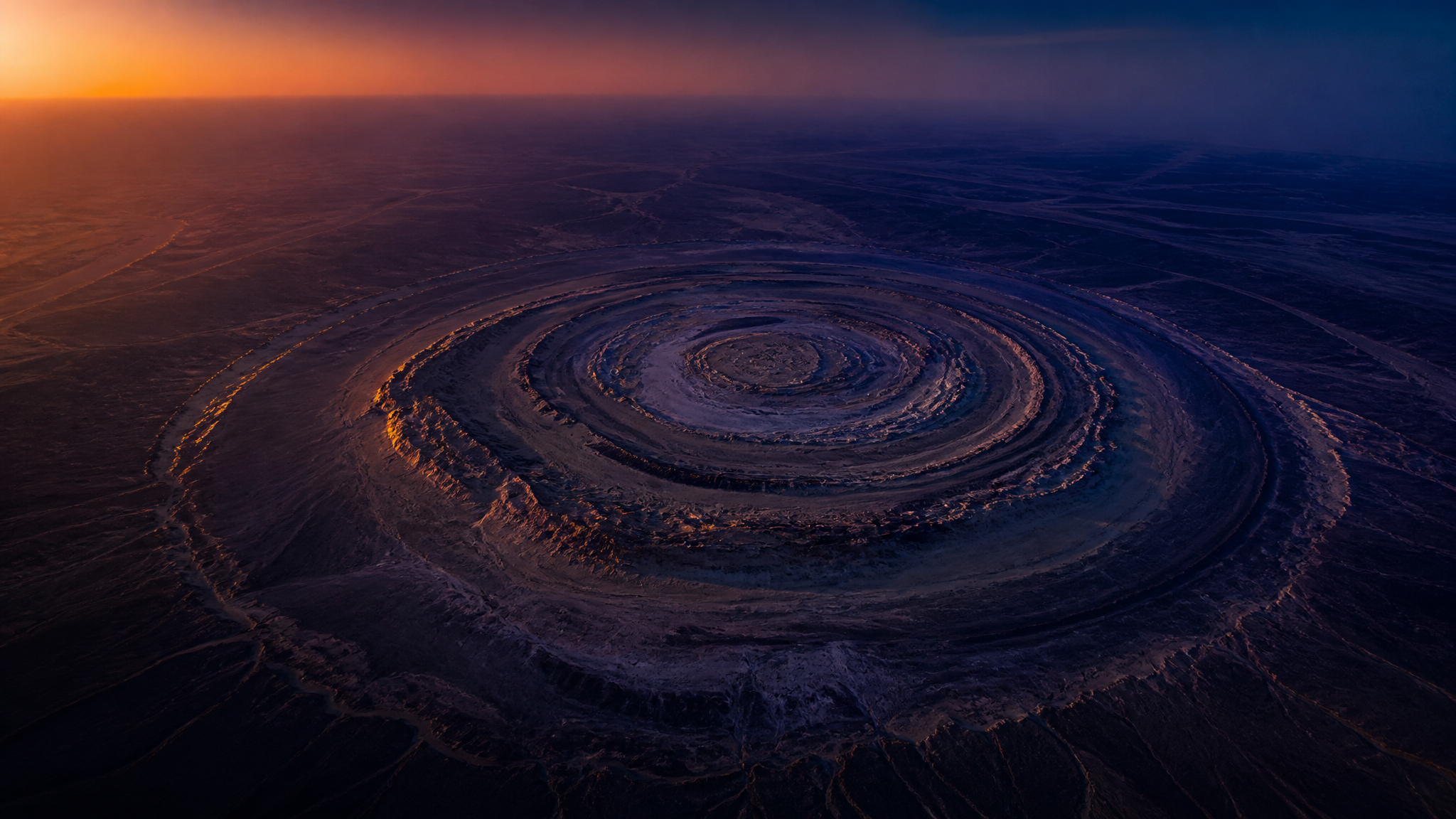
From orbit, the Richat Structure is hard to ignore. It sits in the Sahara of northwestern Mauritania as a set of broad concentric rings, nearly circular, spanning about 40 kilometers across. Early astronauts used it as a landmark. Online, it became something else: a candidate for Atlantis, a scar from a cosmic impact, a buried machine of some forgotten civilization. The visual symmetry is so striking that it invites a conclusion before the evidence has had a chance to speak.
I have spent enough time around mysteries to know this pattern well. First comes the image, then the theory, then the selective reading of every available fact. The Richat Structure is a perfect example of why extraordinary claims are so persistent: it is visually persuasive long before it is scientifically understood. But that does not make every claim around it equal. The challenge is to separate what the landscape actually is from what we wish it meant.
What the Earth Says
Geologists generally describe Richat as a deeply eroded dome, likely formed by igneous activity pushing upward through sedimentary layers. Over time, wind, water, and desert weathering stripped away softer rock and exposed the ringed strata beneath. In plain terms, the structure is not an artificial construction but a natural geological formation with a rare geometry. The circle is not evidence of design by itself; nature is far more inventive than human intuition often allows.
The key point is erosion. What looks carved may simply be revealed. Different rock layers erode at different rates, producing ridges and valleys that can appear almost deliberate from the air. In Richat, those rings are not equal in height or composition. They are the result of complex geology, not a single act of planning. That explanation is not as romantic as a lost continent, but it is grounded in observable processes.
Still, there remains a legitimate mystery here, though it is not the one conspiracy culture usually sells. The formation's scale is extraordinary. Its symmetry is unusual enough that it has drawn scientific attention for decades. And because it is so visually clean, it has become a screen onto which people project bigger stories: ancient knowledge, vanished civilizations, secret histories buried beneath the sand.
The Atlantis Problem
The Richat Structure entered popular myth largely through its supposed similarity to Plato's description of Atlantis as a series of rings. This comparison is seductive. It is also fragile. Plato's account is literary, philosophical, and highly debated. Matching a textual description to a satellite image is the sort of leap that thrives in the absence of careful chronology and context.
Some advocates argue that Richat fits not only the shape but the fate of Atlantis: a proud place swallowed by catastrophe. Yet there is no hard archaeological evidence of a destroyed metropolis beneath the structure. No foundation grids. No artifact fields. No submerged streets or civic remains to support the claim. When researchers have examined the site, they have found geology, not a lost empire.
That should not be read as a dismissal of all intrigue. It is, rather, a reminder that myth and landscape often converge because humans are pattern-seeking animals. We are drawn to symmetry, to circles, to stories of fall and disappearance. A ringed desert formation becomes Atlantis because Atlantis is the story we bring to the desert—not because the desert has confirmed the story.
Why This Mystery Persists
Richat persists because it sits at the intersection of three things people rarely resist: scale, isolation, and ambiguity. From the ground, the formation is less immediately dramatic than in satellite imagery. That gap between aerial appearance and terrestrial experience gives rise to wonder. The mind fills in what the eye cannot fully verify.
There is also a subtle psychological factor. Natural explanations often feel unsatisfying when they describe forces too slow, too impersonal, or too immense for ordinary imagination. Erosion over millions of years does not carry the narrative force of a lost civilization. But the absence of narrative is not the absence of truth. In many cases, the real story is less about hidden hands than about the patient work of geology.
Not every structure that looks deliberate was built. Some of the most astonishing forms on Earth are products of time, pressure, and decay—processes so slow they seem impossible until measured.
The Richat Structure is one of those places where skepticism does not drain the wonder; it sharpens it. A human-made city would be remarkable. A natural formation that can mimic architectural order on a continental scale is remarkable in a different way. If anything, the geological explanation expands the mystery by showing how much beauty can emerge without intention.
What We Can Say With Confidence
At present, the best-supported explanation is that Richat is a natural geological dome eroded into its current ringed shape. The Atlantis theory remains speculative and unsupported by direct evidence. The impact hypothesis has not held up well against the available data. In short: the Earth made the eye, and time polished it.
That conclusion may disappoint those hoping for a hidden city beneath the dunes. But disappointment is not the same as closure. The Richat Structure still deserves attention, not because it proves the supernatural, but because it reveals how easily a real geological marvel can migrate into legend. In that sense, it is a case study in modern mystery-making.
As an analyst, I am wary of stories that begin with the answer. As a writer, I am drawn to the places where the answer is almost too elegant to trust. Richat sits precisely there. It is not a ruined civilization, but it is no less fascinating for that. It is a reminder that the planet itself can produce forms so strange they look like evidence of another intelligence. Sometimes the explanation is simple. That does not make the sight any less extraordinary.