The Rendlesham Forest Incident: Britain's Roswell
The Night That Changed Everything
On the cold night of December 26, 1980, security personnel at RAF Woodbridge in Suffolk, England, reported seeing strange lights descending into nearby Rendlesham Forest. What began as a routine investigation of a possible downed aircraft quickly transformed into one of the most compelling UFO encounters ever documented by military witnesses.
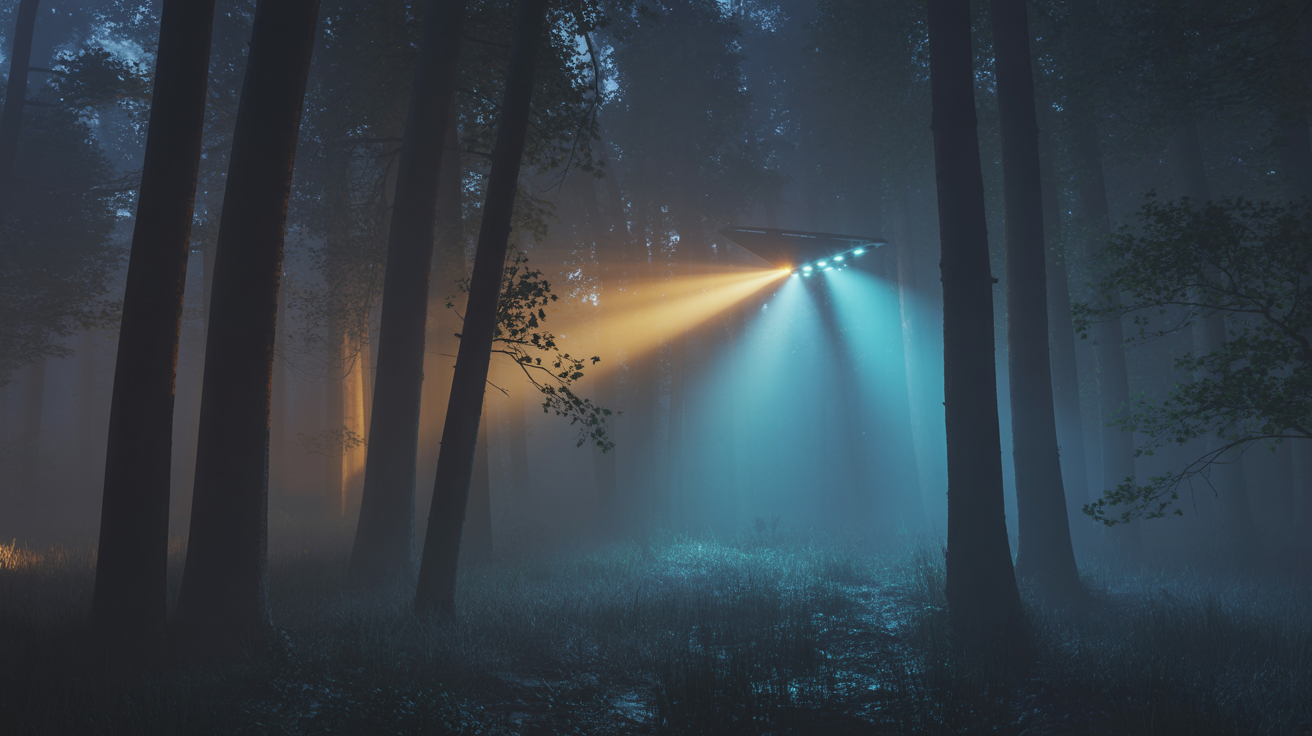
Staff Sergeant Jim Penniston and Airman John Burroughs were among the first to respond. As they approached the lights through the dense forest, they encountered something that defied conventional explanation: a triangular metallic craft, approximately nine feet across and six feet high, hovering silently among the trees. Penniston later reported touching the object's surface, which was warm and covered in strange hieroglyphic-like symbols.
Physical Evidence and Official Documentation
Unlike many UFO reports that rely solely on eyewitness testimony, the Rendlesham incident produced tangible evidence. The following morning, investigators found three depressions in the ground forming a triangular pattern where the craft had allegedly landed. Radiation readings at the site measured significantly higher than background levels—a detail that would be documented in the official report filed by Deputy Base Commander Lieutenant Colonel Charles Halt.
Halt's memo to the UK Ministry of Defence, released years later through Freedom of Information requests, described "unexplained lights" and confirmed the physical trace evidence. Even more remarkably, Halt led a second investigation on December 28 when the phenomena returned, this time recording his observations on audio tape as multiple witnesses watched beams of light pulse through the forest.
The Intelligence Perspective
During my years with the Agency, I learned that the most valuable intelligence often comes from credible witnesses with nothing to gain from fabrication. The Rendlesham witnesses were trained military observers with security clearances—individuals whose careers could be damaged by making outlandish claims. Yet they stood by their accounts despite professional risks and public ridicule.
What makes this case particularly intriguing from an analytical standpoint is the convergence of multiple data points: visual confirmation from numerous trained observers, physical trace evidence, radiation anomalies, and contemporaneous documentation. This isn't the pattern of mass hysteria or misidentification—it's the signature of a genuine anomalous event.
Unanswered Questions
Decades later, key questions remain. Why were U.S. military personnel encountering unknown craft near a NATO base housing nuclear weapons? What was the source of the radiation? And perhaps most puzzling: why did official investigations seem designed to minimize rather than investigate the incident?
The UK Ministry of Defence maintained for years that the event posed "no defence significance," yet internal documents suggest a far greater level of concern. The truth, as I've learned throughout my career, often lies not in official statements but in the questions authorities refuse to answer.
Legacy of the Forest
The Rendlesham Forest incident stands as a watershed moment in UFO research—a case where the evidence is too substantial to dismiss and too strange to fully explain. The witnesses have never recanted, the physical evidence was documented in real-time, and the official paper trail confirms that something extraordinary occurred in those dark woods.
Whether the craft was extraterrestrial, experimental military technology, or something else entirely, one thing is certain: on those December nights in 1980, trained military personnel encountered something that challenged our understanding of what's possible. And that mystery endures.
🛸 Video: The Rendlesham Forest Incident
A Knight Phenomena Investigation