The Paulding Light: Michigan's Unexplained Beacon in the Dark
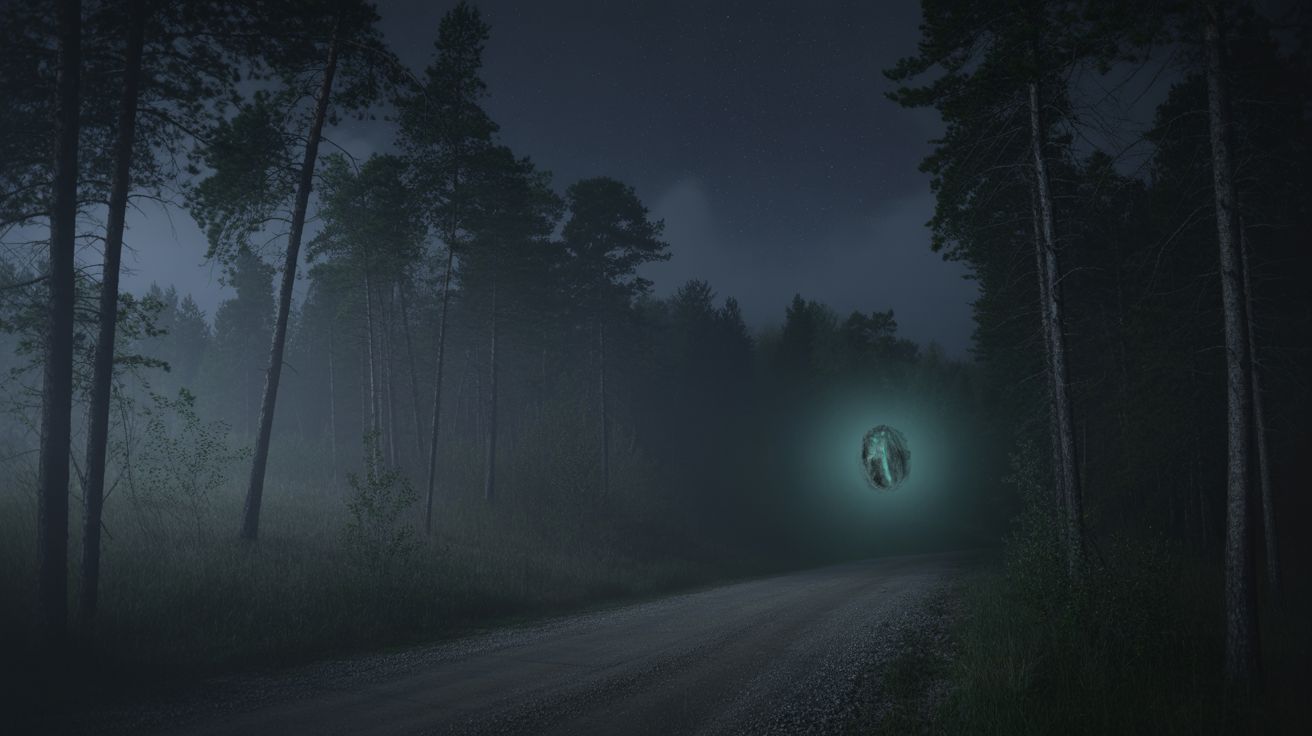
There is a gravel road in the Ottawa National Forest, deep in Michigan's Upper Peninsula, that ends at a wooden sign. The sign instructs you to park your car, face north, and wait. On most nights, you will not wait long. A light will appear in the distance—hovering, pulsing, sometimes splitting into multiple colors—moving in ways that defy easy categorization. It has been doing this, reliably, for more than fifty years. Thousands of people have seen it. Scientists have studied it. The U.S. Forest Service has acknowledged it. And nobody has produced a definitive explanation that survives serious scrutiny.
This is the Paulding Light, and it is one of the most persistently documented anomalous phenomena in the American Midwest.
The Record
The first widely reported sightings date to 1966, when a group of teenagers near Paulding, Michigan—a small community in Ontonagon County—reported a strange light moving through the valley below Robbins Pond Road. They contacted local law enforcement. Deputies came out, observed the light themselves, and filed a report. That report, to my knowledge, has never been satisfactorily closed.
What followed was decades of consistent witness testimony. The light appears most nights after dark. It typically manifests as a single white or yellowish orb, hovering above the tree line in a specific low-lying corridor. It has been observed to change color—shifting to red, occasionally green. It bobs. It swells and contracts. On some nights it appears stationary for extended periods; on others it moves laterally or seems to approach observers before retreating. Multiple witnesses on the same night, standing at the same observation point, have described the same behavior simultaneously.
The U.S. Forest Service eventually installed the wooden sign I mentioned—officially acknowledging the phenomenon and directing visitors to the designated viewing area. That is not a trivial detail. A federal agency does not erect permanent signage for something it considers a hoax or a one-time event.
The Folklore Layer
Every unexplained phenomenon accumulates mythology, and the Paulding Light is no exception. Local legend holds that the light is the ghost of a railroad brakeman killed in the valley in the early twentieth century, still swinging his lantern as a warning. Another version involves a mail carrier. A third attributes it to the spirit of a Native American dancer.
I note these stories not because I find them credible as literal explanations, but because they tell us something important: this light has been part of the regional consciousness long enough to generate multiple competing origin myths. That kind of cultural sediment takes time to accumulate. It suggests the phenomenon predates the 1966 formal reports by a considerable margin.
The Scientific Challenge
In 2010, a team of students from Michigan Technological University conducted what became the most cited scientific investigation of the Paulding Light. Using binoculars and careful observation, they concluded that the light was consistent with automobile headlights from US Highway 45, which runs through the area several miles from the observation point. Atmospheric refraction, they argued, could bend and distort the light in ways that explained the observed behavior.
It was a reasonable hypothesis, and it received significant media coverage. Case closed, many outlets declared.
Except it wasn't.
Several problems with the highway headlight explanation have been raised by subsequent observers and researchers. First, the Paulding Light has been documented on nights when the relevant stretch of highway was closed or had no traffic. Second, the light's behavior—particularly its lateral movement perpendicular to the highway's orientation, and its occasional approach toward observers—does not map cleanly onto what refracted headlights should do. Third, and most compellingly, longtime local observers note that the light's characteristics have remained consistent across decades, while traffic patterns and vehicle headlight technology have changed substantially.
Former Ontonagon County resident James Koski, who has observed the light dozens of times since the 1970s, told an interviewer in 2018: "I know what car headlights look like. I've been driving these roads my whole life. What I've seen out there doesn't move like headlights. It doesn't behave like headlights. The explanation never sat right with people who actually know this area."
I am not dismissing the Michigan Tech findings. Atmospheric optics can produce genuinely strange effects, and highway headlights remain a plausible partial explanation for some of what observers report. But a partial explanation is not a complete one, and the scientific community has largely moved on without resolving the discrepancies.
What the Data Actually Shows
Setting aside both folklore and the contested highway theory, here is what the documented record actually establishes:
The light appears with unusual regularity—far more consistently than weather-dependent phenomena like ball lightning or swamp gas. It has been observed in winter conditions, in rain, and in clear weather. It appears in a geographically specific corridor, which suggests either a fixed source or a fixed set of conditions that produce it. It has been observed simultaneously by multiple independent witnesses on hundreds of occasions, which rules out individual hallucination or misperception as a primary explanation.
The valley where the light appears sits over geological formations that include significant iron ore deposits—a feature shared with several other locations worldwide where anomalous lights have been reported, including the Hessdalen valley in Norway. Whether piezoelectric effects from geological stress, plasma phenomena, or some other earth-energy mechanism could produce a stable, recurring light source in such locations remains an open question in the scientific literature. It is not a fringe question. Researchers at institutions including Dartmouth and the University of Alberta have published peer-reviewed work on tectonic light phenomena. The Paulding corridor has not, to my knowledge, been formally studied from this angle.
My Assessment
I spent twenty-two years analyzing intelligence data for the CIA. The first thing that discipline teaches you is to distinguish between what you know, what you can reasonably infer, and what you are simply assuming. Applied to the Paulding Light, here is where I land:
I know the light exists and has been consistently observed for over fifty years. I know the highway headlight explanation accounts for some observations but not all of them. I know the geological context is potentially relevant and has not been adequately investigated. I do not know what the light is.
That last sentence is the honest one, and it is the one that keeps me interested.
The Paulding Light is not the most dramatic anomaly I have covered on this site. Nobody has died. No government cover-up is obviously implicated. But its very ordinariness—the fact that it shows up reliably, night after night, in a specific spot in the Michigan woods, and that fifty years of curious observers have not produced a universally accepted explanation—makes it, in some ways, more interesting than the headline-grabbing cases.
Unexplained things that happen once are curiosities. Unexplained things that happen every night are problems. And problems, in my experience, eventually yield to sustained, rigorous attention.
The sign at the end of Robbins Pond Road is still there. The light is still appearing. If you have observed it firsthand—particularly if you have documentation, timestamps, or observations that contradict or complicate the highway headlight theory—I want to hear from you. The investigation is open.
🔦 Video: The Paulding Light Michigans
A Knight Phenomena Investigation