The Pascagoula Abduction: The Most Credible UFO Case You've Never Fully Investigated
In my years at the Agency, I learned to distrust witnesses who were too composed. The ones who had their story perfectly packaged, who remembered everything in clean narrative arcs, who never contradicted themselves — those were the ones we watched most carefully. Real trauma produces something messier: fragmented recall, emotional dysregulation, the kind of physiological response you cannot fake in a room with trained observers.
By that standard, Charles Hickson and Calvin Parker were telling the truth about something.
What that something was remains one of the most genuinely unresolved questions in the history of anomalous phenomena. And after decades of treating the Pascagoula Abduction as a footnote to the UFO wave of 1973, the case deserves a harder, more systematic look.
The Setting: Mississippi, 1973
The early 1970s were a strange time in American culture — Watergate was unraveling, Vietnam was winding down in the worst possible way, and public trust in institutions was eroding at a pace that would have been unthinkable a decade earlier. The country was primed for paranoia, which is precisely why debunkers have always found it easy to dismiss the wave of UFO sightings that swept the United States in the fall of 1973.
But context cuts both ways. A culture saturated with anxiety and distrust is also a culture in which two working-class men from Pascagoula, Mississippi, had every reason not to report what they claimed happened to them on the evening of October 11th.
Charles Hickson was 42 years old, a foreman at the Walker Shipyard. Calvin Parker was 19, a recent hire. By all accounts, they were unremarkable men living unremarkable lives — exactly the kind of people who had nothing to gain and everything to lose by walking into the Jackson County Sheriff's Office and reporting that they had been abducted by extraterrestrial beings.
What They Reported
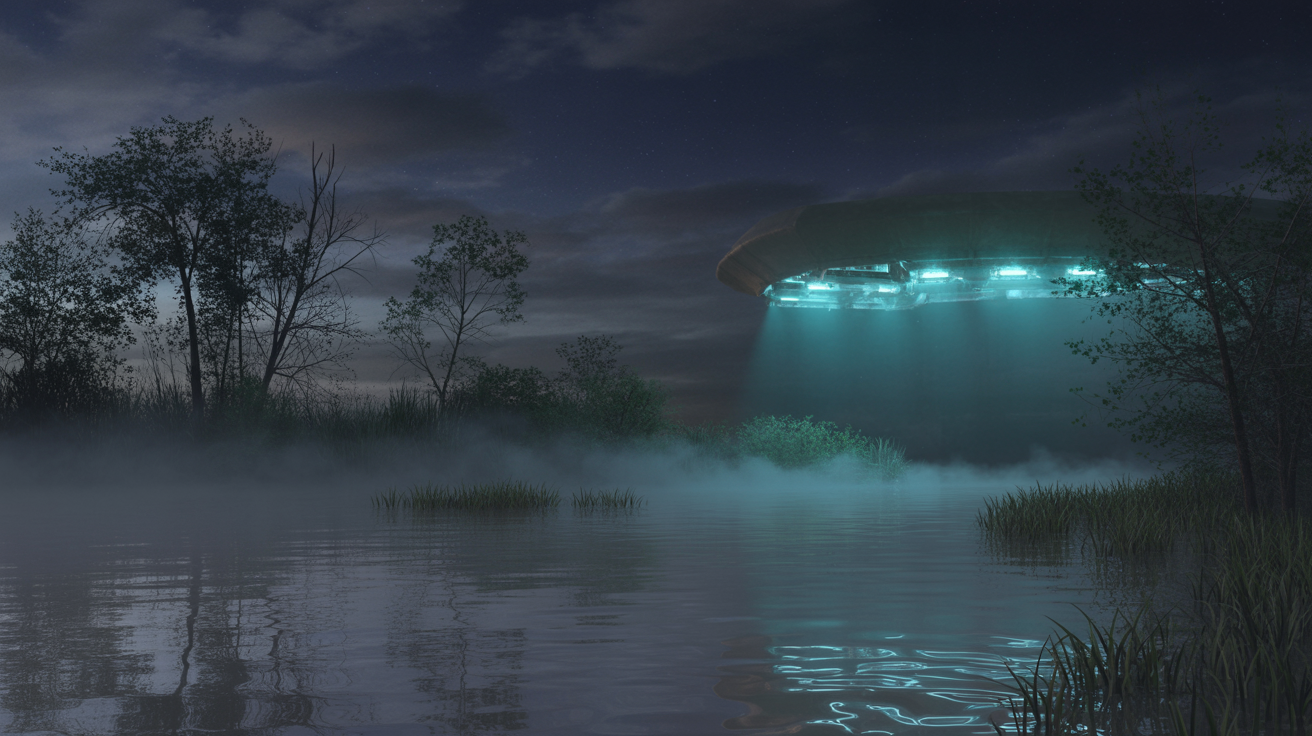
The two men told investigators they had been fishing off a pier on the west bank of the Pascagoula River, near the old Shaupeter Shipyard, when they noticed a blue light in the sky. According to their account, the light descended and resolved into an oval-shaped craft approximately 30 to 40 feet long, hovering just above the ground.
What emerged from the craft is where the story becomes genuinely strange — and where it diverges sharply from the humanoid alien archetypes that dominated UFO literature at the time.
Hickson described three beings, roughly five feet tall, with pale, wrinkled skin resembling an elephant's hide. They had no discernible neck. Where a face would be, there was only a cone-like protrusion where a nose might sit, and two smaller cones at the ears. Their hands, Hickson said, were like a crab's claw — mitten-like, with no individual fingers. Their feet, as far as he could tell, appeared fused together, and they moved in a floating, mechanical manner rather than walking.
Parker, who was younger and by his own later admission less emotionally equipped for what followed, fainted almost immediately. Hickson remained conscious throughout and reported being floated — not carried, floated — into the interior of the craft, where he was examined by what appeared to be a scanning device while suspended in mid-air. He described feeling no pain but an overwhelming paralysis. The entire encounter, he estimated, lasted roughly twenty minutes.
Then they were deposited back on the riverbank. The craft was gone.
The Sheriff's Office Recording
Here is where the Pascagoula case separates itself from the vast majority of abduction claims, and where my analyst's instincts engage most sharply.
Hickson and Parker drove to the Jackson County Sheriff's Office and reported the incident. Sheriff Fred Diamond and Captain Glen Ryder questioned them extensively. At some point — and accounts differ on whether this was deliberate or simply a matter of standard procedure — the two men were left alone in the interrogation room. What the investigators did not tell them was that the room was still being recorded.
The tape of that conversation has been analyzed by researchers for decades. It is not the conversation of two men coordinating a hoax.
"I got to get home and get to bed," Parker says at one point, his voice barely audible. "I'm not going to sleep when I get there. I know that."
"Calvin, when they brought you out — when they brought me out of that thing," Hickson says, "goddamn it, I hope they don't come back."
"I was so scared," Parker replies.
"Me too," Hickson says. "I can't take much more of this."
What strikes me about this exchange is not its drama but its ordinariness. These are not men performing for an audience. They are two people sitting in a fluorescent-lit government room at night, exhausted and frightened, talking the way people talk when they think no one is listening. The emotional register is consistent with acute stress response. Parker's dissociation — the fainting, the fragmented recall — is consistent with trauma, not theater.
I've sat across from people who were lying. The tape from Pascagoula doesn't sound like lying.
The Investigation That Followed
Dr. J. Allen Hynek, who had spent years as the U.S. Air Force's scientific consultant on UFO investigations and was by 1973 one of the most rigorous researchers in the field, traveled to Pascagoula and interviewed both men. His assessment was measured but notable: he found no evidence of fabrication and described the case as one of the most compelling he had encountered.
Dr. James Harder, a hydraulics engineer from the University of California Berkeley who had conducted extensive research into UFO reports, also interviewed the witnesses and later testified before the United Nations on the case. Harder attempted hypnotic regression with both men, a methodology that carries significant evidentiary caveats — hypnosis is not a truth serum, and recovered memories are notoriously unreliable — but the sessions produced details consistent with their original accounts rather than elaborating them into increasingly dramatic narratives, which is the typical pattern when subjects are confabulating.
The U.S. Air Force, which had officially closed Project Blue Book in 1969, had no institutional mechanism to investigate the case. The Aerial Phenomena Research Organization, one of the more rigorous civilian UFO groups of the era, conducted its own review and reached no definitive conclusion but noted the unusual consistency of the witnesses' accounts across multiple interviews.
Polygraph examinations were administered. Hickson passed. Parker was reportedly too distressed to complete a full examination — a detail that skeptics have flagged but which is also consistent with someone in a genuine state of acute psychological distress.
The Skeptical Case
Intellectual honesty requires engaging seriously with the counterarguments, and there are legitimate ones.
The fall of 1973 was the peak of what UFO researchers call the 1973 flap — a nationwide surge in sightings that almost certainly produced a corresponding surge in misidentifications, hoaxes, and psychologically influenced reports. The cultural saturation of UFO imagery meant that any unusual experience was likely to be interpreted through that lens.
The physical description of the beings — the crab-claw hands, the elephant skin, the absence of conventional facial features — is genuinely unusual and does not map neatly onto the alien archetypes of the era, which some researchers cite as evidence of authenticity and others cite as evidence of a more elaborate fabrication designed to seem credible through its very strangeness.
No physical evidence was recovered from the site. No other witnesses reported seeing the craft, though Hickson later claimed that a car had passed on a nearby bridge during the encounter. That driver, if they existed, was never identified.
And then there is the question of what the witnesses had to gain. This is where the skeptical case weakens considerably. Hickson and Parker did not profit meaningfully from their account for years. Parker, in particular, was so destabilized by the experience — and by the subsequent media attention — that he suffered what appears to have been a genuine psychological breakdown, dropping out of public life almost entirely for decades.
Calvin Parker's Silence — and What Broke It
For nearly forty years, Calvin Parker said almost nothing publicly about what happened on the Pascagoula River. He gave occasional interviews, but he consistently avoided the UFO conference circuit, the book deals, the speaking engagements that would have been available to him. He moved away from Mississippi, changed jobs repeatedly, and by most accounts lived a quiet, troubled life.
In 2018, Parker published a book — Pascagoula: The Closest Encounter — that provided the most detailed account of his experience he had ever offered. He was in his mid-sixties by then, and the book reads less like the work of a man capitalizing on a famous story than like someone who had spent decades trying to process something he still didn't fully understand.
Parker's account added details he had never previously disclosed, including a claim that after being returned to the riverbank, he experienced a secondary encounter in which one of the beings communicated with him — not through speech, but through what he described as a direct transfer of information. He was aware of how this sounded. He said so explicitly.
What I find analytically significant is the timing and the texture of the disclosure. Parker waited nearly half a century. He did not dramatically expand the scope of the original account in ways designed to maximize impact. He expressed consistent ambivalence about whether he wanted to be believed. These are not the behavioral markers of a long-running con.
The 1973 Wave: Context That Matters
The Pascagoula case did not occur in isolation. The fall of 1973 produced an extraordinary concentration of UFO reports across the United States and internationally, including the Coyne helicopter incident over Ohio in October of the same year — a case involving a U.S. Army Reserve crew that remains one of the most rigorously documented military UFO encounters on record.
Whether this wave represents a genuine increase in anomalous activity, a social contagion effect amplified by media coverage, or some combination of both is a question I cannot answer definitively. What I can say is that the sheer volume and geographic distribution of reports from that period is difficult to explain through simple mass hysteria. Trained military personnel, law enforcement officers, and ordinary civilians across dozens of states reported similar phenomena within weeks of each other, often with no apparent awareness of other reports.
The Pascagoula case sits at the center of this wave, and its evidential weight is strengthened, not weakened, by that context.
What the Physical Description Tells Us
I want to spend a moment on the beings themselves, because this is where the case gets genuinely strange in ways that are analytically interesting rather than merely sensational.
The entities Hickson described — wrinkled, pale, claw-handed, with cone-like facial features and a floating locomotion — bear almost no resemblance to the dominant alien archetypes of 1973. The Greys, the tall Nordics, the insectoid beings that populate most abduction literature were well-established in the cultural imagination by that point. A hoaxer drawing on available cultural material would almost certainly have produced something more recognizable.
What Hickson described sounds, frankly, more like something from a fever dream than from a science fiction film. The robotic movement, the absence of conventional anatomy, the clinical efficiency of the examination — these details have a texture that is difficult to attribute to creative fabrication, particularly from a 42-year-old Mississippi shipyard foreman in 1973.
This proves nothing. But it is a data point worth holding.
The Unresolved Questions
After reviewing the available evidence — the witness testimony, the hidden recording, the investigator assessments, Parker's decades of silence and eventual disclosure — I am left with several questions that I cannot answer:
- If Hickson and Parker fabricated the encounter, what was their motive, and why did Parker spend forty years avoiding the attention that would have rewarded a successful hoax?
- If the encounter was a misidentification of a natural or man-made phenomenon, what phenomenon produces the specific physiological and psychological responses both men exhibited, and what did they actually see?
- If the encounter was genuine, what were the beings, where did they come from, and why Pascagoula, Mississippi, on an October evening in 1973?
- And perhaps most importantly: why has this case, which meets more of the conventional evidentiary standards for serious investigation than almost any other abduction claim on record, received so little sustained analytical attention from institutions with the resources to investigate it properly?
My Assessment
I don't deal in certainties on this site. What I deal in is the honest evaluation of available evidence, applied with the same analytical discipline I brought to counterterrorism work at the Agency.
The Pascagoula Abduction is not a solved case. It is not a proven hoax, and it is not a proven extraterrestrial encounter. What it is, on the available evidence, is one of the most credible and least adequately investigated anomalous events in the modern record.
The hidden recording alone — two frightened men talking to each other in a room they believed was empty — constitutes a form of evidence that is extraordinarily rare in this field. You cannot easily fake that kind of conversation. You cannot sustain that level of authentic distress as a performance when you believe the audience has left.
Charles Hickson died in 2011, maintaining his account until the end. Calvin Parker is still alive. The Pascagoula River is still there. The pier is gone, but the location is documented.
Whatever happened on that riverbank fifty years ago, it happened to real people. It changed their lives in ways that do not fit the profile of a successful hoax. And it remains, by any honest measure, unexplained.
That's enough for me to keep the file open.
🛸 Video: The Pascagoula Abduction Most
A Knight Phenomena Investigation