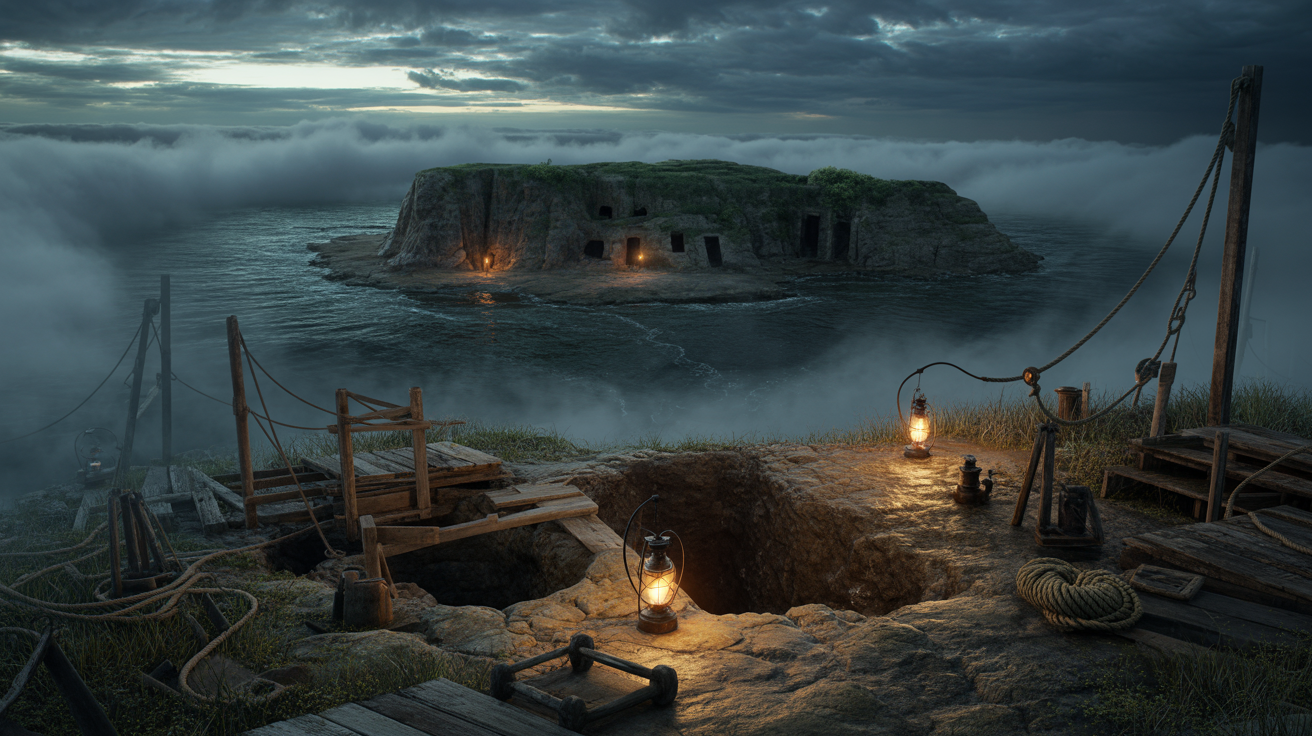
The Oak Island Mystery: Treasure, Tunnels, and Two Centuries of False Starts
Some mysteries persist because they are dramatic. Others endure because they are profitable. Oak Island is unusual because it is both: a place where generations of searchers have chased the idea of buried treasure, and where each failure seems to create a new layer of legend rather than close the case.
The island sits off the coast of Nova Scotia, modest in size and apparently ordinary in character. Yet since the late 1700s, it has been the subject of one of North America’s longest-running treasure hunts. The story begins with a depression in the ground, a few early diggers, and the belief that someone had gone to extraordinary lengths to hide something valuable underground. Everything that followed—collapse, flooding, rumors of booby traps, and a growing catalog of discoveries—turned a local curiosity into a global obsession.
The Original Hole
The core of the Oak Island mystery is the so-called Money Pit. According to the classic version of the story, a group of young men found signs that the ground had been disturbed and began digging. As they went deeper, they reportedly encountered layers of logs or platforms at regular intervals. That detail became central to the legend: not simply that something was buried, but that it had been engineered to resist recovery.
Over time, the tale grew more elaborate. Searchers claimed to find flood tunnels, stones with markings, coconut fiber, and strange deposits in the earth. Each generation inherited the same basic premise: there was something down there, and someone had built an elaborate system to protect it.
That story has a powerful gravitational pull. It sounds too organized to be natural, too persistent to be random. But the first thing an investigator has to ask is whether later interpretation has overtaken the original evidence. Oak Island’s reputation was built in a culture of oral retelling, enthusiastic speculation, and repeated excavation. That combination is ideal for creating legend—and terrible for establishing certainty.
Why the Story Spread
Oak Island became famous because it offered a rare kind of mystery: one that could be pursued with shovels, charts, pumps, and engineering plans. Unlike ghost stories or UFO sightings, this was a physical puzzle. Something tangible might exist beneath the ground, and physical things leave traces.
That made the island irresistible to treasure hunters, investors, and amateur historians. Over the decades, theories multiplied. Some claimed the treasure was pirate loot. Others proposed hidden gold from the Knights Templar, secret works by the French, or documents tied to Shakespeare, Bacon, or the Freemasons. The list is almost a history of what people wanted to believe most urgently in their own era.
But most of those theories do not begin with evidence. They begin with a conclusion and search backward for a fitting story. That does not mean the island is empty of anomalies. It means the anomalies have been wrapped in narrative so many times that separating observation from embellishment is difficult.
“A mystery becomes more valuable when it can survive disappointment.” Oak Island has survived a great deal of it.
What Has Actually Been Found
One of the reasons Oak Island remains compelling is that it has produced real artifacts, though not necessarily the kind that prove a lost hoard. Over the years, searchers have reported discovering old tools, fragments of wood, bits of metal, and various objects that suggest human activity on the island long before modern excavation.
That matters. It is not proof of buried treasure, but it is evidence that the island has a history more complicated than a simple abandoned shoreline. The challenge is scale and context. A nail, a piece of chain, or a coin does not tell you who put it there, when, or why. In a place that has been dug, re-dug, flooded, and disturbed for centuries, context becomes the rarest commodity.
There is also the problem of contamination. Once a site becomes famous, the act of searching changes the site itself. Machinery opens new shafts. Spoil piles are moved. Old layers are mixed with new ones. Items that should have helped solve the mystery can become part of the mystery’s confusion instead.
The Flooding Problem
One reason Oak Island has fascinated engineers as much as treasure hunters is the water. Accounts of the search repeatedly mention flooding that seemed to arrive too efficiently to be accidental. That gave rise to one of the most enduring ideas in the Oak Island story: that man-made tunnels or drains were deliberately built to protect whatever lay below.
It is a dramatic theory, and not impossible in the abstract. People have built sophisticated concealment systems throughout history. But Oak Island also sits in a coastal environment where groundwater, soil structure, and tidal influence can create difficult excavation conditions without any conspiracy at all. A site that floods easily can look deliberately defended even when geology is doing the work.
This is the central tension of the Oak Island case. Every strange feature can be read two ways. It can be the work of hidden hands, or the result of a very complicated piece of land that has been repeatedly disturbed by human beings looking for something that may never have been there in the first place.
Why It Won’t Die
Most mysteries end because the evidence runs out. Oak Island endures because the evidence is enough to sustain hope, but not enough to settle it. That is the perfect fuel for a long-running search.
There is also a psychological element that investigators see in many unsolved cases: the deeper the investment, the harder it becomes to accept an ordinary explanation. Once people have spent money, labor, and years of their lives on a question, the idea that the answer may be underwhelming can feel almost insulting. The search becomes its own form of proof.
And yet, Oak Island remains open in a meaningful sense. No one can say with confidence that nothing important was ever buried there. The island has yielded genuine historical clues, and the scale of effort devoted to it suggests that at minimum, something unusual happened in its past. What is missing is the bridge between anomaly and certainty.
The Most Important Question
In the end, Oak Island may not be about treasure at all. It may be about the human refusal to let a compelling pattern go unresolved. A pit, a flood, a few old objects, a century of stories—that is enough to keep a mystery alive far longer than proof alone would allow.
The sober conclusion is also the most frustrating one: Oak Island is not a solved case, but neither is it evidence of a grand hidden civilization or a guaranteed cache of royal gold. It is something more durable than that. It is a place where ordinary ambiguity was transformed into a national obsession and then handed down, generation after generation, until the search itself became part of the legend.
That may not satisfy the treasure hunter’s instinct. But for anyone trying to separate fact from folklore, it is the real story. Oak Island persists because it occupies the narrow space between what has been found and what has never been proven. That is where many mysteries live. Few survive this long.
💎 Video: The Oak Island Mystery
A Knight Phenomena Investigation