The Nazca Lines: Ancient Runways or Sacred Pathways?
In my years at the CIA, I learned to read patterns in satellite imagery—troop movements, supply routes, infrastructure changes invisible from ground level. But nothing in my training prepared me for the patterns etched into the Nazca Desert of southern Peru: hundreds of massive geoglyphs, some stretching over 1,200 feet, created between 500 BCE and 500 CE by a civilization that had no way to see them from above.
The Nazca Lines are one of archaeology's most persistent enigmas. Not because we don't know who made them—the Nazca culture is well-documented—but because their purpose and method of construction challenge our assumptions about ancient capabilities and motivations.
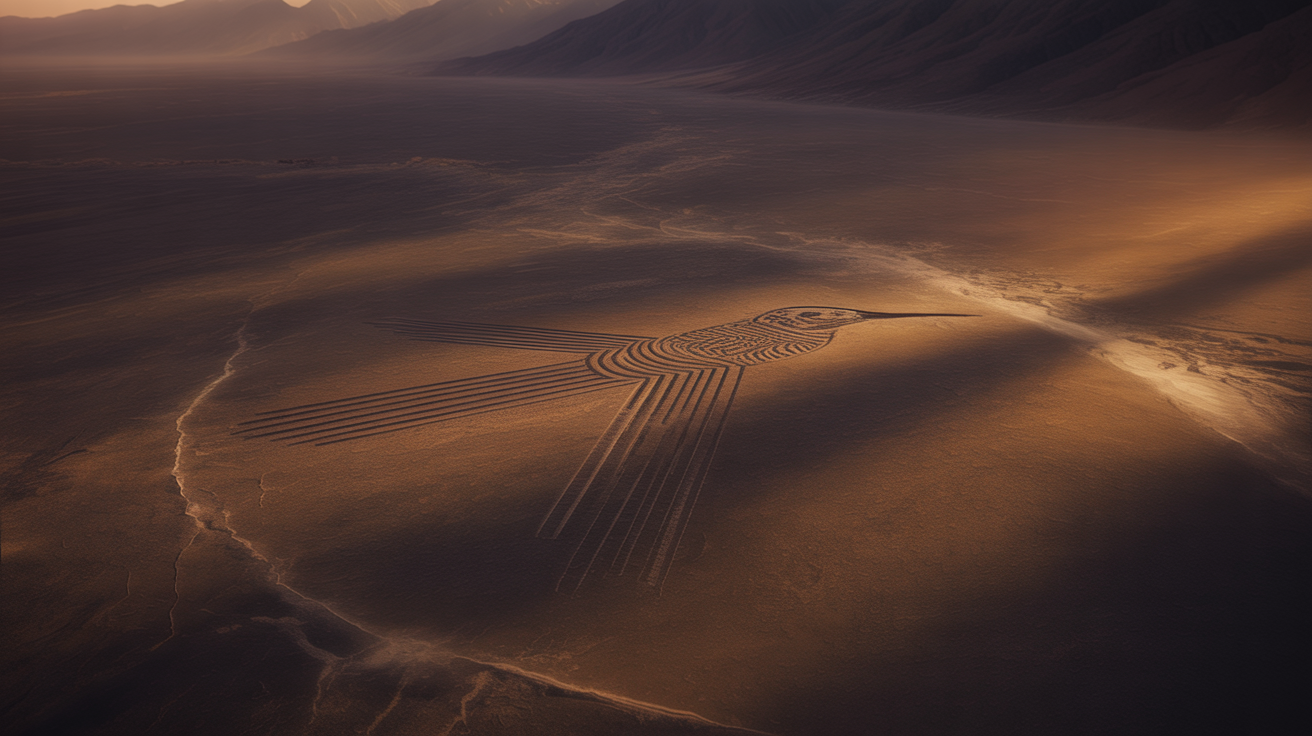
The lines were first documented in the 1920s when commercial airlines began flying over the Peruvian coast. Pilots reported seeing enormous figures carved into the desert floor: a spider, a hummingbird, a monkey with a spiraling tail. Geometric shapes—trapezoids, triangles, and perfectly straight lines—stretched for miles across the arid plateau.
What makes these geoglyphs remarkable isn't just their size, but their precision. The hummingbird, for instance, measures 305 feet from beak to tail, yet its proportions are nearly perfect. The spider is anatomically accurate enough that arachnologists identified it as a member of the genus Ricinulei, a rare species found only in remote Amazon rainforest regions—hundreds of miles from Nazca.
How did a pre-Columbian civilization create images that can only be fully appreciated from an altitude they could never reach?
The most famous researcher of the Nazca Lines was Maria Reiche, a German mathematician who dedicated her life to studying and preserving the geoglyphs. She arrived in Peru in 1932 and spent the next five decades mapping the lines, sleeping in a tent on the desert floor, using a ladder and compass to trace the figures.
Reiche's work revealed something crucial: the Nazca people created these massive designs using surprisingly simple technology. They removed the reddish pebbles covering the desert surface to expose the lighter-colored ground beneath. The desert's extreme aridity—it receives less than an inch of rain per year—preserved the lines for centuries.
But knowing how they were made doesn't explain why.
The most sensational theory came from Swiss author Erich von Däniken, who proposed in his 1968 book Chariots of the Gods? that the lines were ancient runways for extraterrestrial spacecraft. The theory captured public imagination but collapsed under scientific scrutiny. The desert floor is far too soft to support any aircraft, and the lines themselves are shallow trenches, not reinforced surfaces.
More credible theories focus on the lines' astronomical and religious significance. Reiche herself believed many lines aligned with celestial events—solstices, equinoxes, and the rising and setting of certain stars. The Nazca culture was deeply agricultural, dependent on seasonal rains and river flows. Tracking celestial patterns would have been crucial for predicting weather and planning crops.
However, astronomer Gerald Hawkins, who studied Stonehenge's astronomical alignments, analyzed 186 Nazca lines and found that only 20 percent showed any significant astronomical correlation—no better than random chance.
Anthropologist Johan Reinhard offered a different interpretation: the lines were sacred pathways, part of an elaborate ritual landscape. The Nazca people, like many Andean cultures, practiced mountain worship. The lines, he argued, pointed toward sacred peaks and water sources. In a desert environment, water was literally life, and the geoglyphs may have been offerings to mountain deities who controlled rainfall.
This theory gains support from archaeological evidence. Researchers have found pottery shards, shells, and other offerings along many of the lines, suggesting they were walked as part of religious ceremonies. The animal figures—condors, spiders, hummingbirds—all held symbolic meaning in Andean cosmology.
Recent research using drones and satellite imagery has revealed even more complexity. In 2019, Japanese researchers announced the discovery of 143 new geoglyphs using artificial intelligence to analyze high-resolution images. These included humanoid figures and domestic animals, suggesting the lines served multiple purposes over centuries of use.
What fascinates me from an analytical perspective is the organizational capacity required. Creating a 1,200-foot-long figure with consistent proportions demands planning, coordination, and a method for maintaining perspective without aerial view. Some researchers suggest the Nazca used scale models and a grid system, expanding small designs to massive proportions using ropes and stakes.
But this raises another question: why invest such enormous effort in images that couldn't be seen in their entirety? The answer may lie in understanding a fundamentally different worldview. The Nazca people didn't need to see the complete figures—their gods did.
In many ancient cultures, monumental architecture and art served as communication with the divine. The pyramids of Egypt, the temples of Angkor Wat, the cathedrals of medieval Europe—all were designed to impress and honor deities, not human observers. The Nazca Lines may represent the same impulse: creating sacred art on a scale worthy of the gods who looked down from the mountains and sky.
There's also evidence that the lines evolved over time. Earlier geoglyphs tend to be figurative—animals and plants—while later ones are increasingly geometric. This suggests changing religious practices or astronomical knowledge, a civilization adapting its sacred landscape to new understandings.
The Nazca culture itself collapsed around 500 CE, possibly due to prolonged drought or environmental degradation. They left no written records, no explanation for their desert drawings. The lines remained, visible but largely ignored, until the age of flight revealed them to modern eyes.
Today, the Nazca Lines face new threats. Climate change is bringing unprecedented rainfall to the region, eroding the delicate geoglyphs. Illegal mining and urban expansion encroach on the protected area. In 2014, Greenpeace activists damaged the site while placing a banner near the hummingbird figure, leaving footprints that may take decades to fade.
UNESCO designated the Nazca Lines a World Heritage Site in 1994, but preservation remains challenging. The same aridity that protected the lines for 2,000 years makes the region attractive for development and agriculture.
What can we conclude about the Nazca Lines? They were likely multifunctional: astronomical markers, ritual pathways, offerings to mountain deities, and expressions of cultural identity. They demonstrate that ancient peoples were capable of remarkable feats of planning and execution, even without modern technology.
But perhaps the most important lesson is humility. We may never fully understand the motivations of the Nazca people. Their worldview, their relationship with the landscape and cosmos, was fundamentally different from ours. The lines remind us that human ingenuity and spiritual expression take forms we're still learning to comprehend.
Standing on the observation tower at Nazca, looking out over the spider and the hummingbird, I'm reminded that mystery isn't always a puzzle to be solved. Sometimes it's an invitation to imagine possibilities beyond our current understanding—to recognize that ancient peoples were not primitive versions of ourselves, but sophisticated cultures with their own complex ways of seeing and shaping the world.
The Nazca Lines endure, silent and enigmatic, waiting for each generation to bring new questions and new technologies to their interpretation. What will we discover next? And what will those discoveries reveal—not just about the Nazca, but about ourselves?
📐 Video: The Nazca Lines Ancient
A Knight Phenomena Investigation