The Lubbock Lights: Texas Skies, Cold War Anxiety, and the Problem of Seeing What Isn’t There
I have spent a career separating signal from noise, and very few cases illustrate that struggle better than the Lubbock Lights. In the summer of 1951, a tight cluster of brilliant objects appeared over West Texas, observed by multiple witnesses and captured in a now-famous set of photographs. The incident has become a staple of UFO literature, but the historical value of the case is not whether one prefers a sensational answer. The real question is simpler and more difficult: what, exactly, did trained and untrained observers see in the skies over Lubbock, and how much confidence can we place in the evidence?
As with so many aviation and aerial anomaly reports, the Lubbock Lights sit at the intersection of ordinary physics, human perception, and Cold War-era suspicion. The case is old enough to have acquired mythology, but the underlying file remains instructive because it includes something rare: contemporaneous witness accounts, a set of photographs, and official attention from the Air Force. That combination gives us enough material to analyze the event without surrendering to either cynicism or credulity.
Historical Background
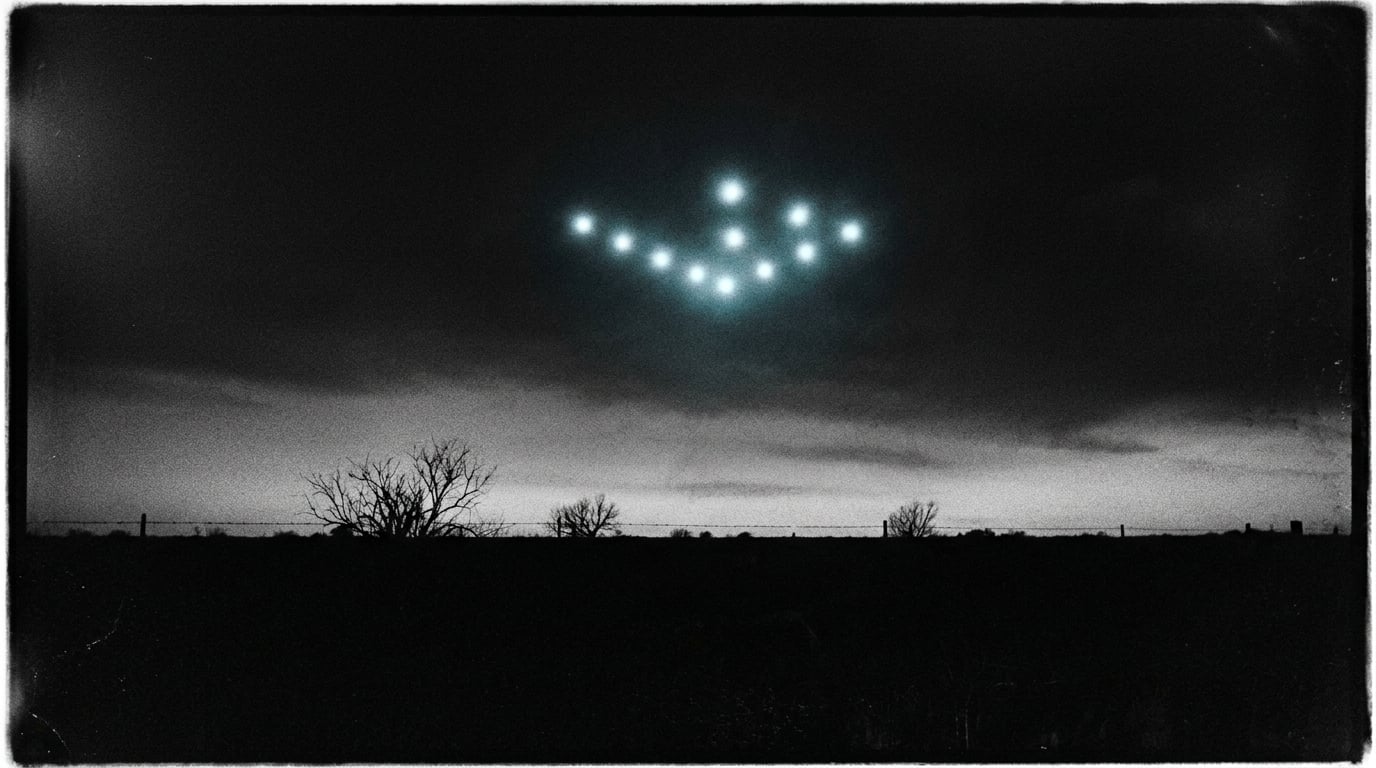
The sightings began in the summer of 1951, centered around Lubbock, Texas. The most famous night occurred on August 30, when several men reportedly observed a formation of lights flying silently overhead. The witnesses were not all identical in what they described, but the recurring theme was a V-shaped or arc-shaped arrangement of luminous objects moving at high speed. This mattered because the sighting occurred during an era when reports of “flying saucers” were already embedded in the American imagination, only four years after the Kenneth Arnold sighting had ignited the modern UFO age.
Lubbock itself was not an obscure location. It was an important West Texas city with airfields, military activity nearby, and open skies that invited long-distance observation. In that setting, any unusual aerial phenomenon would be scrutinized immediately, if only because the early 1950s were an age of radar, jets, and atomic dread. People were not merely looking up at the sky; they were interpreting it through the lens of national insecurity.
The principal witnesses associated with the most famous photographs were three professors from Texas Technological College: Dr. W.L. "Bill" Levell, Dr. A.J. Hedrick, and Dr. R.H. Cross are often referenced in secondary discussions, though the core photo series is most closely tied to Dr. W. L. McDonald and Paul C. Jones in some retellings. What matters for the investigator is not simply the names but the quality of observation: educated men, accustomed to careful judgment, watching a bright formation from a dark sky. That sounds compelling, but expertise in one domain does not immunize a witness against optical error in another.
The Famous Photographs
The photographs are the heart of the case. Taken by a young Texas Technological College student, Paul Trent, the images show a series of luminous objects arranged in a loose arc or V formation. They are grainy, stark, and frustratingly ambiguous. Ambiguity, of course, is the currency of UFO cases. A photograph that is too clear often ends the mystery; a photograph that is too vague prolongs it indefinitely.
Trent and his wife reportedly saw the lights overhead and rushed inside to retrieve a camera. The resulting images were published and widely discussed. Supporters of the extraterrestrial hypothesis point to the fact that multiple exposures appear to show a formation maintaining an apparent pattern, suggesting coordinated movement rather than random flare or astronomical illusion. Skeptics counter that the objects could be birds illuminated by city lights or the moon, with the formation an artifact of motion blur, exposure timing, and observer expectation.
From an intelligence perspective, photographs are not proof; they are leads. A photograph is only as good as the context surrounding it. Without knowing focal length, exposure duration, altitude, distance, atmospheric conditions, and the exact geometry of the scene, the image alone cannot bear the weight of extraordinary conclusions. In other words: the photograph may be real, but the explanation is still not embedded in the emulsion.
Witness Accounts and Their Value
Witness testimony in the Lubbock case is important because it was not limited to one isolated observer. Several people reportedly saw the lights, and the professors gave the case a level of credibility that helped it persist. One witness described the objects as moving rapidly and silently in formation. Others noted a bluish-white glow. Some accounts suggest the lights appeared to be at a high altitude; others imply they were closer than that. These inconsistencies are not unusual. They are, in fact, expected.
Here is what professional analysis tells us: when people see unfamiliar lights at night, the brain performs rapid pattern recognition. It will try to impose shape, direction, and purpose on incomplete information. A formation of birds reflecting urban illumination can appear structured and purposeful. A line of insects, aircraft, or even stars distorted by atmospheric conditions can become a procession. Once the first witness says “formation,” the rest of the group is often anchored to that frame.
The central problem in aerial sightings is not that people lie. It is that people interpret.
That does not mean the witnesses were mistaken in a careless sense. It means their perception was mediated by conditions that make reliable estimation difficult: darkness, distance, speed, unfamiliar silhouettes, and the social reinforcement of group observation. In intelligence work, a multi-witness event increases interest, but it does not automatically increase certainty. Multiple witnesses can corroborate a genuine event or collectively amplify a shared misperception.
Official Attention and the Air Force Angle
The Lubbock Lights drew the attention of the Air Force, then operating within the broader framework of Project Blue Book and its predecessors. Officially, the military was interested in aerial reports because the early Cold War demanded vigilance. Anything unfamiliar in the sky could, in theory, be a Soviet aircraft, a test platform, or an atmospheric anomaly. That basic reality gave many UFO cases their cultural force: uncertainty itself was politically charged.
Various official and semi-official explanations were proposed over time. One of the most persistent was that the lights were simply birds, most likely plovers or similar species, illuminated by city lights from below and moonlight from above. Birds in flight can form loose patterns, shift abruptly, and maintain altitude over long distances. When viewed in darkness, especially by observers not expecting avian targets, they can create the illusion of intelligent movement.
This explanation is not glamorous, but it fits several important facts. First, birds can appear as bright points of light when viewed from the correct angle and under the right illumination. Second, a flock can seem to move in formation without being rigidly geometric. Third, the city of Lubbock and its surrounding lighting conditions could have produced exactly the sort of reflective effect that would make dark bodies appear luminous.
Still, there is a weakness in the bird hypothesis that must be acknowledged: it does not perfectly account for all reported aspects of the sightings, especially if some witnesses accurately described high-speed movement or unusual silence. The question is whether those discrepancies justify abandoning the terrestrial explanation. My answer is no—not unless the evidence compels us to do so.
Alternative Theories
Over the years, the case has attracted several alternative theories, ranging from experimental aircraft to extraterrestrial craft. None has solved the problem conclusively.
1. Birds with optical enhancement
This remains the most practical explanation. Birds can form a V, can reflect city lights, and can be photographed as bright objects under long exposure or imperfect focus. The apparent speed may be exaggerated by the lack of reference points in the night sky. A flock crossing a luminous background can seem like a disciplined aerial unit.
2. Aircraft or military activity
In 1951, America was awash in jet experimentation and military secrecy. Could the Lubbock Lights have been aircraft? The formation described by witnesses and the silent movement reported in some accounts do not fit standard aircraft traffic well. That said, militarized skies are always more complex than the public realizes, and speculative conclusions should never be ruled out solely because an explanation is convenient.
3. Astronomical or atmospheric effects
Reflections, temperature inversions, and unusual atmospheric layers can distort perception. Yet the repeated reports of structured movement make a purely astronomical explanation less satisfying. The lights were not described as fixed celestial objects. They behaved like moving things, which pushes us back toward terrestrial or technological causes.
4. Extraterrestrial visitation
This is the favorite of the enthusiasts and the least responsible conclusion based on the available record. The Lubbock Lights do not require visitors from another star system. They require only an unfamiliar but ordinary source of light, observed under poor night conditions by sincere people whose brains did what brains do: they searched for meaning.
The Evidence in Context
When assessing the Lubbock Lights, I evaluate the case the same way I would evaluate any intelligence report: source reliability, environmental conditions, corroboration, and alternative explanations.
- Source reliability: The principal witnesses were not sensationalists. That improves credibility, but sincerity is not the same as accuracy.
- Environmental conditions: Night observation, distance, and lack of stable reference points severely weaken certainty.
- Corroboration: There were multiple witnesses and photographs, which is significant. Yet all the evidence points to the same event, not necessarily to the same correct interpretation.
- Alternative explanations: The bird hypothesis remains strong because it accounts for formation, illumination, and motion better than the exotic theories.
One of the most important lessons in evidence analysis is that the presence of a photograph does not eliminate ambiguity; it can sometimes deepen it. People often assume photographs freeze truth. In reality, they freeze one perspective of truth under specific conditions that may be poorly understood. The Lubbock photographs are persuasive only if one begins by assuming a non-terrestrial cause. If one begins with ordinary nocturnal optics, they become much less mysterious.
Why the Case Still Matters
The Lubbock Lights endure because they are a good case, not because they are a solved one. They contain the essential ingredients of a durable mystery: credible witnesses, visual evidence, official interest, and a haunting visual profile. They also emerged during a period when Americans were primed to expect secrets in the sky. That cultural context is not incidental. It is the atmosphere in which the event occurred.
Cases like this teach us how rumors become legends. A genuine sighting, perhaps of birds or a terrestrial phenomenon, is observed by respectable people. Photographs are taken. Officials take notice. Newspapers amplify the story. Later writers strip away the uncertainty and leave behind only the dramatic skeleton. After a few decades, the event is no longer a record of perception; it becomes a myth of contact.
I am not interested in debunking for the sake of contempt. I am interested in resisting the seductive shortcut from mystery to conclusion. The skies over Lubbock may well have contained an unusual but mundane phenomenon. That is often where the truth lives: not in the fantastic, but in the half-seen, the misread, the overinterpreted.
Comparisons to Other UFO Cases
The Lubbock Lights share features with many classic aerial cases. Like the Nimitz encounter or the Kaikoura lights, they rely heavily on witness interpretation of luminous objects under difficult observational conditions. Unlike those later cases, the Lubbock incident occurred before modern digital capture and before the public had developed a more sophisticated vocabulary for aerial uncertainty. That makes the historical record both valuable and limited.
In older cases, we must always ask whether the event itself was extraordinary or whether the reporting environment made it seem so. The answer is often both. People see something real, then build a story around it. The story may outlive the phenomenon by decades.
The Knight Assessment
My professional conclusion is straightforward: the Lubbock Lights are a legitimate historical mystery, but not strong evidence of extraterrestrial visitation. The witness testimony deserves respect, and the photographs deserve study, but neither compels an exotic explanation. The most plausible account remains that observers saw birds or another ordinary airborne phenomenon under unusual lighting conditions, then interpreted the event through the cultural anxieties of the early Cold War.
Could there be details we do not fully understand? Certainly. That is the honest position. But uncertainty is not permission to leap into fantasy. The burden of proof rests on the extraordinary claim, and in this case that burden has not been met. What remains is a compelling, atmospheric, and still somewhat unsettling reminder that the human eye is both a marvel and a liability.
The Lubbock Lights are less a visitation than a warning: in the dark, certainty is fragile, and the sky can make fools of the attentive.