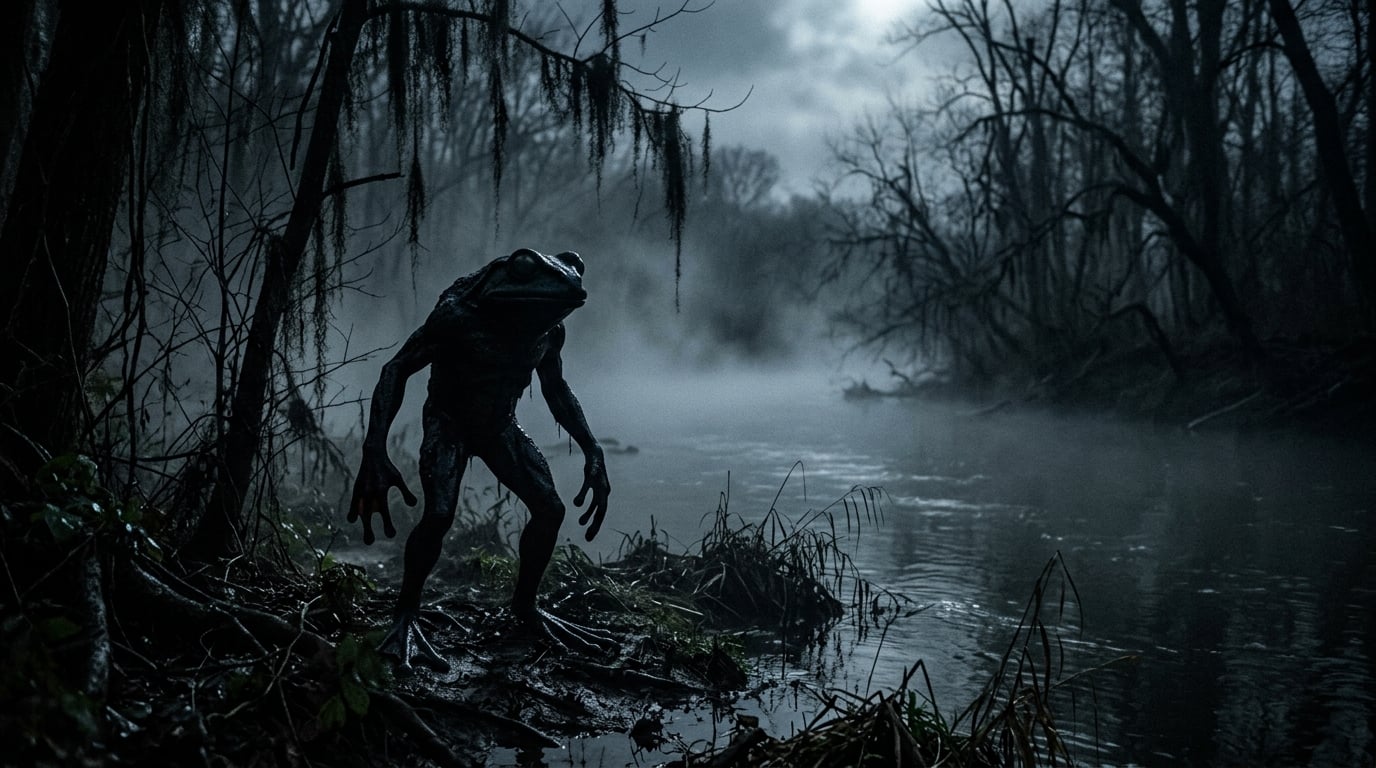
The Loveland Frogmen: Ohio's Bipedal Amphibian Encounters
I've spent years analyzing witness testimony under pressure. I know what fabrication looks like, what mass hysteria sounds like, and what happens when trained observers report something that doesn't fit the paradigm. The Loveland Frogmen case sits in that uncomfortable third category—multiple sightings, separated by years, involving witnesses with no apparent motive to lie, describing something that shouldn't exist.
This isn't folklore passed down through generations. This is a concentrated series of encounters in a specific location, reported by people who had everything to lose by going public. And the details are disturbingly consistent.
The 1955 Encounter: A Businessman's Report
The first documented encounter occurred in May 1955, along a lonely stretch of road near the Little Miami River in Loveland, Ohio. An unnamed businessman was driving home around 3:30 a.m. when he spotted what he initially thought were three men crouched by the roadside.
As he slowed his vehicle, the figures stood upright. What he saw next would haunt him enough to file a police report: three bipedal creatures, approximately three to four feet tall, with leathery skin described as gray-green in color. Their heads were disproportionately large, with wide mouths and wrinkled faces that witnesses compared to frogs. No clothing. No tools. Just three entities standing in the pre-dawn darkness, staring back at him.
The businessman watched them for several minutes. One of the creatures allegedly raised what he described as a wand or rod-like object above its head, which emitted sparks. Moments later, all three creatures moved toward the river and disappeared into the darkness.
He drove directly to the Loveland Police Department and filed a report. The officer who took his statement noted that the man appeared genuinely shaken, showed no signs of intoxication, and had no history of mental illness or attention-seeking behavior. The report was filed and largely forgotten—until seventeen years later.
March 3, 1972: Officer Ray Shockey's Sighting
On the night of March 3, 1972, Loveland Police Officer Ray Shockey was patrolling Riverside Drive near the Little Miami River around 1:00 a.m. As he rounded a curve, his headlights illuminated something crouched on the road ahead.
Shockey initially thought it was a dog that had been struck by a vehicle. He slowed to investigate. The creature turned its head toward the patrol car, then stood upright on two legs. Shockey later described it as three to four feet tall, weighing between 50 and 75 pounds, with leathery skin and a face that resembled a frog or lizard.
The creature stared at Shockey for several seconds before moving to the guardrail, stepping over it, and descending the embankment toward the river. Shockey watched it disappear into the darkness. He immediately radioed the incident to dispatch and returned to the station to file a formal report.
This wasn't a civilian with a wild story. This was a trained police officer, on duty, reporting what he'd seen through official channels. The report was logged, documented, and became part of the public record.
March 17, 1972: Officer Mark Matthews Confirms
Two weeks later, on March 17, 1972, Officer Mark Matthews was driving along the same stretch of Riverside Drive. He spotted what appeared to be an animal lying in the road. As he approached, the creature stood on two legs and began moving toward the guardrail.
Matthews exited his vehicle and drew his weapon. He fired at the creature, though he later stated he believed he missed. The entity went over the guardrail and down the embankment. Matthews retrieved what he thought was the body—but it turned out to be a large iguana, missing its tail.
This is where the official narrative fractures. Matthews later claimed that the iguana was all he'd seen, that there was no bipedal creature, and that the incident had been exaggerated. In a 2016 interview with Cincinnati Magazine, Matthews stated he'd shot an escaped pet iguana and that the "Frogman" story had been blown out of proportion.
But here's the problem: Matthews' original report described a bipedal creature that stood and moved on two legs. Iguanas, even large ones, do not walk upright for extended distances. And his account matched Shockey's sighting from two weeks earlier—before the two officers had compared notes in detail.
The Pattern Recognition Problem
As an analyst, I look for patterns. The Loveland Frogmen case presents several:
Geographic consistency: All sightings occurred within a half-mile radius along the Little Miami River near Loveland, Ohio. This isn't a wandering legend—it's a localized phenomenon.
Temporal clustering: The 1955 sighting and the 1972 encounters are separated by seventeen years, but the 1972 incidents occurred within two weeks of each other. This suggests either a recurring presence or a brief window of activity.
Witness credibility: The 1955 witness was a businessman with no prior history of unusual claims. Shockey and Matthews were both active-duty police officers. These aren't attention-seekers or known hoaxers.
Description consistency: All witnesses described bipedal creatures, three to four feet tall, with leathery, frog-like skin. The descriptions align across nearly two decades, reported by individuals with no apparent connection to one another.
The Iguana Explanation and Its Limits
Matthews' later retraction and the iguana explanation have been used to dismiss the entire case. But the explanation doesn't account for Shockey's independent sighting two weeks earlier. It doesn't explain the 1955 encounter. And it doesn't address the biomechanical impossibility of an iguana walking upright on two legs for the distance described.
Could Matthews have encountered an iguana and, in the heat of the moment, misidentified it as something more unusual? Possibly. Could he have later downplayed the incident to avoid ridicule? Also possible. But that doesn't erase Shockey's testimony or the 1955 report.
What the Evidence Suggests
I don't traffic in certainty when the data doesn't support it. The Loveland Frogmen case doesn't give us physical evidence—no bodies, no clear photographs, no biological samples. What we have is testimony, and testimony is only as strong as the credibility of the witnesses and the consistency of their accounts.
In this case, both hold up better than most. Multiple witnesses, separated by time, describing the same type of entity in the same location. No financial motive. No pattern of fabrication. Just reports that don't fit comfortably into known biology.
Could these have been misidentified animals? Possibly, though no known species matches the descriptions. Could they have been hoaxes? The 1972 sightings involved on-duty police officers with nothing to gain and much to lose. Could they have been something else entirely—something we don't yet have a framework to explain? That's the question that keeps cases like this alive.
The Loveland Frogmen remain unresolved. The sightings stopped after 1972, leaving behind only reports, speculation, and the uncomfortable reality that sometimes credible people see things that shouldn't be there. And sometimes, those things are seen more than once.