The Lonnie Zamora Socorro UFO Incident: A Close Encounter That Still Holds Up Under Scrutiny
Opening Hook: The Day a Police Officer Followed the Evidence Into the Desert
On April 24, 1964, Socorro, New Mexico, became the center of one of the most enduring UFO cases in the modern record. What matters here is not rumor, not a secondhand tale passed around years later, but a sworn law-enforcement witness who stopped his patrol car, pursued what he believed was an accident, and returned with an account that forced both local and federal authorities to take notice.
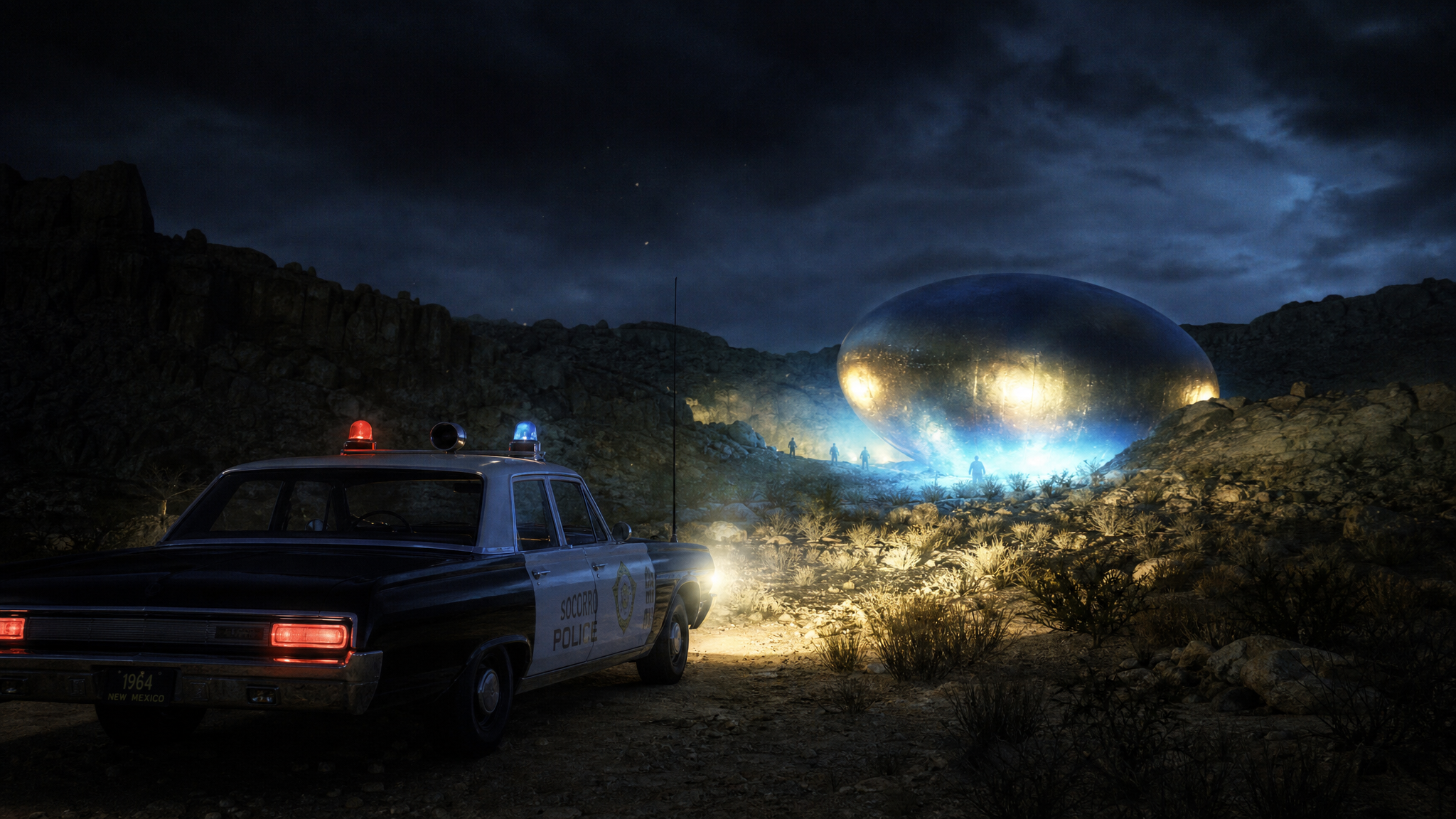
Officer Lonnie Zamora of the Socorro Police Department reported seeing a loud, flame-like object in the distance. He pursued it, heard an unusual roar, and then encountered a strange, egg-shaped craft resting in a ravine south of town. He claimed he saw two small figures near it, one appearing to notice him before both disappeared. When he approached the area after the object departed, he found burned brush, scorched ground, and four depressed marks in the desert soil. That combination of witness, time, place, and physical residue is why this case still demands attention.
Background: Why Socorro Matters More Than Most UFO Stories
The early 1960s were a fertile period for aerial anomaly reporting in the United States. Cold War anxiety was high, civilian aviation was expanding, and military radar and test activity created a constant backdrop of noise in the skies. Most sightings from that era collapse quickly under scrutiny. They are vague, inconsistent, or contaminated by folklore. Socorro is different because it begins with a trained observer on duty, in daylight, during a mundane patrol.
Zamora was not a thrill-seeker. He was an experienced officer responding to a possible speeding violation when the sighting began. That detail matters. A witness in motion, under routine stress, is not an ideal observer in the laboratory sense, but neither is he easily dismissed as someone predisposed to fantasy. By all accounts, Zamora's first instinct was practical: investigate what looked like an overturned vehicle or an explosion. Only when he crested the ridge did the scene shift from ordinary to impossible.
The craft description was unusual but not flamboyant. He did not describe flashing lights, classic saucers, or comic-book aliens. He reported a shiny object that looked metallic, on supports or legs, with a ladder-like structure nearby. The figures were small, dressed in what he interpreted as coveralls or white uniforms. He heard a roar, saw a flame, and watched the object rise out of the ravine. This is the kind of account that survives initial skepticism because it is anchored in sensory detail rather than narrative excess.
Public Record: The Case Was Documented Fast, and That Changed Everything
One reason the Socorro incident remains credible to investigators is the speed with which it entered official channels. Zamora reported the event to his supervisors almost immediately. Local authorities contacted outside agencies. News coverage followed. The story was not incubated for months in the privacy of a UFO club; it emerged into the public record while memories were still fresh.
There were multiple early interviews with Zamora, and those accounts were remarkably consistent in their essentials. He stuck to the same core elements: the flame, the pursuit, the object on the ground, the figures, the roar, the departure, and the traces left behind. In UFO work, consistency is not proof, but it is a filter. Cases with weak internal structure tend to mutate quickly as tellers incorporate suggestion, publicity, or pressure. Socorro did not fracture in that way.
Another public-record factor is what the case did not produce. There was no convincing local prank explanation. No confession emerged. No identifiable aircraft, balloon, or experimental vehicle was matched cleanly to the witness statement. The lack of a mundane resolution does not mean the event was extraterrestrial, only that the available record resists neat closure.
Official Documents: What the Investigation Did and Did Not Find
The Air Force's Project Blue Book examined the incident. That alone is significant. When a case reaches Blue Book, it enters the institutional machinery of 1960s UFO analysis, a system designed to classify sightings as astronomical, atmospheric, psychological, hoaxed, or unknown. Socorro was not dismissed immediately as nonsense. It was reviewed because the incident had a credible witness and at least some physical indications.
The official record includes investigator visits to the scene, photographs, measurements, and interviews. Researchers documented the terrain and the marks Zamora described. They also considered whether a test vehicle, a prank, or a natural phenomenon might explain what he saw. The problem was always the same: each candidate explanation solved one part of the puzzle while leaving the rest untouched.
If a vehicle had landed there, where was it? If a prank had been staged, why were the impressions and scorching so difficult to match to a known setup? If the object was an aircraft or test craft, why did the witness description diverge so strongly from known hardware of the period? Blue Book eventually listed the case as unidentified. That classification is not a declaration of alien origin, but in the official language of the era it meant the evidence did not fit the available bins.
Years later, the case would continue to attract attention from civilian researchers and skeptics alike. That persistence is itself a kind of official afterlife. Good cases do not disappear; they remain in circulation because the public record does not fully absorb them.
Witness Accounts: The Strength and Limits of a Single Observer
The central witness is also the central vulnerability. Any serious investigator has to ask: what if Lonnie Zamora was mistaken? Mistakes happen. Eyewitness perception is fragile, especially under stress and in dynamic environments. Desert heat can distort distance. A brief event can compress into a misleading narrative. Fire, glare, and reflected light can create false structure.
Those objections are fair, but they do not end the inquiry. Zamora was not reporting a distant light over hours; he was describing a proximate event with an abrupt sequence. He heard sound, observed a landing-like scene, saw figures, and then encountered a departing craft. The immediate sensory impact of the encounter makes simple misidentification harder, not easier. His training as a police officer also matters. He had experience observing unusual situations and documenting events.
One of the most persistent debates concerns the figures Zamora reportedly saw. Were they human beings? Children? Workers? Mechanical forms? Or were they a later embellishment? The testimony is uncomfortable precisely because it sits at the boundary between the extraordinary and the ordinary. If there were people at the site, why did they vanish so quickly? If there were no people, why did Zamora describe them so specifically?
There is also the question of corroboration. In many classic UFO cases, a witness stands alone. That does not invalidate the event, but it limits certainty. In Socorro, others did not see the craft itself in the moment. What they did see were the aftereffects, the agitation, and the physical scene. That kind of partial corroboration is valuable, even if it stops short of independent confirmation.
Pattern Analysis: The Details That Keep Socorro from Collapsing
When I examine a case like Socorro, I look for three things: structure, residue, and repeatability. Structure means the story hangs together internally. Residue means the event left something behind beyond testimony. Repeatability asks whether the case fits a broader pattern without needing to be forced into one.
Socorro scores unusually well on all three. The narrative structure is coherent. Zamora's sequence of events follows a logical progression from routine patrol to pursuit to encounter to aftermath. The residue exists in the form of ground marks, scorched vegetation, and documented site inspection. And the pattern? The case resembles other close-encounter reports in which a credible observer witnesses a low-altitude object, an unusual sound or propulsion effect is noted, and the object departs abruptly, leaving marks or heat damage.
That pattern does not prove a single source of origin. It does suggest that the Socorro case belongs to a category of incidents that are not merely visual misperceptions. Something happened there. The question is what.
There are several hypotheses. One is classified aerospace testing. Another is an unconventional human-made device of unknown origin to the witness. A third is that Zamora encountered a brief atmospheric or optical event that, under pressure, acquired craft-like features. The final, most sensational hypothesis is that he witnessed a non-human vehicle. My job is not to decorate the mystery but to weigh the odds. In the Socorro case, the human-tech explanation remains possible but incomplete. The atmospheric explanation accounts for too little. The non-human explanation may fit the pattern, but it extends beyond the evidence.
The Analytical Problem: Why the Case Resists Both Debunking and Certainty
Debunkers often make the mistake of thinking that if a case is not proven extraordinary, it must be ordinary. That is not analysis; it is impatience. Socorro is one of the rare incidents where the available evidence remains stubbornly balanced. The witness is credible. The reporting was prompt. The site evidence was investigated. The official conclusion was not a clean solve. Yet the case also lacks the hard proof that would force a radical reinterpretation of events.
This is where disciplined investigation must remain uncomfortable. It is easy to mock uncertainty and easier still to fill it with mythology. The hard work is to leave a case exactly where the evidence leaves it. Socorro does not require us to believe in little green men. It does require us to admit that a trained law-enforcement officer, in daylight, reported an object and aftermath that the systems of the day could not explain.
Conclusion: The Case of Socorro Is Not Solved, and That Is the Point
After decades of reviewing cases like this, I've learned to distrust dramatic certainty. The Socorro incident does not need exaggeration. It stands on its own. What makes it important is not that it proves aliens, but that it survives the usual demolition tools: ridicule, retrospective distortion, and easy identification. It remains in the narrow band of cases where the witness credibility is strong, the documentation is real, and the explanation remains incomplete.
If you want a neat answer, Socorro will disappoint you. If you want an honest answer, Socorro is exactly the kind of case intelligence analysts should pay attention to: a credible observer, a rapidly documented event, physical traces, and a file that still contains unresolved seams. The desert floor near Socorro gave up enough to make the question unavoidable, but not enough to close it. That is why, more than half a century later, the Lonnie Zamora incident still deserves a serious look.
Not every mystery is a door to the impossible. Some are just stubborn facts that refuse to fit the furniture of our assumptions. Socorro is one of those facts.