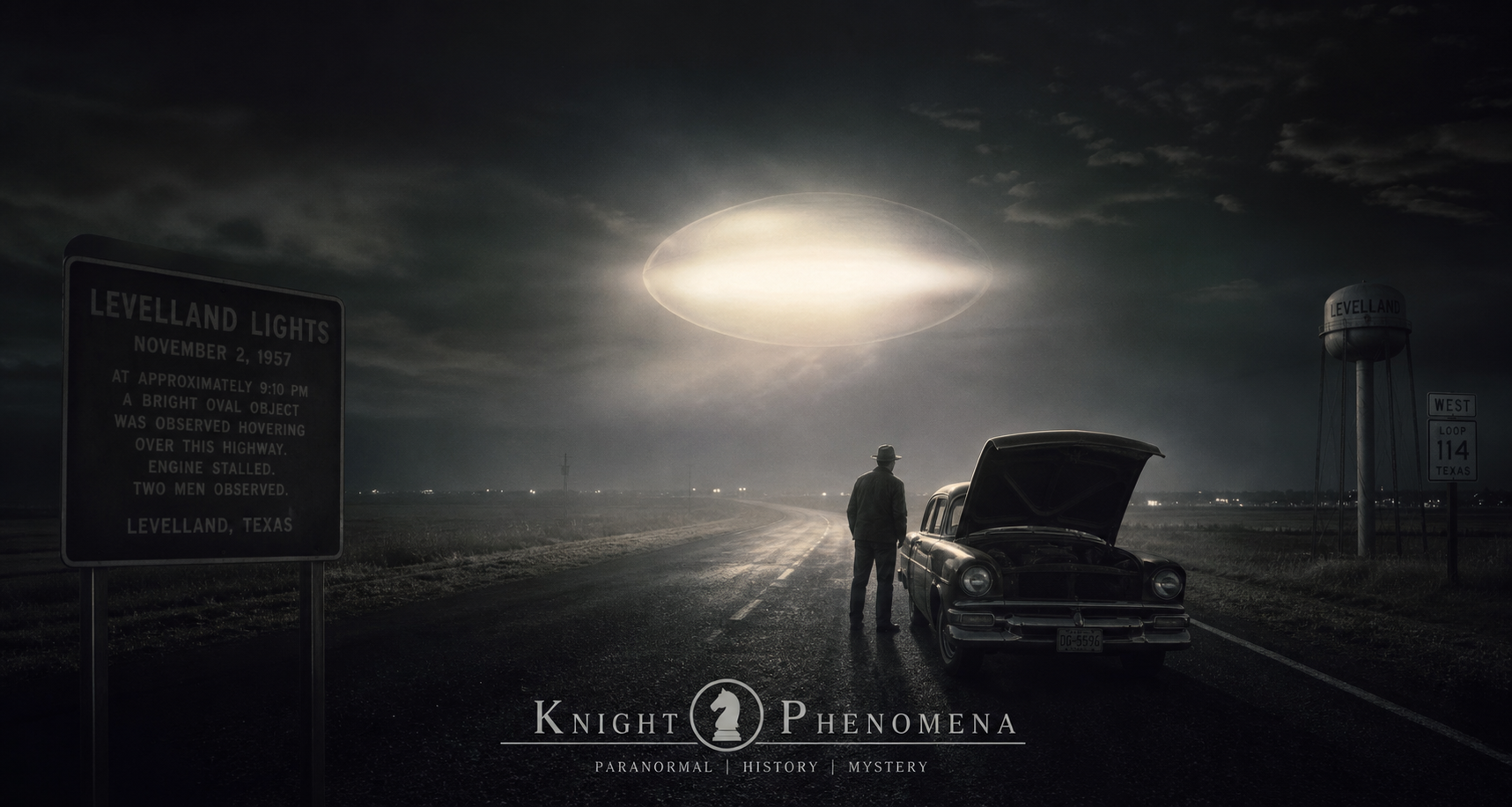
The Levelland Lights: When a Texas Town Went Dark
I've spent years analyzing pattern recognition in intelligence work, and one principle holds constant: when multiple independent sources report the same anomaly within a compressed timeframe, you pay attention. The Levelland incident of 1957 represents exactly this kind of convergence—a cascade of reports so consistent, so geographically concentrated, that dismissing them requires more mental gymnastics than investigating them.
What happened in Levelland, Texas over the course of two and a half hours on November 2, 1957, remains one of the most compelling UFO cases in American history. Not because of blurry photographs or dubious testimony, but because of something far more difficult to fabricate: a documented pattern of electromagnetic interference witnessed by fifteen separate individuals who had no contact with each other.
The Night Everything Stopped
It began at 11:00 PM when Pedro Saucedo and Joe Salaz, driving four miles west of Levelland, encountered a glowing object that appeared to be sitting on the road ahead. Saucedo would later describe it as torpedo-shaped, approximately 200 feet long, and brilliantly illuminated. As they approached, their truck's engine died. The headlights went dark. Then, according to both men, the object rose from the road with a rush of wind and heat so intense they felt it inside the vehicle.
When the object departed, the truck's electrical system spontaneously restored itself.
Saucedo called the Levelland Police Department at 11:15 PM. Officer A.J. Fowler took the report, likely filing it away as another Saturday night oddity. But then the calls started coming in.
At 11:45 PM, Jim Wheeler reported his vehicle stalled four miles east of Levelland when a glowing egg-shaped object crossed the road in front of him. At 12:05 AM, Jose Alvarez reported the same phenomenon—engine failure, dead lights, a luminous object, then spontaneous restart after it departed. At 12:15 AM, married couple Frank and Newell Wright experienced identical electrical failure when a large glowing object passed over their vehicle.
By 1:30 AM, Officer Fowler had received reports from fifteen different witnesses scattered across a roughly twelve-mile radius. The descriptions varied in detail, but the core elements remained constant: a bright, oval or egg-shaped object, complete electrical failure in vehicles, and spontaneous restoration of power after the object left.
The Investigation That Wasn't
The U.S. Air Force's Project Blue Book investigated the Levelland incident, and their conclusion remains one of the most transparently inadequate explanations in the project's history. Their official determination: ball lightning and electrical storms caused both the sightings and the vehicle failures.
There's one problem with this explanation—there was no storm.
Weather records from Lubbock, Texas (the nearest weather station) show clear skies with good visibility on the night of November 2-3, 1957. No lightning activity was recorded. No precipitation. The conditions were, by meteorological standards, unremarkable.
The Blue Book investigator, Staff Sergeant Norman P. Barth, spent less than four hours in Levelland. He interviewed three witnesses. His report acknowledged that "ball lightning" typically doesn't cause engine failure, then concluded it was ball lightning anyway. When pressed on the weather discrepancy, the Air Force suggested that localized electrical disturbances could have occurred without being recorded at the weather station.
This is technically possible in the same way that it's technically possible I'm descended from Napoleon—the odds are just astronomically against it.
What makes the Air Force explanation particularly suspect is the timing. The Levelland incident occurred just days after the Soviet Union launched Sputnik 2. The American public was already anxious about objects in the sky. The last thing the Air Force wanted was a legitimate UFO incident that suggested technology beyond both American and Soviet capabilities.
The Electromagnetic Signature
From an analytical standpoint, the most significant aspect of Levelland isn't the visual sightings—it's the electromagnetic interference pattern. Fifteen vehicles experienced complete electrical failure in the presence of the phenomenon. This wasn't a case of engines sputtering or headlights dimming. Witnesses consistently reported total, instantaneous power loss followed by equally instantaneous restoration.
Modern vehicles with electronic ignition systems are vulnerable to electromagnetic pulse effects, but the 1957 vehicles in Levelland used mechanical ignition systems—distributors, points, and magnetos. These systems are remarkably resistant to electromagnetic interference. To cause the kind of complete failure reported would require an electromagnetic field of considerable strength and specific characteristics.
Could this have been a natural phenomenon? Ball lightning remains poorly understood, but documented cases don't typically show this kind of systematic effect on electrical systems. St. Elmo's fire, another proposed explanation, is a corona discharge that occurs during thunderstorms—which, again, weren't present that night.
The alternative explanation—that fifteen separate witnesses independently fabricated identical stories about electromagnetic effects they had no reason to understand or expect—strains credulity even further than the phenomenon itself.
The Witnesses Who Wouldn't Budge
I've learned to evaluate cases not just on the initial reports, but on how witnesses respond to pressure over time. Hoaxers tend to embellish. Misidentification cases tend to fall apart under scrutiny. The Levelland witnesses did neither.
Pedro Saucedo, the first witness, was a farm worker with no history of attention-seeking behavior. He was reluctant to report what he'd seen, fearing ridicule. When interviewed years later, his account remained consistent in every material detail. Jim Wheeler, a truck driver, similarly maintained his story without elaboration or contradiction. The Wrights, Jose Alvarez, and the other witnesses showed the same pattern—consistency without embellishment, reluctance without recantation.
Several witnesses reported being harassed after the incident became public. Some lost jobs. Others faced community ridicule. None recanted. None claimed they'd been mistaken. This kind of testimonial persistence, particularly in the face of social cost, is a strong indicator of genuine experience—whatever that experience actually was.
Assessment: The Case That Demands Better Questions
After reviewing the Levelland incident through the lens of intelligence analysis, I'm left with an uncomfortable conclusion: we don't have an adequate conventional explanation for what happened that night.
The ball lightning hypothesis fails on meteorological grounds. Mass hallucination doesn't explain the electromagnetic effects. Coordinated hoax doesn't account for the witnesses' consistency and credibility. We're left with a documented pattern of anomalous phenomena that affected multiple independent observers and produced measurable physical effects on mechanical systems.
Does this mean Levelland was extraterrestrial? Not necessarily. What it means is that something occurred that exceeded the explanatory frameworks available in 1957—and arguably, the frameworks available today. Whether that something was an unknown natural phenomenon, experimental technology, or something else entirely remains an open question.
What troubles me most about Levelland isn't the mystery itself—it's the institutional response. The Air Force investigation was perfunctory at best, deliberately misleading at worst. When confronted with a genuine anomaly, the response was to force-fit it into an inadequate explanation rather than acknowledge the limits of understanding.
In intelligence work, we have a saying: the absence of evidence isn't evidence of absence. Levelland represents something rarer and more valuable—the presence of evidence without a satisfactory explanation. Sixty-six years later, that evidence still waits for someone to ask better questions than the Air Force was willing to ask in 1957.
The lights over Levelland went dark that November night. The questions they raised never have.