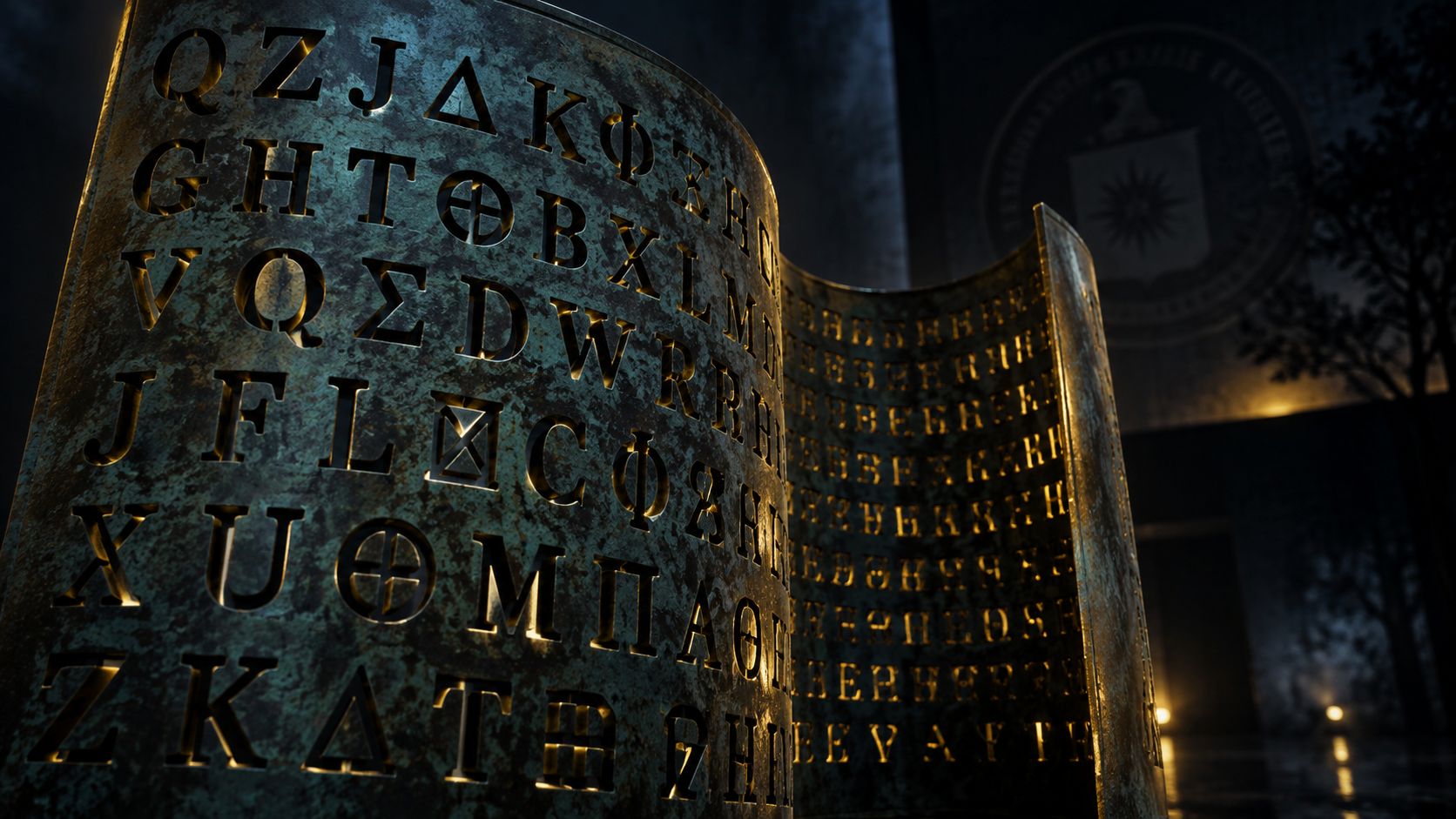
The Kryptos Sculpture: The Unbroken Cipher in the CIA's Own Courtyard
In November 1990, a sculpture was dedicated in a courtyard outside the cafeteria at CIA headquarters in Langley, Virginia. It is made of copper, granite, petrified wood and lodestone, and it carries about 865 characters of apparently random letters cut into an S-shaped copper screen. Thirty-five years later, the last 97 of those characters remain publicly unsolved. The work is called Kryptos, the Greek word for “hidden.” It sits on the grounds of the most famous secret-keeping institution in the world, and it has defeated professional cryptanalysts, amateurs, and a large number of computers.
Most mysteries I investigate involve missing records or contested testimony. This one is different. The artifact is in plain view and the creator is alive. The rules are known, and three of its four sections have been solved and verified. That makes it a useful case study in how intelligence problems are actually attacked, and in why some of them stay closed.
The Public Record: A Commission at Langley
Kryptos was created by Jim Sanborn, a Washington-area sculptor, under the General Services Administration’s Art in Architecture program. That program sets aside a portion of federal construction budgets for artwork. Sanborn won the commission for the courtyard of the CIA’s New Headquarters Building. His proposal was a sculpture that would embody secrecy and the process of revealing it.
Sanborn was not a cryptographer, so he needed expert help. He consulted Edward Scheidt, then chairman of the CIA’s Communications Security Office and a veteran of the agency’s cipher systems. Scheidt taught him classical encryption methods, and together they designed the four messages. The sculpture is divided into two halves. One is a long copper sheet of text, and the other is a Vigenère-style tableau, a grid of shifted alphabets. The tableau uses a keyed alphabet that begins with the letters KRYPTOS, which gave solvers an early hint about the method.
The arrangement of the work is itself documented. The ciphertext is on the sculpture, and the sections are labeled K1 through K4 by the solving community. Sanborn has said consistently that the whole piece is a layered puzzle in which each section prepares the solver for the next.
The Solved Sections
K1 was enciphered with a Vigenère cipher using the keyword PALIMPSEST. It decrypts to a line of Sanborn’s own poetry: “Between subtle shading and the absence of light lies the nuance of iqlusion.” The misspelling of “illusion” is deliberate, and it showed solvers early on that the plaintext would not be perfectly clean.
K2 used the same method with the keyword ABSCISSA. The plaintext describes information gathered using “the Earth’s magnetic field,” transmitted “underground to an unknown location,” and asks “Does Langley know about this? They should. It’s buried out there somewhere.” It then gives geographic coordinates, 38°57′6.5″ N, 77°8′44″ W, and the words “Layer two.” Those coordinates fall on or very near the CIA campus. Sanborn later suggested that the coordinates as first decrypted were slightly off from what he intended, which is a reminder that even the “solved” sections contain irregularities.
K3 used a transposition cipher rather than substitution. It decrypts to a passage adapted from Howard Carter’s account of opening Tutankhamun’s tomb in 1922, ending with the famous exchange, “Can you see anything?” The theme of a sealed chamber slowly revealing its contents fits the sculpture’s design.
Who Solved It, and When
The solving history is where the intelligence angle gets interesting. In 1999, Jim Gillogly, a California computer scientist, publicly announced that he had recovered K1 through K3 using computer-assisted analysis. His announcement drew attention, and the CIA then disclosed that one of its own analysts had already solved the same sections years earlier.
That analyst was David Stein, who had worked on the puzzle in 1992 using pencil and paper, in his own time, over a period he estimated at hundreds of hours. A separate group at the National Security Agency had also reportedly solved the first three sections in the early 1990s. The agency did not announce this at the time, which is typical of institutional handling of such results: the achievement is recorded internally, and the public learns about it much later.
The sequence is instructive. Three groups with different resources reached the same milestone independently, and each stalled at the same place.
K4: The 97 Characters
The fourth passage is a block of 97 letters:
OBKRUOXOGHULBSOLIFBBWFLRVQQPRNGKSSOTWTQSJQSSEKZZWATJKLUDIAWINFBNYPVTTMZFPKWGDKZXTJCDIGKUHUAUEKCAR
Nobody has publicly produced a verified decryption of it by analysis alone. That is not for lack of effort. The known methods used in K1 through K3 have been exhaustively tested against it, as have many variations. Because the passage is short, statistical attacks have very little material to work with. Cryptanalysis of classical ciphers depends heavily on text length. A hundred characters is simply thin evidence, and a well-designed cipher can resist it even if it is not mathematically strong.
Sanborn has said that K4 requires a break from the methods of the earlier sections, and he has hinted that the solver will need to understand the previous plaintexts and the sculpture’s own context. This is one reason many attempts fail: they assume K4 is a harder version of K1 through K3, when it may not be a conventional extension at all.
The Released Clues
Because the puzzle stalled, Sanborn has gradually released hints. They are the most reliable data we have about the plaintext:
- 2010: Characters 64 through 69 of the ciphertext (NYPVTT) decrypt to BERLIN.
- 2014: Characters 70 through 74 (MZFPK) decrypt to CLOCK.
- 2020: A further clue revealed the word NORTHEAST within the plaintext.
“Berlin” and “clock” next to each other have led many analysts to the Berlin World Clock (Weltzeituhr) at Alexanderplatz, a landmark of the former East Berlin. That reading fits the Cold War flavor of the CIA setting and the “northeast” direction clue, but it remains inference. Sanborn has not confirmed any interpretation. It is also notable that the clues were released through a plaintext-to-ciphertext mapping, which means they constrain the solution without giving the method.
Pattern Analysis: Why Has It Held?
From a methodological standpoint, there are four plausible explanations for K4’s resistance. They are not mutually exclusive.
1. Insufficient ciphertext. With only 97 characters, many different plaintext-and-key combinations are equally consistent with the data. Without a confirming crib, a solver can generate plausible English from nearly any hypothesis. Known fragments like BERLIN and CLOCK help, but they also create a risk of confirmation bias.
2. A multi-step cipher. K4 may combine several operations, such as a transposition followed by a substitution, with keys that are not obviously derivable. Each added layer multiplies the search space and breaks the signatures that solvers normally use to identify a method.
3. Non-cryptographic dependencies. Sanborn has implied that physical features of the sculpture matter. If the key depends on the sculpture’s layout, its location, or a fact known only to its designers, then the ciphertext alone is under-determined. In intelligence terms, the key may be an off-channel secret, like a one-time pad that is never transmitted.
4. Possible errors in the ciphertext. The earlier sections contain known irregularities, including an intentional misspelling and a later-acknowledged correction. If K4 contains a misplaced or omitted letter, then a correct method applied to the wrong text will fail, and solvers would never know which part of their reasoning was at fault.
The same ambiguity applies to the claims of solutions. Over the years a steady stream of people have announced K4 decryptions. None has been accepted, because a solution must be independently verifiable by a method that produces the stated plaintext from the given ciphertext without special pleading. Producing readable-looking text is easy. Producing text that follows from a defensible, repeatable procedure is not.
The Sale of the Solution
Sanborn has said he wants the work to outlive him, and he has had to think about what happens to the answer. In 2025 the K4 plaintext and related materials were offered at public auction and were reported to have sold for just under a million dollars. Whatever the buyer does with it, the sale means the solution is no longer solely in the artist’s head, and the puzzle may eventually be settled by disclosure rather than analysis. That outcome would be anticlimactic, but historically it is common. Many “unsolvable” ciphers have been resolved by finding a keyword in an archive rather than by brilliant mathematics.
Analytical Conclusion
Kryptos is not a paranormal mystery, and no one serious claims otherwise. There are no anomalies in the physical record and no unexplained witnesses. What it offers instead is a clean illustration of a truth that intelligence professionals know well: the difficulty of a secret depends less on the strength of the cipher than on how much information the adversary has about the context and the key.
My assessment is that K4 is almost certainly solvable in principle. Sanborn and Scheidt designed it with a specific method, and that method was meant to be discoverable by a determined solver who understood the clues embedded in the earlier sections and the sculpture. I assess with moderate confidence that the plaintext refers to a Berlin location, probably the Weltzeituhr, and that the method includes a non-standard step that has not been systematically tested because it falls outside the classical toolkit most analysts apply.
The lesson is the one that matters: three independent teams, including professionals at the CIA and NSA, solved the first three sections within a few years of each other, then all stopped at the same wall. When that happens in intelligence work, the problem is rarely a lack of talent. It is a wrong assumption about the nature of the problem. Until someone identifies the assumption, the 97 characters will stay where they have been since 1990, in plain sight in a courtyard in Langley, waiting for someone to ask the right question.