The Kaikoura Lights: New Zealand's Most Documented UFO Encounter
In my years analyzing intelligence data at the CIA, I learned that the best cases aren't the ones with the most dramatic claims—they're the ones with multiple, independent verification streams. The Kaikoura Lights incident of 1978 remains one of the few UFO cases where visual observation, radar tracking, and film documentation all converged on the same night, in the same airspace, witnessed by trained professionals.
What happened over New Zealand's South Island that New Year's Eve wasn't a single sighting by a lone observer. It was a cascade of events involving commercial pilots, air traffic controllers, and a television crew that had been dispatched specifically to investigate earlier reports. The result was something rare in UFO research: contemporaneous documentation created by skeptics trying to debunk the phenomenon.
The First Night: December 21, 1978
The sequence began ten days before the famous footage was captured. On December 21, the crew of Safe Air Ltd Flight 866, a cargo plane traveling from Blenheim to Christchurch, observed a series of bright lights pacing their aircraft. Captain John Randle and First Officer Keith Mathieson reported the objects to Wellington Air Traffic Control, which confirmed unknown radar returns in the same location.
The objects appeared as bright, pulsating lights that would accelerate rapidly, hover, then move in ways inconsistent with conventional aircraft. Wellington ATC tracked the returns for several minutes before they vanished from both visual and radar observation simultaneously.
This initial incident made local news but might have faded into obscurity if not for what happened ten days later.
December 30-31: The Filmed Encounter
Melbourne television reporter Quentin Fogarty and cameraman David Crockett of Australia's Channel 0-10 Network flew aboard an Argosy cargo plane on December 30, intending to investigate and likely debunk the earlier reports. They brought professional film equipment and a healthy dose of skepticism.
What they captured instead became some of the most analyzed UFO footage in history.
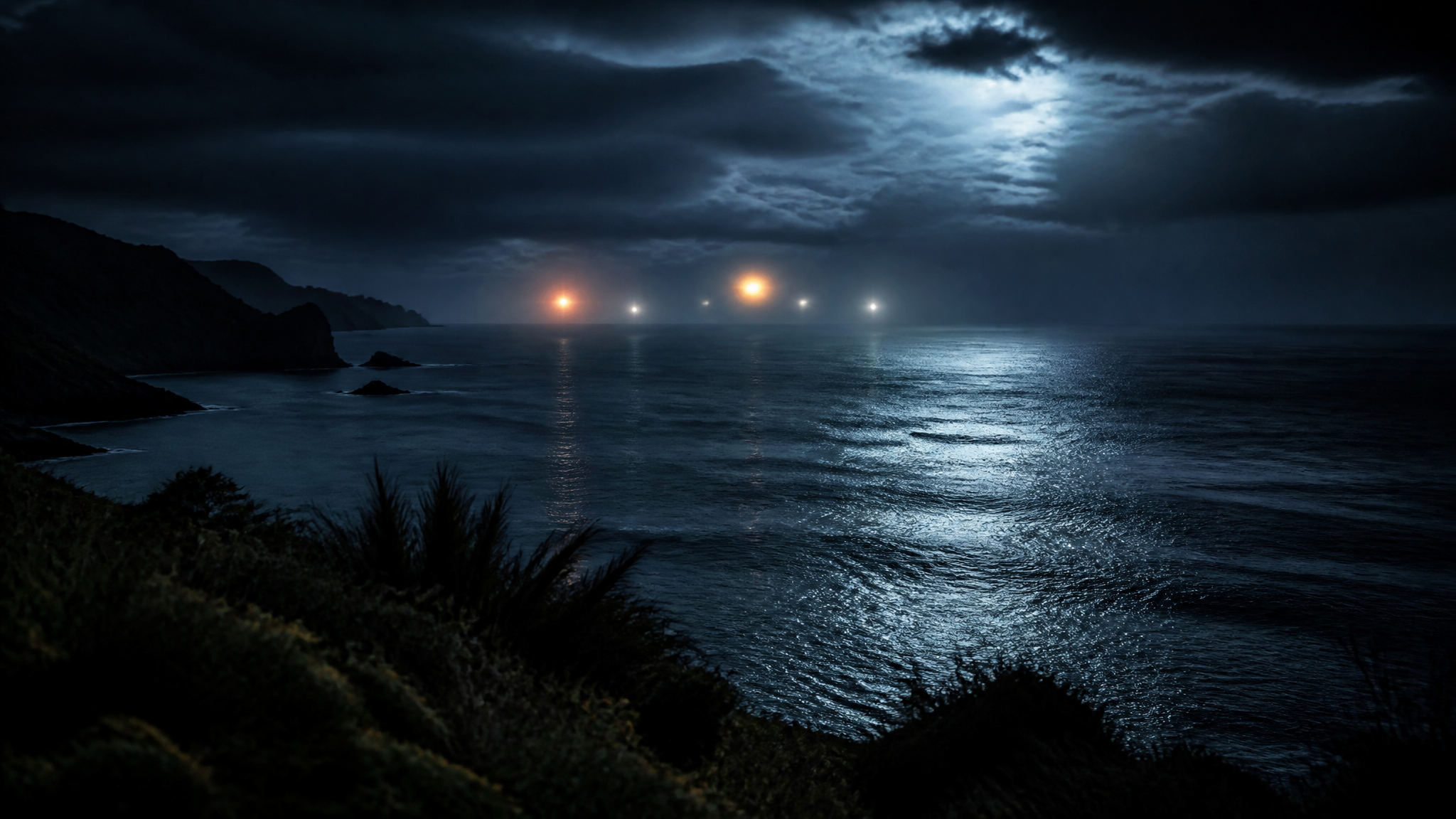
Shortly after midnight on December 31, as the aircraft flew near the Kaikoura Peninsula, both the crew and the television team observed bright lights performing maneuvers that defied conventional explanation. Crockett filmed the objects while Fogarty provided real-time audio commentary. Simultaneously, Wellington Air Traffic Control was tracking unknown radar returns in the exact positions where the visual objects appeared.
The footage shows luminous objects that brighten and dim, move in relation to the aircraft, and at times appear to pace the plane before accelerating away. The audio recording captures the genuine confusion and excitement of the witnesses, including Fogarty's repeated confirmation with ATC about the radar contacts.
"I am a skeptic no longer. I saw it with my own eyes, and on film, and on radar."
— Quentin Fogarty, December 31, 1978
The Evidence Stack
What makes Kaikoura compelling from an analytical standpoint is the convergence of independent data streams:
Visual Observation: Multiple trained observers—commercial pilots, a television crew, and ground witnesses—reported seeing the same phenomena from different vantage points.
Radar Confirmation: Wellington Air Traffic Control tracked unknown returns that corresponded with visual sightings. The radar contacts showed objects moving at speeds and in patterns inconsistent with known aircraft.
Film Documentation: Professional-grade footage captured luminous objects exhibiting unusual flight characteristics. The film has been analyzed by multiple experts over decades.
Real-Time Audio: Fogarty's commentary and radio communications with ATC were recorded, providing contemporaneous documentation of the event as it unfolded.
The Official Explanations
The New Zealand Defence Force conducted an investigation and concluded the sightings were likely caused by a combination of natural phenomena: lights from squid fishing boats reflected off clouds, the planet Venus, and unusual atmospheric conditions creating optical illusions.
Dr. Bruce Maccabee, an optical physicist who analyzed the film footage extensively, found this explanation inadequate. His analysis suggested the filmed objects were large, luminous sources at considerable distance—not reflections or atmospheric phenomena. The radar returns, he noted, couldn't be explained by fishing boats or planets.
The squid boat theory, in particular, faces significant problems. The lights were observed at altitudes and distances inconsistent with surface vessels. Radar doesn't typically track fishing boats from the distances and altitudes involved. And the witnesses—experienced pilots familiar with the appearance of ground lights from altitude—insisted these were something different.
The Pattern Recognition Problem
In intelligence work, we look for patterns that either confirm or contradict a hypothesis. The Kaikoura case presents patterns that resist conventional explanation:
The objects appeared on multiple nights, suggesting something more than a one-time atmospheric anomaly. They were tracked by radar while simultaneously observed visually, eliminating purely optical explanations. They exhibited intelligent behavior—pacing aircraft, responding to the plane's movements, accelerating beyond conventional aircraft capabilities.
Yet they also exhibited patterns consistent with misidentification: appearing in areas with fishing activity, occurring during periods of unusual atmospheric conditions, and showing characteristics that could potentially be explained by multiple mundane phenomena occurring simultaneously.
What the Evidence Actually Supports
After reviewing the available documentation, I'm left with an uncomfortable conclusion: the evidence doesn't cleanly support either the extraordinary explanation or the conventional one.
The convergence of visual, radar, and film evidence is compelling. The witnesses were credible, trained observers who had nothing to gain from fabrication. The real-time documentation eliminates the possibility of memory distortion or embellishment after the fact.
But the evidence also isn't conclusive enough to rule out a complex combination of natural phenomena misinterpreted under unusual conditions. Atmospheric optics can create convincing illusions. Radar can track anomalous returns caused by weather conditions. Human perception is fallible, even among trained observers.
What we're left with is a case that sits in the uncomfortable middle ground—too well-documented to dismiss, too ambiguous to declare solved. The Kaikoura Lights remain exactly what they were on that New Year's Eve in 1978: unidentified flying objects in the most literal sense of the term.
The film footage still exists. The radar data was recorded. The witnesses maintain their accounts decades later. And we still don't have a definitive answer that satisfies both the evidence and Occam's Razor.
Sometimes the most honest conclusion is the most frustrating one: we simply don't know.