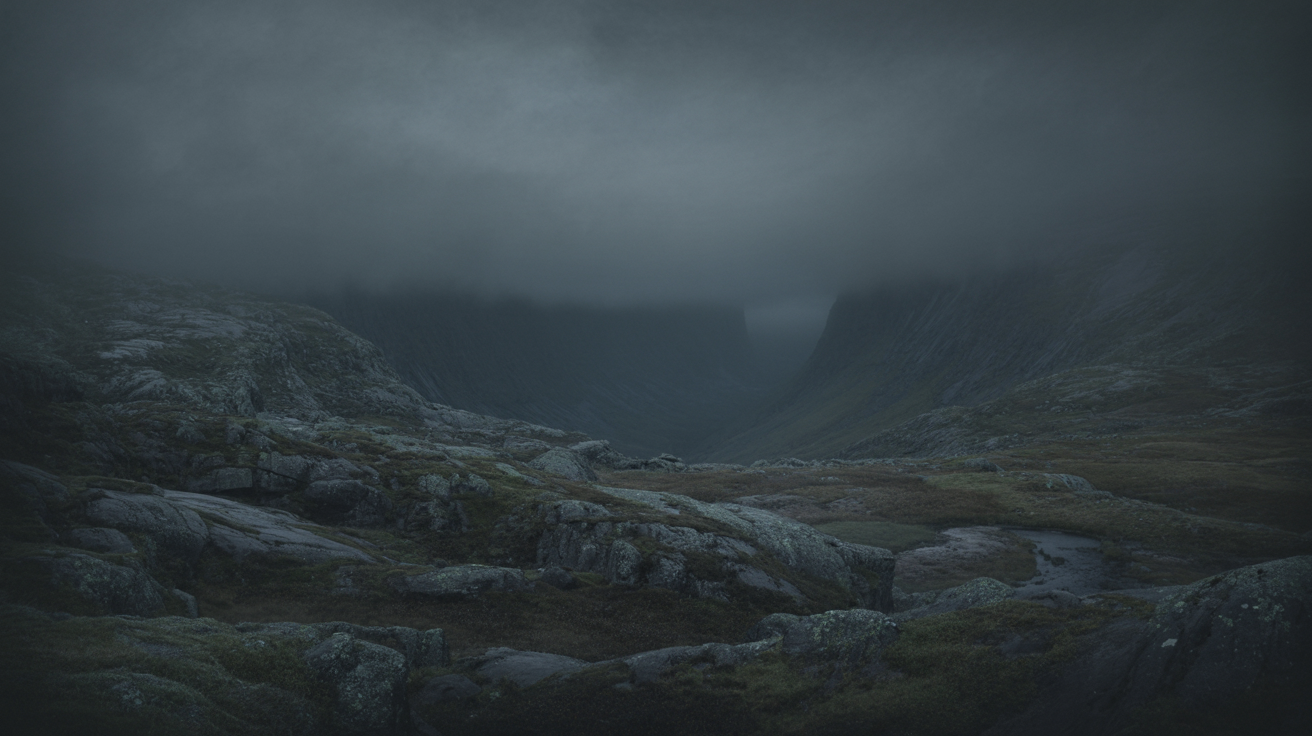
The Isdal Woman: Norway's Unsolved Death Valley Mystery
On November 29, 1970, a father and his two daughters were hiking through Isdalen Valley—the "Ice Valley"—near Bergen, Norway, when they stumbled upon a sight that would launch one of Scandinavia's most perplexing cold cases. Partially hidden among the rocks lay the badly burned body of a woman, surrounded by charred belongings and empty bottles that had contained a powerful sedative.
The Scene
As a former intelligence analyst, I've reviewed countless crime scenes, but the Isdal Woman case stands out for its deliberate complexity. The victim's fingerprints had been sanded off. All identifying labels had been meticulously removed from her clothing. Her dental work suggested she was European, but the specific techniques used pointed to no single country.
Near the body, investigators found:
- Two plastic bottles that had contained Fenemal (a barbiturate sedative)
- Partially burned Norwegian currency
- A dozen pairs of glasses with non-prescription lenses
- Wigs and disguises
- Jewelry with identifying marks filed off
The autopsy revealed she had ingested 50-70 sleeping pills before her death. Carbon monoxide in her blood indicated she was alive when the fire started, yet the positioning of her body suggested she had been placed there rather than having collapsed naturally.
The Trail of Aliases
Working backward from hotel registrations, Norwegian police discovered the woman had traveled extensively through Norway in the weeks before her death, checking into hotels under at least eight different aliases. Each time, she used a false address and paid in cash. Her handwriting analysis revealed she deliberately altered her script with each registration.
What caught my attention from an intelligence perspective: she followed classic tradecraft. She never stayed in one location more than a night. She avoided major cities. She used coded entries in her diary—a substitution cipher that investigators eventually cracked, revealing only a list of travel dates and locations throughout Europe.
Witnesses described her as well-dressed, speaking German with what might have been a French or Belgian accent. She was seen meeting with unknown men in hotel lobbies. She carried expensive luggage but wore inexpensive clothing with the labels removed.
The Intelligence Angle
The Cold War context cannot be ignored. Bergen was home to a major NATO naval base. The year 1970 saw heightened tensions between East and West. The woman's behavior—the aliases, the coded diary, the counter-surveillance techniques—all point to someone with intelligence training.
But for which side? And why would an operative end up dead in such a theatrical manner?
Some theories suggest she was a courier who knew too much. Others propose she was a double agent whose cover was blown. The sleeping pills and fire could indicate either suicide or a staged murder meant to look like suicide. In my experience analyzing covert operations, the truth often lies in the details that don't fit the obvious narrative.
The Isotope Analysis
In 2016, Norwegian authorities exhumed the Isdal Woman's remains for isotope analysis—a technique that can reveal where someone lived based on the chemical signatures in their teeth and bones. The results were startling: she had lived in multiple locations across Europe, spending significant time in Germany and France, with possible connections to Eastern Europe.
Her front teeth showed she had grown up in a region with low fluoride levels, likely somewhere in Central or Eastern Europe. But her molars told a different story, suggesting she had spent her teenage years in a different location entirely.
Unanswered Questions
What troubles me most about this case is the precision of the erasure. Someone—whether the woman herself or others—went to extraordinary lengths to ensure she could never be identified. In intelligence work, that level of operational security is reserved for the most sensitive cases.
Was she running from something? Was she protecting someone? Or was her death meant to send a message to others in the intelligence community?
The Norwegian police officially closed the case in 1971, ruling it a probable suicide. But they kept the file open, and in recent years, new technologies and renewed public interest have brought fresh attention to the mystery.
Fifty-three years later, the Isdal Woman remains unidentified. Her death remains unexplained. And somewhere, perhaps, someone knows exactly who she was and why she died in that remote Norwegian valley.
The question is: will they ever tell?
🕵️ Video: The Isdal Woman Norways
A Knight Phenomena Investigation