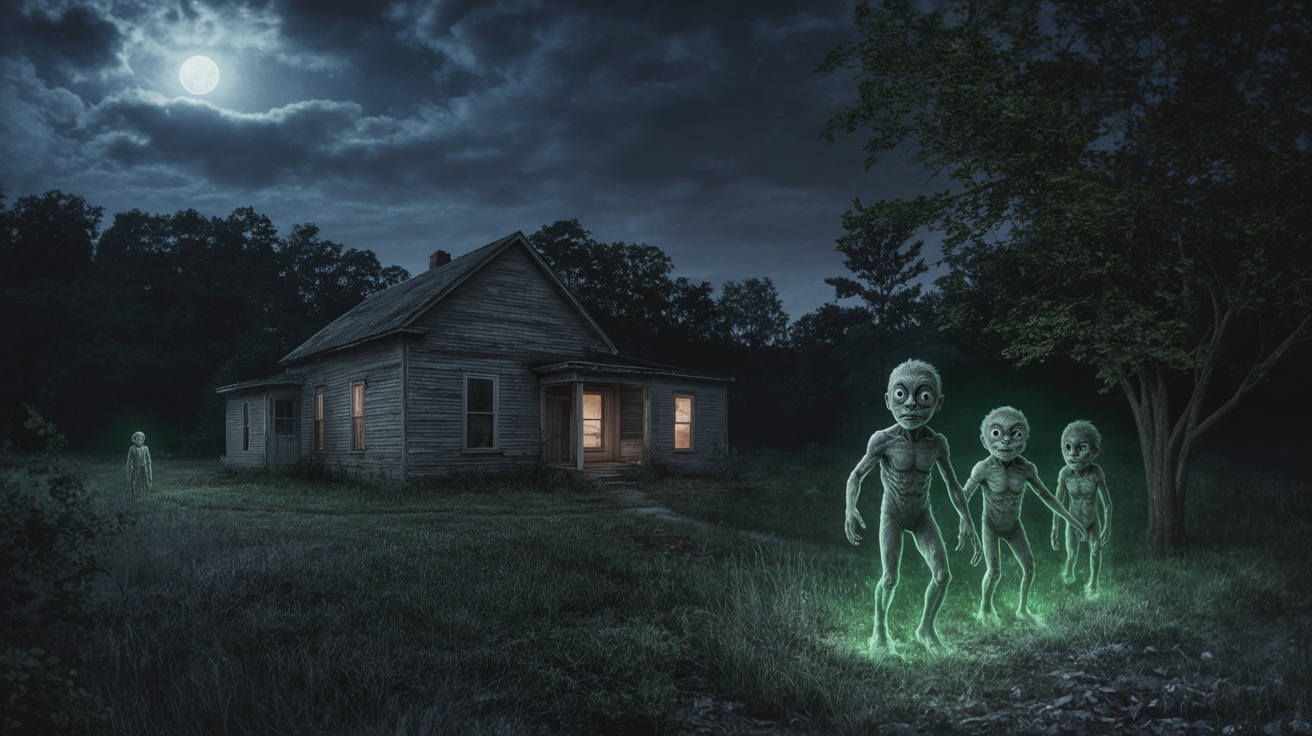
The Hopkinsville Goblins: The Night a Kentucky Farm Family Fought Something Not of This World
A Farm, Two Families, and Something at the Door
In my years at the CIA, I learned to treat witness testimony the way a structural engineer treats load-bearing walls — carefully, methodically, and with full awareness that the wrong assumption can bring everything down. Most eyewitness accounts collapse under scrutiny. The Kelly-Hopkinsville encounter of August 21, 1955, does not collapse. It bends, it resists, and it refuses to fall.
The setting is rural Christian County, Kentucky. A small farmhouse outside the hamlet of Kelly, population negligible. Two families — the Suttons and their guests, the Taylors — were gathered for an ordinary summer evening when Billy Ray Taylor stepped outside to fetch water from the well. What he saw in the sky above the tree line, he described as a large, luminous object trailing a rainbow of exhaust, descending into a gully roughly a quarter mile from the house. He ran back inside. Nobody believed him.
Within the hour, they all believed him.
The Creatures at the Window
The first creature appeared at the screen door. Witnesses described it as roughly three and a half feet tall, with an oversized round head, enormous eyes that reflected yellow light, long arms that nearly dragged the ground, and hands — or claws — that ended in talons. Its skin, they said, appeared silvery, almost metallic, and it seemed to glow with a faint inner luminescence.
What followed was not a passive sighting. It was, by every account, a sustained engagement lasting approximately four hours.
Elmer Sutton and Billy Ray Taylor opened fire with a .22 rifle and a 20-gauge shotgun. At close range. Repeatedly. The creatures, witnesses said, would flip backward when struck — as if the impact registered — but then right themselves and continue. No blood. No bodies. No evidence of injury. One creature grabbed the hair of a family member reaching from a rooftop. Another was shot point-blank as it peered through a window. It fell, got up, and retreated into the darkness.
The families eventually fled in their vehicles to the Hopkinsville police station, arriving in a state of visible distress. Officers who responded to the scene found the family shaken but coherent, the house riddled with bullet holes, and shell casings consistent with the reported firefight. They found no creatures. They did find something they couldn't immediately explain: a luminous patch on the ground near the gully where Taylor had first seen the object descend.
The Witness Problem — In Reverse
Here is where my analytical training forces me to pause and recalibrate. In most paranormal cases, the witness problem works against credibility — too few witnesses, too much time elapsed, too many inconsistencies. The Kelly-Hopkinsville case presents the opposite challenge.
There were eleven witnesses. Adults and children. Their accounts were taken separately by police and, subsequently, by investigators from nearby Fort Campbell Army Base, who arrived the following morning. The core details held across independent interviews: the physical description of the creatures, the duration of the encounter, the ineffectiveness of the gunfire, the creatures' apparent preference for appearing at windows and on the rooftop rather than attempting direct entry.
Bud Ledwith, a radio station employee who interviewed the family in the early hours of August 22nd, noted that the witnesses showed no signs of intoxication and demonstrated what he described as genuine, unperformed fear. The local police chief, Russell Greenwell, stated publicly that he believed the family had encountered something real, though he declined to speculate on what that something was.
"These were not the kind of people who make up stories. They were scared. Whatever they saw, they saw it." — Chief Russell Greenwell, Hopkinsville Police Department, 1955
What the Skeptics Offer
I have a professional obligation to present the counter-arguments, and I'll do so honestly.
The most persistent skeptical explanation involves great horned owls. Astronomer Joe Nickell, writing for the Skeptical Inquirer, proposed that the creatures' described features — large eyes, taloned appendages, the ability to glide rather than walk, the tendency to appear at elevated positions — are consistent with large owls seen in poor lighting conditions by frightened people. It's not an absurd hypothesis. Great horned owls are aggressive, can appear surprisingly large in flight, and their eyes do reflect light dramatically.
The problem is the gunfire. Eleven witnesses, two firearms, four hours, and not a single owl carcass, feather cluster, or blood trail. Either every shot missed — at close range, through a screen door — or the owl hypothesis requires us to believe the witnesses fabricated the physical confrontation entirely while accurately reporting everything else. That's not how mass confabulation typically works.
Other explanations have included escaped circus animals, swamp gas, and collective hysteria. None of them survive contact with the documented evidence.
The Fort Campbell Factor
This is the detail that, in my experience, separates a curiosity from a case worth serious attention: military involvement.
Personnel from Fort Campbell, one of the largest Army installations in the United States, arrived at the Kelly farmhouse the morning after the encounter. They conducted their own examination of the property. Their findings, if any, were never made public. The Army's official position was that the visit was routine and yielded nothing of significance.
I've seen that language before. "Routine." "Nothing of significance." In intelligence work, those phrases sometimes mean exactly what they say. Sometimes they mean the opposite. Without access to whatever report Fort Campbell filed — if one was filed — I cannot tell you which applies here. What I can tell you is that a military installation doesn't dispatch personnel to a rural farmhouse at dawn because a family saw some owls.
What Remains
The Kelly-Hopkinsville encounter has been investigated, debated, and dissected for nearly seven decades. It has attracted serious researchers and carnival hucksters in roughly equal measure. The town of Hopkinsville now hosts an annual "Little Green Men Days" festival, which is either charming or a tragedy depending on your perspective.
But strip away the merchandise and the mythology, and what you have is this: eleven people, a documented police response, military follow-up, physical evidence of a sustained firefight, and a description of entities that matches no known animal, aircraft, or natural phenomenon. The witnesses never sought fame. Several of them, in later interviews, expressed that they wished the whole thing had never happened.
That, in my experience, is not the profile of a hoax. Hoaxers want attention. The Sutton family moved away from Kelly shortly after the incident and spent years trying to avoid the subject entirely.
I don't know what visited that farmhouse on August 21, 1955. I know that something did. And I know that whatever it was, it didn't bleed when they shot it.
That detail has never stopped bothering me.
👽 Video: The Hopkinsville Goblins Kentucky
A Knight Phenomena Investigation