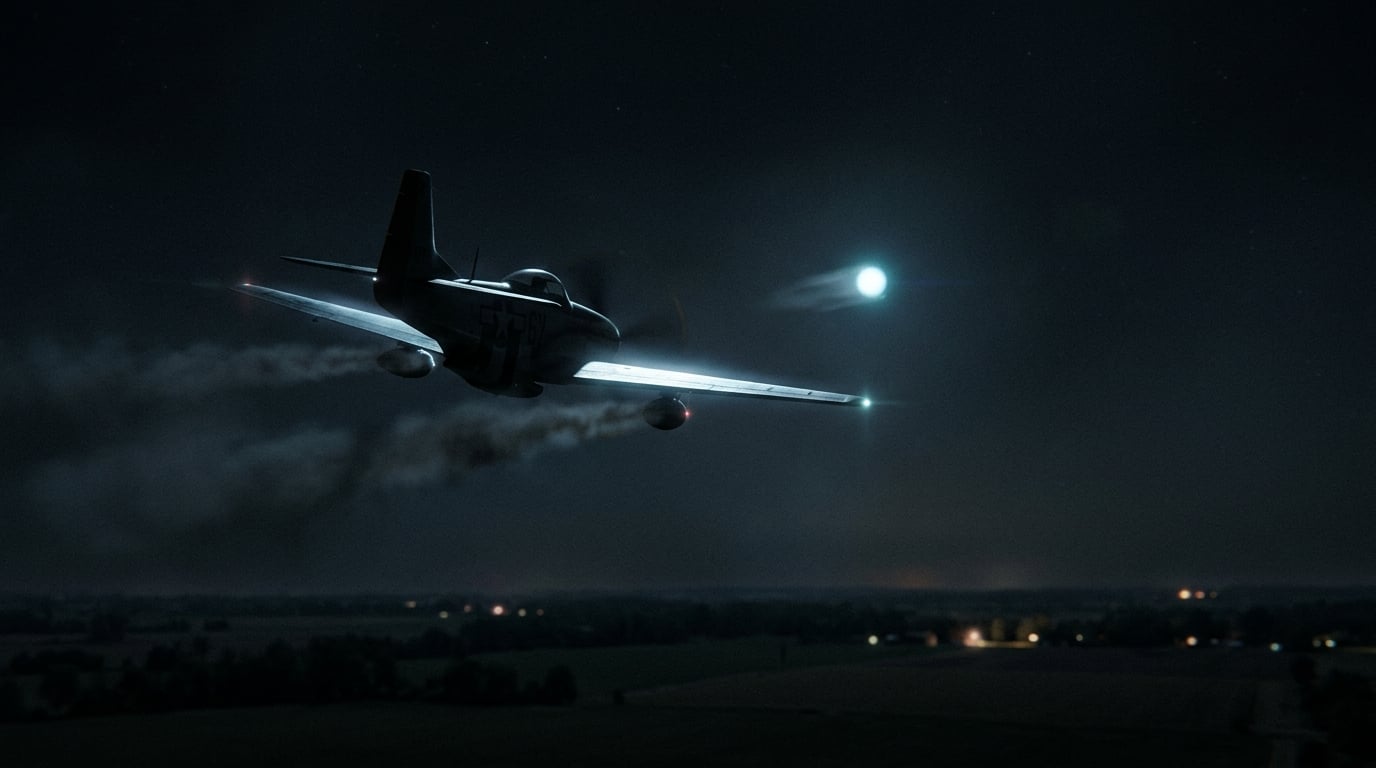
The Gorman Dogfight: The Night a P-51 Chased a Phantom Over Fargo
Some UFO cases become famous because they are dramatic. Others endure because they are tidy. The Gorman Dogfight is neither. It is messy, conditional, and rooted in a real event: a decorated pilot, a night flight over Fargo, and a luminous object that did not behave the way an object should. That does not make it extraterrestrial. It does, however, make it worth examining carefully.
On October 1, 1948, former World War II pilot George F. Gorman was flying a P-51 Mustang in the Fargo, North Dakota area when he reported encountering a bright, fast-moving light. According to his account, the light maneuvered in ways that appeared deliberate and, at times, almost tactical. Gorman pursued it. The object climbed, turned, and matched his moves. The story quickly became one of the earliest and most cited examples in the modern UFO era. The problem is that the closer one gets to the original records, the less the case resembles a clean mystery and the more it resembles a collision of observation, perception, and post hoc interpretation.
What Actually Happened Over Fargo?
The core facts are straightforward. Gorman was participating in night-flying activity when he observed a bright white light in the sky. He believed it was an aircraft, then realized it did not show the expected navigation lights or conventional structure. He attempted to intercept it. A pursuit followed. The light seemed to reverse direction, change altitude, and evade him.
That is the public version. But intelligence work begins by asking which parts are observation, which are inference, and which are later embellishment. Gorman saw a light. He also made judgments about its motion based on a dark sky, imperfect distance cues, and the stress of flight. Those factors matter. Human beings are not good at estimating the speed and range of unstructured lights at night. Pilots are better than most, but not immune.
It is also important to note the environment: an aircraft at night in an era before modern radar transparency, stabilized cockpit displays, or ubiquitous ground-based tracking. The sky was not a controlled laboratory. It was an ambiguous operating space.
The Pilot’s Credibility: Important, But Not निर्णative
Supporters of the UFO interpretation often start with Gorman’s credentials. He was not a farmboy spinning a tale after midnight; he was a trained pilot with wartime experience. That is a valid point. Credibility is evidence, but only one element of it.
A skilled observer can still misidentify a phenomenon. In intelligence analysis, witness sophistication improves the reliability of certain details while leaving the underlying interpretation vulnerable. A military pilot may accurately report that a light accelerated. He may still be mistaken about what caused the apparent acceleration. This distinction is central.
There is also the question of memory contamination. The Gorman case quickly entered the public UFO discourse. Once a report becomes part of the mythology, later summaries often simplify it into a cleaner, stranger, more cinematic narrative. Original testimony tends to be less elegant and more uncertain. That is usually where the truth lives.
The Competing Explanations
Several conventional explanations have been proposed over the decades. None is perfect. All deserve consideration.
1. A lighted balloon or atmospheric object. This theory appears often in retrospective discussions, but it is not a slam dunk. A balloon does not naturally mimic sharp turns or apparent climbs in the way Gorman described. Still, at night, a small light source carried by wind can seem to move with intention when tracked from a moving aircraft. Relative motion can deceive.
2. A star or planet observed through motion illusion. This is less satisfying as a standalone explanation for the pursuit element, but it can account for the initial misperception of a bright stationary object. Once a pilot begins maneuvering, vestibular cues, depth illusion, and target fixation can create the impression that a celestial object is engaging in evasive behavior.
3. Another aircraft. The date and location make this less likely than other explanations, but not impossible. Aircraft lighting, distance, and angle can produce a single bright source that is hard to classify at night. However, reports that the object performed abrupt maneuvers make this explanation incomplete unless one assumes a large amount of observational error.
4. Instrument or perception error under stress. This is the most analytically durable explanation. Night flight, adrenaline, and the chase dynamic can distort perceived speed and direction. Once the pilot is in pursuit, every movement by the object is interpreted relative to his own maneuvering. The object may not be performing miraculous turns; it may simply be a moving point of light whose apparent position is changing in a confusing sky.
Why the “Dogfight” Narrative Took Hold
The phrase “dogfight” is powerful. It turns a sighting into combat. It implies intelligence on the part of the unknown object. Once that framing exists, the case becomes self-reinforcing. A chase suggests agency. Agency suggests technology. Technology suggests origin. The leap from “a light behaved oddly” to “a craft engaged a fighter pilot” is dramatic, but it is not evidence-based.
This is how many mystery cases evolve. The initial report is narrower than the legend. Newspapers, later authors, and enthusiast communities expand the event into a symbolic confrontation between humanity and the unknown. The symbolism becomes more memorable than the raw data. In the Gorman case, that process was especially influential because the story arrived during the formative years of the modern UFO age, when the United States was primed to interpret strange aerial sightings through a national-security lens.
The Intelligence Analyst’s Problem: Separating Pattern From Projection
From an intelligence perspective, the critical task is not to ask whether something was seen. Something clearly was. The question is what it was, and what confidence we can assign to competing explanations.
Three analytical points stand out.
First, the data set is thin. We do not have rich sensor fusion, corroborating radar tracks, or multiple independent instrumented platforms. We have a pilot report and later interpretations. That is not nothing, but it is not enough to support extraordinary claims.
Second, the event occurred in a highly ambiguous observational environment. Night sky observations are inherently difficult. Perception is worst when the observer is moving, emotionally activated, and attempting to classify a target in real time.
Third, there is a large gap between “unexplained” and “extraordinary.” Many cases linger in that gap because they resist a neat answer. Resistance to explanation does not automatically imply the exotic. It often means the evidence is incomplete.
What Makes the Case Still Interesting
I do not dismiss the Gorman Dogfight as a non-event. Quite the opposite. It remains important because it captures a real and unresolved category of experience: competent observers encountering lights that appear to behave intelligently. That category is worth studying, especially when it involves trained personnel and structured reporting.
But seriousness cuts both ways. If we are going to treat such cases as worthy of investigation, we must also treat mundane explanations as worthy of full consideration. That means resisting the urge to fill gaps with extraterrestrial certainty. It means accepting that some cases are anomalies in perception rather than anomalies in physics.
There is also a historical reason the case matters. Gorman’s report helped establish the template for later UFO encounters: a pilot, a luminous object, evasive maneuvers, and a sense that the object knew it was being watched. That template has repeated so often that it can shape expectations. Once a narrative becomes available, future observers may unconsciously fit new events into it. The Gorman case may be one of the origin points of that pattern.
My Assessment
After reviewing the case in the documentary style I prefer, my assessment is measured: the Gorman Dogfight is best understood as an unresolved aerial perception event, not as proof of a nonhuman craft. The pilot was credible. The report was sincere. The object may have been real in the sense that a light was present and moving. But the leap from unusual light to engaged aerial opponent is not supported by the evidence we have.
Could there have been an unknown atmospheric or optical phenomenon? Yes. Could there have been an aircraft or light source misread under stress? Also yes. Could Gorman have genuinely experienced a sequence of movements that looked tactical from the cockpit? Absolutely. But none of that requires extraterrestrial technology.
In intelligence terms, the correct label is not “case closed.” It is “insufficient evidence for the extraordinary.” That is not a cop-out. It is the disciplined answer.
Conclusion
The Gorman Dogfight endures because it sits at the intersection of witness credibility, aerial ambiguity, and the human need to interpret the unknown as intentional. That combination makes for compelling storytelling and weak certainty. When the facts are stripped back, the mystery does not disappear—but neither does the evidence for anything beyond a difficult night encounter in a difficult visual environment.
The lesson is broader than one pilot and one light over Fargo. It is that some mysteries are built less on hidden forces than on the limits of observation. That is often less satisfying than a spacecraft in the dark, but it is usually where the truth is hiding.