The Fresno Nightcrawlers: Surveillance Footage of Something That Shouldn't Exist
I've spent thousands of hours reviewing surveillance footage. During my time at the Agency, I learned to spot the anomalies—the figure that doesn't belong, the movement pattern that breaks from the baseline, the shadow that shouldn't exist in that particular light. You develop an eye for what's real and what's manufactured, what's human and what's trying to appear human.
Which is why the Fresno Nightcrawlers bother me more than they probably should.
In November 2007, a homeowner in Fresno, California, set up a security camera after his dogs kept barking at something in his yard at night. What he captured looked like a practical joke—until it happened again, in a different location, years later. And then the analysis started. And the more you look at these things, the less sense they make.
The Footage That Started Everything
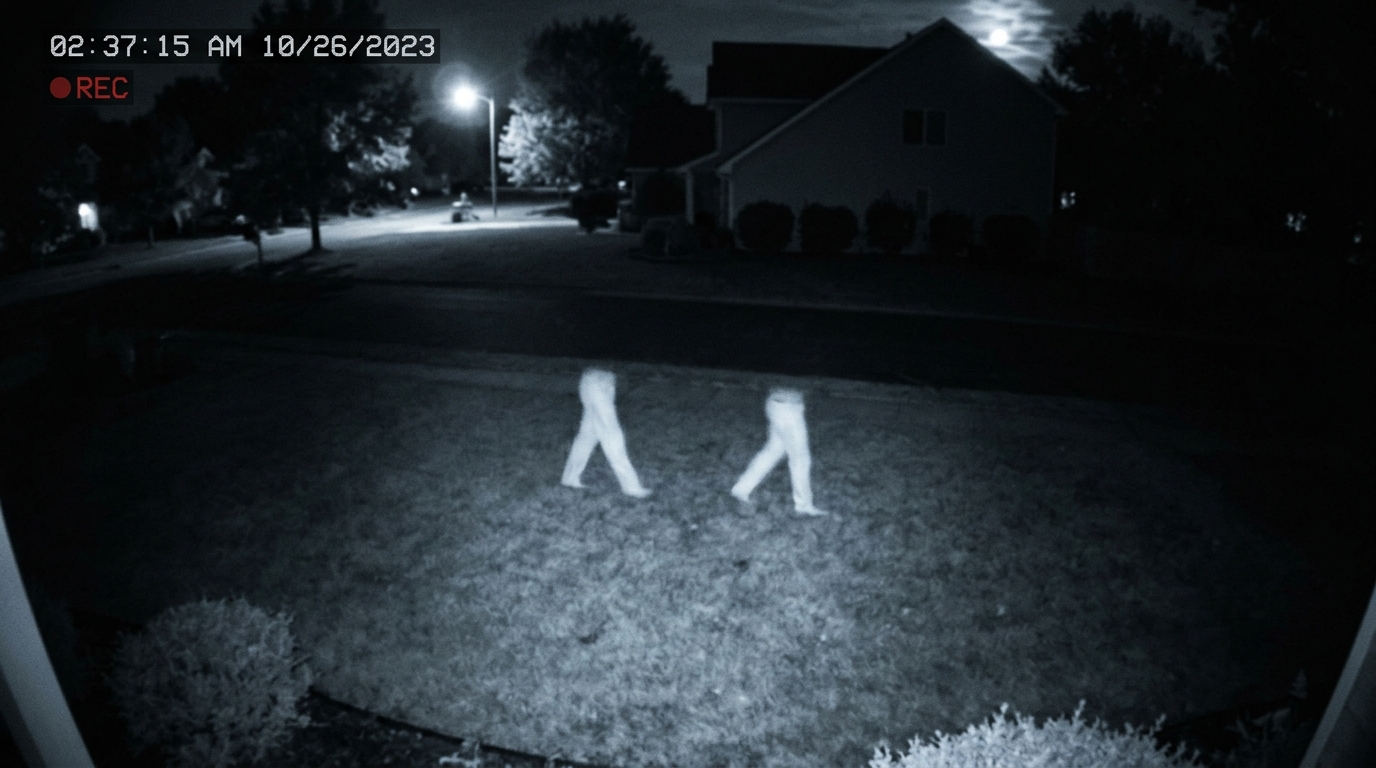
The original video is grainy, shot in night-vision mode. It shows what appears to be two entities moving across a lawn. But calling them entities feels inadequate. They look like pairs of white pants walking by themselves. No torso. No arms. Just legs—or what might be legs—with a small, rounded mass at the top that could charitably be called a head.
They move with a distinctive gait, almost waddling, the fabric or skin or whatever comprises them rippling with each step. The taller one is perhaps four feet high. The smaller one, following behind, maybe two and a half feet. They cross the yard, pass behind a tree, and disappear from frame.
The homeowner, who has remained anonymous, reported the footage to local news. It made the rounds on paranormal television shows. And then, in 2011, it happened again.
Yosemite: The Second Sighting
A different camera, a different location, the same impossible thing.
This time, the footage came from Yosemite National Park, captured on a trail camera. The quality was slightly better, the lighting different, but the subject was unmistakable: the same walking leg-creatures, moving through the frame with that distinctive, almost mechanical gait.
Two separate incidents, years apart, different locations, different cameras, different witnesses. In intelligence work, we call that pattern confirmation. When the same anomaly appears in multiple, unconnected data streams, you stop dismissing it as noise.
The Yosemite footage added something the Fresno video lacked: scale reference. Trees, rocks, known distances. The entities were small—shorter than the surrounding brush—but they moved with purpose, not the random drift of debris or the erratic motion of animals.
The Analysis Problem
I've had colleagues in video forensics review both pieces of footage. Not officially, you understand—this isn't the kind of thing you put through official channels. But over drinks, in conversations that stay off the record, I've asked people who know how to spot CGI, puppetry, and practical effects.
Their consensus: if it's a hoax, it's an exceptionally good one.
The movement is too fluid for stop-motion. The lighting and shadows are consistent with the environment. There's no evidence of digital manipulation in the original files. The gait—that strange, waddling walk—shows weight distribution and momentum that would be difficult to fake with strings or rods.
One analyst pointed out something I'd missed: the smaller entity's movements mirror the larger one with a slight delay, like a child following a parent. That kind of behavioral detail is hard to script. It suggests either genuine footage of something unknown, or hoaxers with an understanding of movement psychology that rivals professional animators.
The Native American Connection
Here's where it gets interesting from a cultural intelligence perspective.
After the Fresno footage went public, members of the Yokuts tribe came forward with stories. They had legends of these things—entities they called "the walking people" or "the little people." Descriptions varied, but the core elements matched: small, pale, leg-like beings that appeared at night and disappeared without trace.
The Yokuts are indigenous to the Central Valley of California, including the Fresno area. Their oral traditions go back centuries, long before security cameras and internet hoaxes.
In intelligence analysis, we look for historical precedent. If a phenomenon has deep cultural roots, it changes the probability matrix. Either the hoaxers did extensive anthropological research to align their fake with existing folklore, or the folklore exists because people have been seeing these things for a very long time.
The Skeptical Explanations
I'm obligated to walk through the conventional explanations, because that's how you eliminate false positives.
Theory One: Puppetry. Someone created leg-shaped puppets and walked them through the frame using fishing line or rods. Problem: the movement is too smooth, the weight distribution too realistic. Puppets on strings don't walk like that, especially not on uneven ground.
Theory Two: Costume/Hoax. Someone dressed in a white suit designed to obscure their body, creating the illusion of walking legs. Problem: the proportions don't work. The entities are too short, the legs too long relative to the "head." A human in a costume would show more bulk, more mass at the top.
Theory Three: CGI. Digital effects added in post-production. Problem: forensic analysis of the original files shows no evidence of digital manipulation. The compression artifacts, noise patterns, and metadata are consistent with unedited security footage.
Theory Four: Misidentification. The entities are actually known animals or objects misinterpreted due to poor lighting and camera quality. Problem: no known animal moves like that. The gait is bipedal, deliberate, and unlike anything in the regional fauna.
None of these explanations are satisfying. Each requires assumptions that strain credibility as much as accepting the footage at face value.
The Pattern Recognition Problem
In my previous work, I tracked patterns across disparate data sets. You look for connections, for threads that link seemingly unrelated events. The Nightcrawlers present a pattern recognition problem because they don't fit any existing category.
They're not cryptids in the traditional sense—no biological features that suggest an undiscovered species. They're not UFO-related—no craft, no lights, no high-strangeness elements. They're not ghosts or spirits—they have physical presence, they interact with the environment, they cast shadows.
They're something else. Something that walks through our world with apparent purpose, gets captured on camera twice, and then vanishes back into whatever space they occupy when we're not looking.
What I Think
I've learned to be comfortable with uncertainty. In intelligence work, you rarely get complete pictures. You make assessments based on incomplete data, assign probability ranges, and accept that some questions don't have answers.
The Fresno Nightcrawlers fall into that category.
Are they real? The footage suggests something physical was captured on camera. Whether that something is a biological entity, an interdimensional visitor, or an elaborate hoax executed with remarkable skill—I can't say with certainty.
What I can say is this: two separate cameras, years apart, captured the same anomaly. The footage has withstood forensic scrutiny. The phenomenon aligns with indigenous folklore predating modern technology. And no conventional explanation adequately accounts for all the evidence.
In the intelligence community, when you encounter a pattern you can't explain, you don't dismiss it. You file it, you watch for recurrence, and you wait for more data.
I'm still waiting.
If these things are real—if something that looks like walking legs with minimal body mass actually exists in the forests and yards of Central California—then we're missing a fundamental piece of our understanding of what shares this world with us.
And if they're not real, if this is all an elaborate construction, then someone went to extraordinary lengths to create something that serves no obvious purpose beyond making us question what we think we know.
Either way, the Nightcrawlers represent a gap in our knowledge. A blank space on the map where something strange walks through the frame and refuses to be explained away.
I've seen enough in my career to know that blank spaces are where the interesting things hide. The Fresno Nightcrawlers are still hiding. But they've been caught on camera twice.
I suspect they'll be caught again.