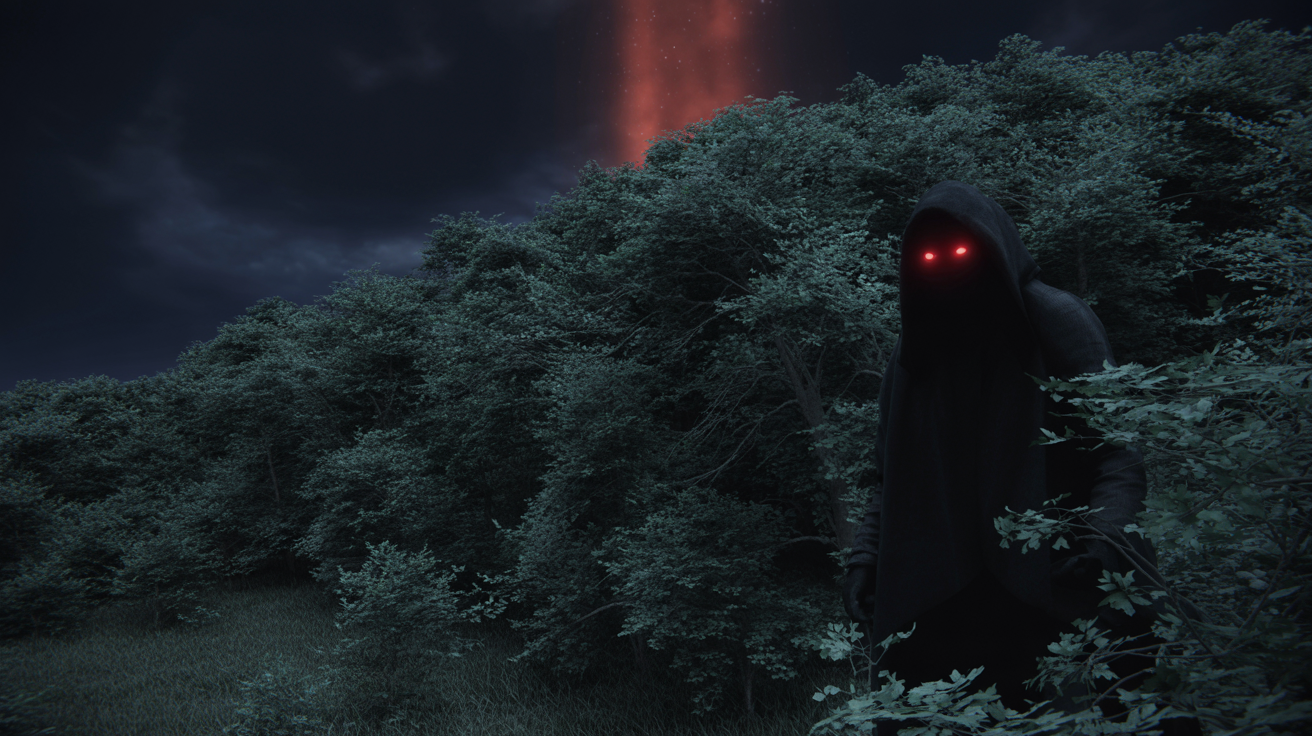
The Flatwoods Monster: A Wartime Sky, a 10-Foot Shadow, and a Mystery That Wouldn't Die
At 7:15 p.m. on September 12, 1952, the town of Flatwoods in Braxton County, West Virginia, was still settling into an ordinary Friday evening. Then a light crossed the sky.
What happened after that is one of the most famous odd stories in American paranormal history: a group of boys saw what looked like a falling object land on a nearby hillside, adults joined the search, and in the dark they encountered something that many would later describe as a towering, hooded figure with glowing eyes. The case became known as the Flatwoods Monster. Whether it was a misidentified animal, a mass fear event, a meteor trail, or something stranger, the story has proved remarkably resistant to a clean explanation.
The first report: a light, a crash, and a decision to investigate
The incident began with a flash in the sky seen by local schoolboys, including Eddie May and his brother Fred, along with classmates. They described a bright red object arcing overhead and appearing to descend on a hillside near the property of Mrs. Kathleen May, their mother. They ran home and, along with Mrs. May and neighbors, went to look.
That detail matters. This was not a lone witness in an empty field. It was a social event, unfolding in real time, with multiple observers primed by a dramatic sky and an apparent landing site. In 1952, in rural Appalachia, such a report carried instant force. The Korean War was still underway. The public was already accustomed to strange aircraft, secret tests, and a constant background hum of Cold War anxiety. A light in the sky did not have to be alien to be alarming.
As the group climbed the hill with flashlights, the atmosphere changed. People reported a sharp, unpleasant odor—something metallic or burning. Then the beam of a flashlight supposedly caught the figure.
The shape in the dark
Descriptions vary, which is exactly what one would expect from frightened witnesses in near-darkness. Some accounts say the being was tall, perhaps 10 feet high. Others suggest a smaller figure made larger by posture, distance, or the hill's slope. The most repeated image is the same: a dark body, a hood-like or spade-shaped head, and eyes that glowed red in the flashlight beam.
One boy reportedly screamed. The group retreated downslope. Some later said they heard a hiss. Others remembered a rustling sound or the sense that the thing was moving toward them. By then, fear had already done much of the work that evidence could not.
Here is the skeptical problem: eyewitnesses in stressful, low-light conditions are notoriously vulnerable to misperception. If you put several people on a steep West Virginia hillside after sunset, after seeing a bright aerial object, and then tell them something has landed nearby, you have created a perfect environment for partial perception and rapid story-building. That does not mean the witnesses were dishonest. It means the human brain, under pressure, tries to complete the picture.
"The terrifying part of the Flatwoods case is not that everyone agreed. It is that they did not."
What investigators found—and what they did not
Local sheriff's deputies and National Guard personnel arrived later. They found the area around the hill but no clear creature, no wreckage, and no obvious landing site. The ground details, when documented at all, were ambiguous. Some observers pointed to a burned or disturbed patch of vegetation. Others saw nothing that would survive scrutiny.
That absence is central. For a case that began with a supposed crash and ended with a monster encounter, there is remarkably little physical evidence. No confirmed tracks. No recovered material. No debris with a chain of custody. No sample that can be tested today against modern forensic standards.
What there was, however, was a lot of publicity. Newspapers picked up the story quickly. A local incident became a national curiosity, and national curiosity has a way of hardening into folklore. Over time, the Flatwoods Monster stopped being just a reported encounter and became a symbol: the eerie Appalachian outsider, the wartime sky intruder, the thing that might be seen but never held.
Possible explanations: meteor, owl, and the machinery of fear
Several explanations have been proposed over the years. The most grounded begins with the sky event itself. On September 12, 1952, witnesses may have seen a meteor or fireball. That would explain the bright moving object and the impression that something had fallen nearby.
From there, the hillside encounter may have been a case of misidentification. A barn owl perched in a tree, seen briefly in flashlight glare, can look bizarre from below: large eyes reflecting red, body shape distorted by distance, wings or branches creating a hooded outline. Add the smell of oil, damp vegetation, or a disturbed area of ground, and the mind fills in threat.
There is also the possibility that part of the experience was amplified by collective expectation. Once one witness calls out danger, others do not independently parse the scene with laboratory precision. They inherit the emotional frame. That is not fraud; it is human nature.
Still, the Flatwoods Monster has enough residue of uncertainty to survive these explanations. The witnesses remained convinced. The story persisted because it had the essential ingredients of lasting mystery: a sky anomaly, a frightening figure, and no decisive proof to close the file.
Why the case endured
Flatwoods did not become legendary because it was the strangest possible event. It became legendary because it sat precisely at the intersection of fear, timing, and ambiguity. In 1952, Americans were already trained to think the sky might conceal something hostile. The object on the hillside did the rest.
The incident also benefited from its physical setting. The woods, the darkness, the steep terrain, the smell, and the speed of the retreat all make for a story that feels cinematic without becoming fully certain. That uncertainty is the engine of paranormal folklore. If a case can be explained too neatly, it dies. If it remains partly unresolved, it lives.
Today the Flatwoods Monster is remembered in museums, local tourism, and the wider catalog of American mysteries. The creature has become part of the region's identity, which is another way of saying that the story has outlived the evidence. There may never have been a monster at all. But there was a sighting, a reaction, and a set of witnesses who believed they had seen something that did not belong in the woods that night.
As an investigator, I am left with a restrained conclusion. The Flatwoods case does not read like proof of an extraterrestrial visitor. It reads like a classic encounter between an unusual sky event, imperfect perception, and the human need to give shape to fear. That may sound disappointing. In practice, it is exactly how many enduring mysteries are made.
And yet the story still works, because one detail refuses to go away: for those who were there, the thing on the hill was real enough.
👽 Video: The Flatwoods Monster A
A Knight Phenomena Investigation