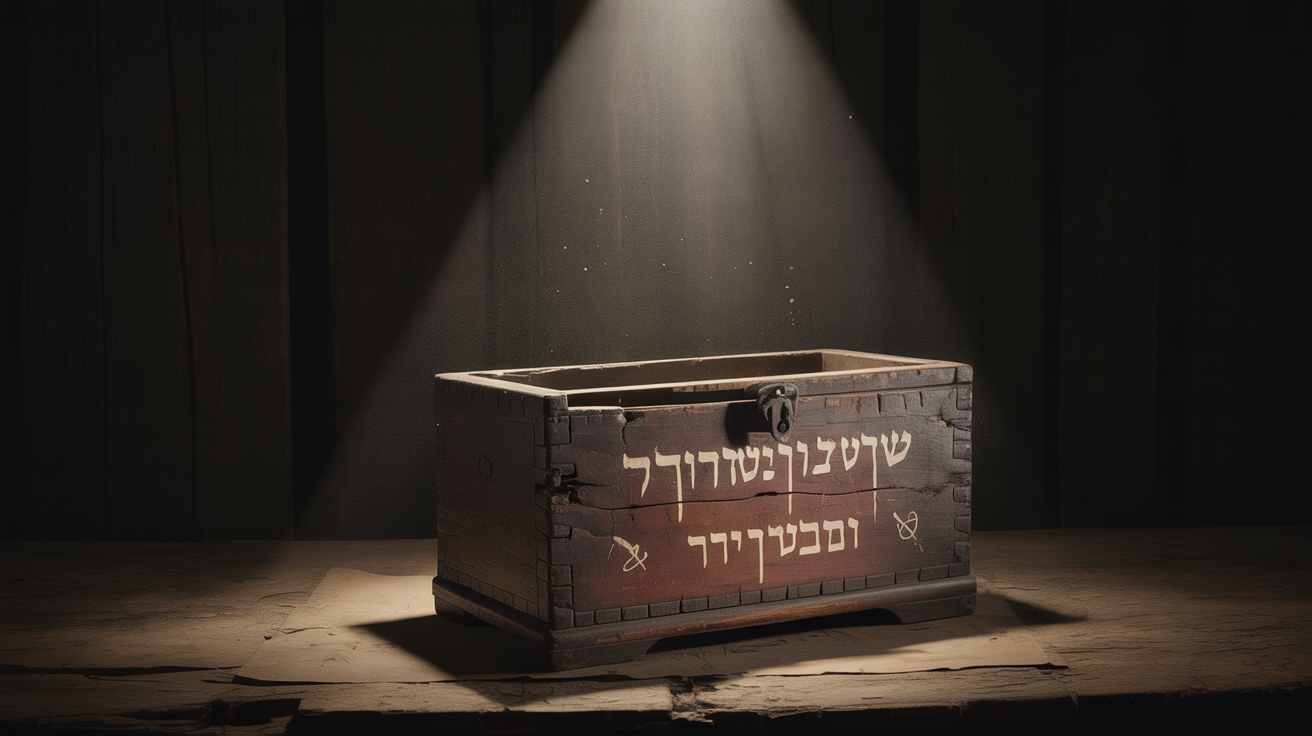
The Dybbuk Box: A Wine Cabinet, a Curse, and a Trail of Broken Lives
In my years at the CIA, I learned to be deeply suspicious of coincidence. When multiple independent sources report the same anomaly, when patterns emerge across unconnected individuals, when the data points refuse to resolve into a clean, rational explanation — that's when you stop dismissing and start investigating. The Dybbuk Box is one of those cases.
\n\nIt is, on its surface, a story about a piece of furniture. A small, antique wine cabinet, roughly the size of a shoebox, constructed from Spanish cedar and fitted with a peculiar collection of objects inside: two 1920s pennies, a lock of blonde hair bound with cord, a lock of black hair, a small granite statue engraved with the Hebrew word Shalom, a dried rosebud, a golden wine goblet, and a single candle holder with four octopus-shaped legs. Unremarkable, perhaps, to the untrained eye. But the provenance of this cabinet — and what allegedly followed it from owner to owner — constitutes one of the most thoroughly documented paranormal case studies of the 21st century.
\n\nThe Origin: A Survivor's Secret
\n\nThe box's documented history begins with a woman named Havela, a Polish Holocaust survivor who immigrated to the United States after World War II. According to her granddaughter, who sold the cabinet at an estate sale in Portland, Oregon in 2001, Havela had purchased the box in Spain before the war. She brought it with her to America and kept it sealed for the rest of her life, refusing to discuss its contents or allow anyone to open it.
\n\nWhen the granddaughter was asked about the box at the estate sale, she became visibly distressed. Her instructions were explicit: the box must be sold. It could not be thrown away, it could not be given away, and under no circumstances should it be opened. She offered no further explanation.
\n\nIn Jewish folklore, a dybbuk is a malicious spirit — typically the soul of a deceased person — that attaches itself to the living or to objects. The concept is ancient, rooted in Kabbalistic tradition, and while it occupies the same cultural space as Western demonic possession, it carries its own distinct theological weight. A dybbuk box, in this tradition, is an object used to contain such a spirit. Whether Havela believed she was housing something dangerous, or whether she was simply honoring a cultural practice passed down through generations, we cannot know. She took that answer with her.
\n\nKevin Mannis and the First Wave
\n\nThe man who purchased the box at the estate sale was Kevin Mannis, a furniture refinisher and antiques dealer from Portland. He opened it almost immediately. What he found inside were the objects described above — curious, but not alarming. He cleaned the cabinet and attempted to give it as a gift to his mother. Within minutes of receiving it, she suffered a stroke. She later communicated, through a letter board, that she did not want the box.
\n\nMannis began experiencing what he described as a recurring nightmare — shared, he would later discover, by every person who slept under the same roof as the box. The dream was consistent in its details: a dark, shadowy figure, a smell of cat urine and jasmine, and a sensation of being watched from inside a dark space. His hair began falling out. He developed a persistent eye infection. He sold the box on eBay in 2003, posting a detailed account of his experiences in the listing.
\n\n\n\n"I am not a superstitious person," Mannis wrote in his original eBay listing. "I don't believe in ghosts or the paranormal. But I know what happened to me, and I know what happened to the people around me when this box was in my home."
That listing is significant from an investigative standpoint. It was written in real time, before the box became famous, before there was any cultural incentive to embellish. The specificity of the reported symptoms — the shared nightmares, the physical ailments, the smell — is the kind of detail that, in intelligence work, we call corroborating texture. It's harder to fabricate than broad claims.
\n\nA Chain of Misfortune
\n\nThe box passed through several owners after Mannis, each of whom reported variations of the same phenomena. A student who purchased it developed hives and a respiratory infection within days. A couple who bought it reported that every light bulb in their home burned out simultaneously the night they brought it inside. One owner reported waking to find their partner standing over them, staring blankly, with no memory of having gotten out of bed.
\n\nThe box eventually came to Jason Haxton, a museum director in Missouri, who purchased it in 2004 after reading Mannis's eBay account. Haxton was, by his own admission, a skeptic. He was also methodical. He documented everything — his own symptoms (which included welts, hair loss, and coughing up blood), the accounts of visitors to his home, and the results of consultations with Jewish scholars and Kabbalistic rabbis who examined the box.
\n\nThe rabbis' assessment was unambiguous: the box should be resealed and never opened again. Haxton complied. He had the cabinet wrapped in a specific manner prescribed by the rabbis and stored it away. His symptoms, he reported, resolved within weeks.
\n\nThe Pattern Analysis
\n\nHere is where my analytical background becomes relevant. When I assess a case like this, I'm looking for several things: consistency of reported phenomena across independent witnesses, the absence of obvious financial or reputational motive for fabrication, and the degree to which the evidence resists alternative explanations.
\n\nThe Dybbuk Box scores unusually high on all three measures. The shared nightmare phenomenon is particularly striking. Across multiple unconnected individuals, in different cities, over a period of years, the same dream was reported with the same specific details. The probability of this occurring by chance or by suggestion alone — given that many of these individuals had no prior knowledge of each other's experiences — is low enough to warrant serious attention.
\n\nThe physical symptoms are harder to evaluate. Hair loss, eye infections, and respiratory issues have numerous mundane explanations. But the clustering of these symptoms around the box's presence, and their reported resolution after the box was removed, creates a temporal correlation that is at minimum worth noting.
\n\nCould there be a material explanation? Possibly. Some researchers have speculated about mold spores or chemical residue inside the cabinet producing psychosomatic or physiological effects. It's a reasonable hypothesis, and one that has never been fully tested. Haxton reportedly declined to have the box opened for scientific analysis, deferring to the rabbis' instructions.
\n\nWhat the Box Tells Us
\n\nThe Dybbuk Box was the inspiration for the 2012 horror film The Possession, which did what Hollywood invariably does — amplified, dramatized, and ultimately trivialized a case that deserves more careful treatment. The cultural noise generated by that film has made it harder, not easier, to assess the underlying evidence objectively.
\n\nWhat I can say with confidence is this: something happened to the people who came into contact with this object. Whether that something was supernatural, psychological, environmental, or some combination of all three remains genuinely unresolved. The case is not closed. The pattern is real. And in my experience, real patterns always point somewhere.
\n\nThe box, as of last confirmed report, remains sealed and in private storage. Haxton has declined to reveal its current location. Given everything documented about this case, that may be the most rational decision anyone connected to it has ever made.
\n\nSteven Knight is a former CIA analyst and the founder of Knight Phenomena. He investigates unexplained events using the same pattern-recognition and source-analysis methodologies developed during his intelligence career.
📦 Video: The Dybbuk Box Wine
A Knight Phenomena Investigation