The Dover Demon: Three Witnesses, One Spring Night, and a Mystery That Refuses to Shrink
When a Mystery Fits in a Few Minutes
Most cases that survive for decades are built on layers: conflicting testimony, missing records, opportunistic rumors, and a steady accretion of legend. The Dover Demon is different. It is not a sprawling century-old tale or a government file thick with redactions. It is, on the record, a short encounter in April 1977 near Dover, Massachusetts, involving three teenagers, a dark roadside, and an object of description so strange that it still resists easy categorization.
That brevity is part of its power. A mystery does not need scale to be durable. Sometimes it needs only a few witnesses who appear honest, a setting with poor visibility, and an image that the mind cannot comfortably file away. In that sense, the Dover Demon is less a monster story than a study in how human perception behaves under stress.
The Reports
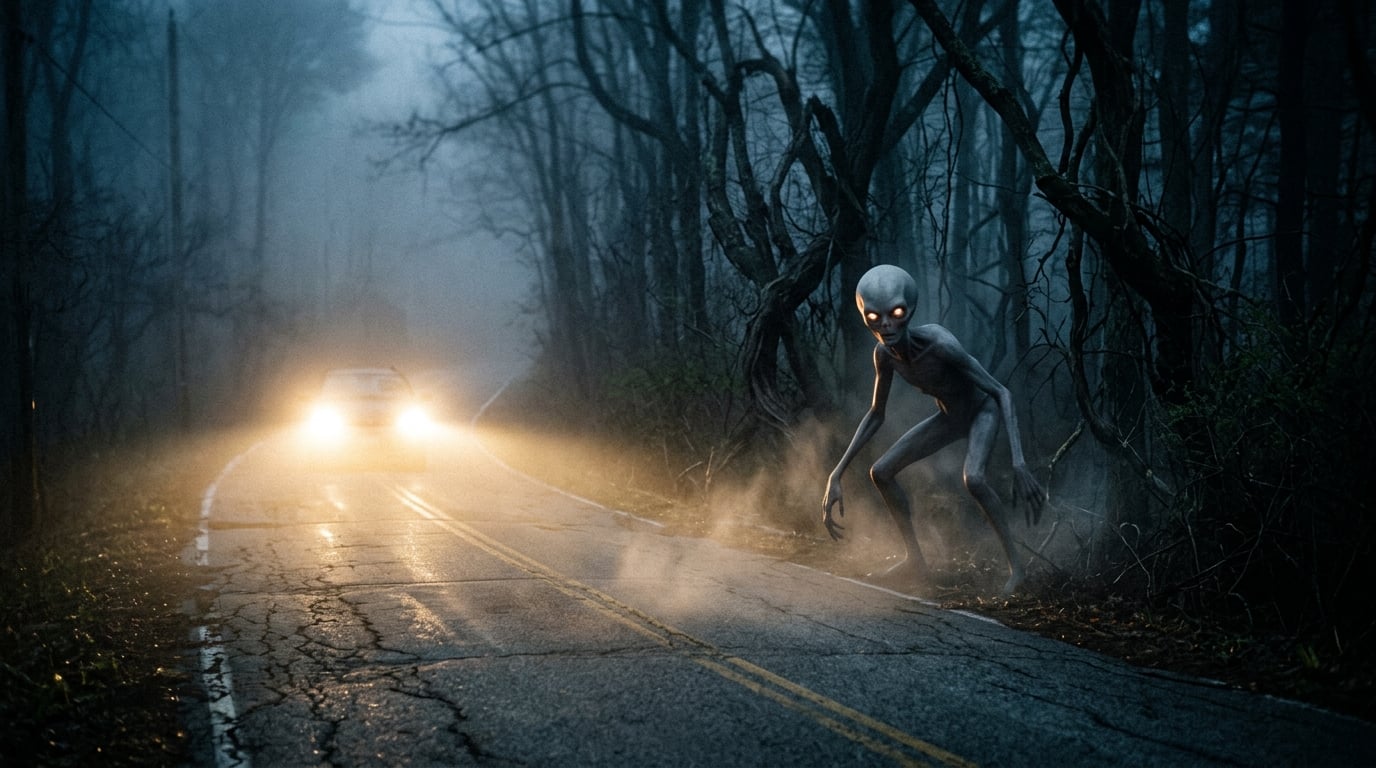
On the night of April 21, 1977, 17-year-old William Bartlett was driving through Dover with friends. He later reported seeing a small figure at the side of the road. Other local accounts followed over the next day, including testimony from John Baxter and Abby Brabham, both teenagers who claimed they saw a strange creature near the same area. The descriptions were not identical, but they overlapped in ways that matter: a creature about four feet tall, thin-limbed, with a disproportionately large head, thin arms and legs, and large eyes that seemed to reflect or emit light.
"It had no visible hair, no ears that I could make out, and its eyes looked enormous."
That is the kind of description that sticks. It is specific enough to feel credible, but vague enough to generate endless reinterpretation. The witnesses did not describe a classic animal, nor did they present the polished theatrics of a hoaxer. They described something awkward, unsettling, and difficult to compare to anything familiar.
There was no confirmed physical evidence. No footprints preserved in a way that settled the matter. No clear photographs. No material trace that could be tested, measured, and archived. For investigators, that absence is frustrating. For folklore, it is fertile ground.
Why the Case Matters
What makes the Dover Demon notable is not that it proves the existence of an unknown species. It does not. What it proves is that credible-looking testimony can arise from ambiguous conditions and still resist complete dismissal. In intelligence work, this is a familiar problem. A report can be sincere and still be wrong. In fact, sincere witnesses are often more dangerous to a clean analysis than obvious liars, because they force you to confront uncertainty instead of simply rejecting the source.
The witnesses in Dover were young, but not unusually prone to sensationalism by any obvious public record. Their accounts were not shaped into a grand narrative at the start. The creature was not immediately transformed into a national icon. That relative restraint gives the case a certain credibility. It also means the more extraordinary the claim, the thinner the supporting structure becomes.
The Environment: Darkness, Distance, and a Spring Night
April in New England is a bad time for certainty. The light is changing, the air is cold, and rural roads can be deceptive. Objects at the roadside can look larger, smaller, or stranger than they really are. An animal seen at an angle, briefly illuminated by headlights, can produce a face that the brain fills in with alarm. The human mind is not a camera; it is a rapid pattern-recognition machine that hates ambiguity.
That does not mean the witnesses invented what they saw. It means we have to consider how quickly ordinary things can become extraordinary when the conditions are poor. A sickly deer, an emaciated animal, a startled juvenile, or even a misperceived person could produce fragments of the reported image. The problem is that none of those explanations fully captures the totality of the descriptions. Each solves one detail and leaves others behind.
There is also the issue of memory contamination. Once a strange event is discussed, the recall process changes. Witnesses compare notes, consciously or not. Newspaper coverage enters the picture. Curiosity hardens uncertainty into image. By the time a story reaches the public, the original perception has usually acquired polish it never had in the moment.
The Skeptical Case
The most conservative reading is that the Dover Demon was a misidentification or a sequence of misidentifications amplified by fear and retelling. That is not a weak explanation. It is the default explanation in cases like this, and for good reason. Most unexplained sightings eventually collapse into a combination of darkness, emotion, and pattern matching. The mind sees what it is primed to see, especially when it expects danger.
There is also no need to invoke the supernatural when a mundane chain can do the job. A night drive, a roadside glimpse, a strange silhouette, adolescent excitement, and a local environment ripe for rumor can create a durable mystery without any exotic creature at the center. If I were building a case file for a skeptical review, that would be my baseline assumption.
But there is a discipline to skepticism, and it matters here. A skeptical conclusion should explain the evidence better than the alternative. In the Dover case, the skeptical explanation is plausible, but it is not elegant. It still has to account for multiple witnesses, similar broad descriptions, and the fact that the reports were not immediately absurd in the way hoaxes often are. That is why the case survives. It is easy to doubt it. It is harder to close it cleanly.
Why People Still Talk About It
Modern mystery culture often rewards scale. We want hidden installations, impossible machines, vanished aircraft, or vast conspiracies. Dover is smaller than that. It is almost modest. Yet the very modesty of the case may be what keeps it alive. There is no grand apparatus to expose, no single definitive document to uncover. There is only a narrow window in time and a handful of human beings trying to describe something they could not easily name.
That is closer to the real world than many legends. Most anomalies are not cinematic. They are brief, confused, and badly documented. They produce just enough structure to make us wonder whether the world contains corners our categories do not cover. The Dover Demon sits in that space, neither proven nor disproven, neither myth nor fact, but a stubborn residue of experience.
Final Assessment
My view is simple. The Dover Demon does not force us to accept an unknown creature in the woods of Massachusetts, but it does remind us how thin the line can be between observation and interpretation. Something was seen. The witnesses almost certainly believed it. Whether that something was an animal, a person, a trick of light, or a genuine unidentified phenomenon remains unresolved.
That is enough to keep the file open. Not because the answer is likely to be paranormal, but because the case is a clean example of why mysteries endure: human observers are fallible, environments are deceptive, and a few seconds of fear can outlast a lifetime of explanation. In intelligence terms, this is an unresolved incident with incomplete evidence. In human terms, it is the kind of story that never quite leaves the road.