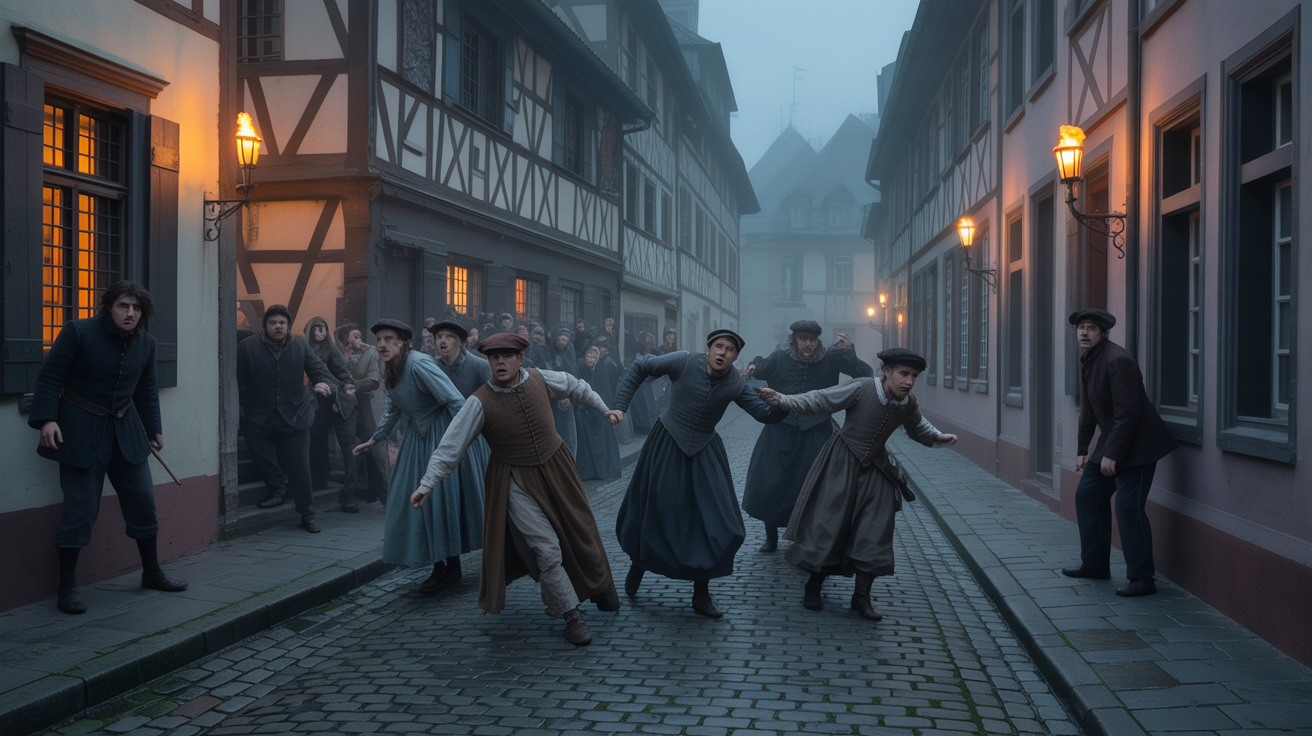
The Dancing Plague of 1518: When a City Could Not Stop Moving
On a hot July day in 1518, in the imperial city of Strasbourg, a woman stepped into the street and began to dance. She did not dance for an audience, or for celebration, or because musicians had struck up a tune. According to the surviving records, she danced because she could not stop. Within days, others joined her. Within weeks, the phenomenon had spread until the city authorities were doing something astonishingly counterproductive: they hired musicians and cleared space for the dancers, hoping to burn off the condition with more motion. Instead, the crisis deepened.
It is one of the most unsettling episodes in European history because it sits at the intersection of the medical, the social, and the inexplicable. No one today believes Strasbourg was overtaken by a curse in any literal sense. But when you read the accounts carefully, you also realize that this was not a simple case of people cutting loose at a festival. Whatever it was, the event behaved like a contagion of body and belief.
The historical setting matters
To understand the dancing plague, you have to understand Strasbourg as it existed in the early 16th century. It was part of the Holy Roman Empire, a place shaped by religious anxiety, periodic famine, disease, and punishing labor. This was not a psychologically quiet era. Europe had already endured centuries of plague, and ordinary life was wrapped in superstition, devotion, and fear. In that environment, physical symptoms often carried meanings that were as spiritual as they were medical.
The summer of 1518 was also hot, and the city had recently suffered hardship. Chroniclers from the period describe poverty, hunger, and social strain. Those conditions matter because they create the kind of pressure cooker in which strange behaviors can become socially amplified. In modern intelligence work, we would call this an enabling environment: not the cause, necessarily, but the terrain on which the event could take root and spread.
What the sources actually say
The most cited account describes a woman identified in later retellings as Frau Troffea beginning to dance in the street in July. Her movements continued for days. Others reportedly joined her, and the number of dancers increased into the dozens, perhaps more. Some accounts say people collapsed from exhaustion; some say deaths occurred, though the exact number is uncertain. That uncertainty is important. We are not dealing with a modern incident recorded by cameras, physicians, and police logs. We are working with chronicled reports, municipal references, and later retellings that do not always align.
That does not make the event imaginary. It makes the evidence noisy. And noisy evidence demands discipline. We should resist the temptation to turn a strange historical event into a neat paranormal narrative simply because neat narratives are satisfying. The job is to ask which explanation best fits the available record, what each source can really support, and where the gaps are too large to overstate confidence.
The first suspect: ergot poisoning
The most popular naturalistic explanation is ergotism, a toxic reaction to rye infected with the fungus Claviceps purpurea. Ergot can produce hallucinations, convulsions, numbness, and a range of neurological symptoms. Because it grows on grain, it has long been associated with outbreaks of strange behavior in agrarian societies. In theory, this could explain why a group of people in a grain-dependent city might suddenly experience abnormal movements and altered states.
But ergot is not a perfect fit. Classic ergotism usually produces pain, burning sensations, gangrene, or seizures; it does not neatly explain days of coordinated dancing spreading through a city street. It also tends to affect those who consume the contaminated grain, whereas the Strasbourg accounts suggest a social spread pattern more than a purely dietary one. Ergot remains possible as a contributing factor, but as a single explanation it feels too tidy for the actual shape of the event.
The stronger case: mass psychogenic illness
The explanation that currently carries the most analytical weight is mass psychogenic illness, sometimes called mass hysteria, though that term is often used too loosely. In these events, psychological distress manifests as physical symptoms and spreads through observation, suggestion, and social reinforcement. The symptoms are real to the sufferers, even if the trigger is not a toxin or pathogen in the traditional sense.
Strasbourg in 1518 was a society primed for this sort of cascade. Fear was institutionalized. Religious symbolism was everywhere. People believed in saints, curses, divine punishment, and the possibility that the body could be commandeered by forces beyond the self. If one woman began to dance compulsively in public, neighbors would not interpret it as a private neurological event. They would read it through the cultural logic of possession, punishment, or contagion. That interpretation itself could intensify the phenomenon.
There is also a practical clue: the city authorities initially responded by encouraging the dancers to keep going, even hiring musicians and creating a dance space. If the condition was fueled by stress, suggestion, and expectation, that response could have acted like pouring oxygen onto a fire. The authorities were not irrational; they were applying the best logic available to them. But from an analytical standpoint, it was exactly the kind of intervention that could worsen a socially contagious episode.
Religion, ritual, and the power of expectation
There is one more layer here that deserves attention. In parts of medieval and early modern Europe, sufferers of movement disorders were sometimes taken to shrines associated with St. Vitus, the patron saint linked to dancing afflictions. Ritual, prayer, and communal response were part of the treatment framework. That matters because if a community already believes a symptom has spiritual origins, then a public display can reinforce the very mechanism producing the symptom.
In modern terms, expectation can shape physiology. Belief changes attention, attention changes stress response, and stress changes the body. That chain does not require anything supernatural, but it can produce events that look uncanny from the outside. In the case of Strasbourg, the line between medicine, theology, and social behavior was so blurred that the event could move from individual distress to public spectacle almost instantly.
What the dancing plague was not
It was probably not a literal curse. It was probably not a demonic invasion. And it almost certainly was not a single-cause mystery waiting for one dramatic answer. The best reading of the record suggests a convergence: a stressed population, a culturally loaded symptom, fear of divine or supernatural punishment, and a cascade effect that turned one person's distress into many people's crisis.
That is less glamorous than a ghost story, but more instructive. The facts point toward a phenomenon in which human beings, under pressure, can synchronize fear, expectation, and physical expression with frightening speed. If that sounds familiar, it should. We see versions of this mechanism in modern panic events, viral misinformation, and collective anxieties that outpace the facts that supposedly anchor them.
The analyst's conclusion
My own view is straightforward: the Dancing Plague of 1518 is best understood not as a paranormal event, but as a historical demonstration of how strange the human nervous system can become under stress and belief. That does not make it trivial. If anything, it makes it more troubling. A city of ordinary people, acting within the logic of their time, became trapped inside a feedback loop they could not see and could not stop.
What remains compelling is not that Strasbourg was haunted in some supernatural sense, but that it showed how quickly a community can turn sensation into certainty, and certainty into contagion. The mystery is not whether people danced. They did. The real mystery is why a society so far removed from ours in language and worldview produced an episode that still feels modern: confusion, spread, failed interventions, and a desperate search for meaning. Sometimes the most unsettling phenomena are not the ones that defy nature. They are the ones that reveal how nature behaves when human beings get in the way.
💃 Video: The Dancing Plague Of
A Knight Phenomena Investigation