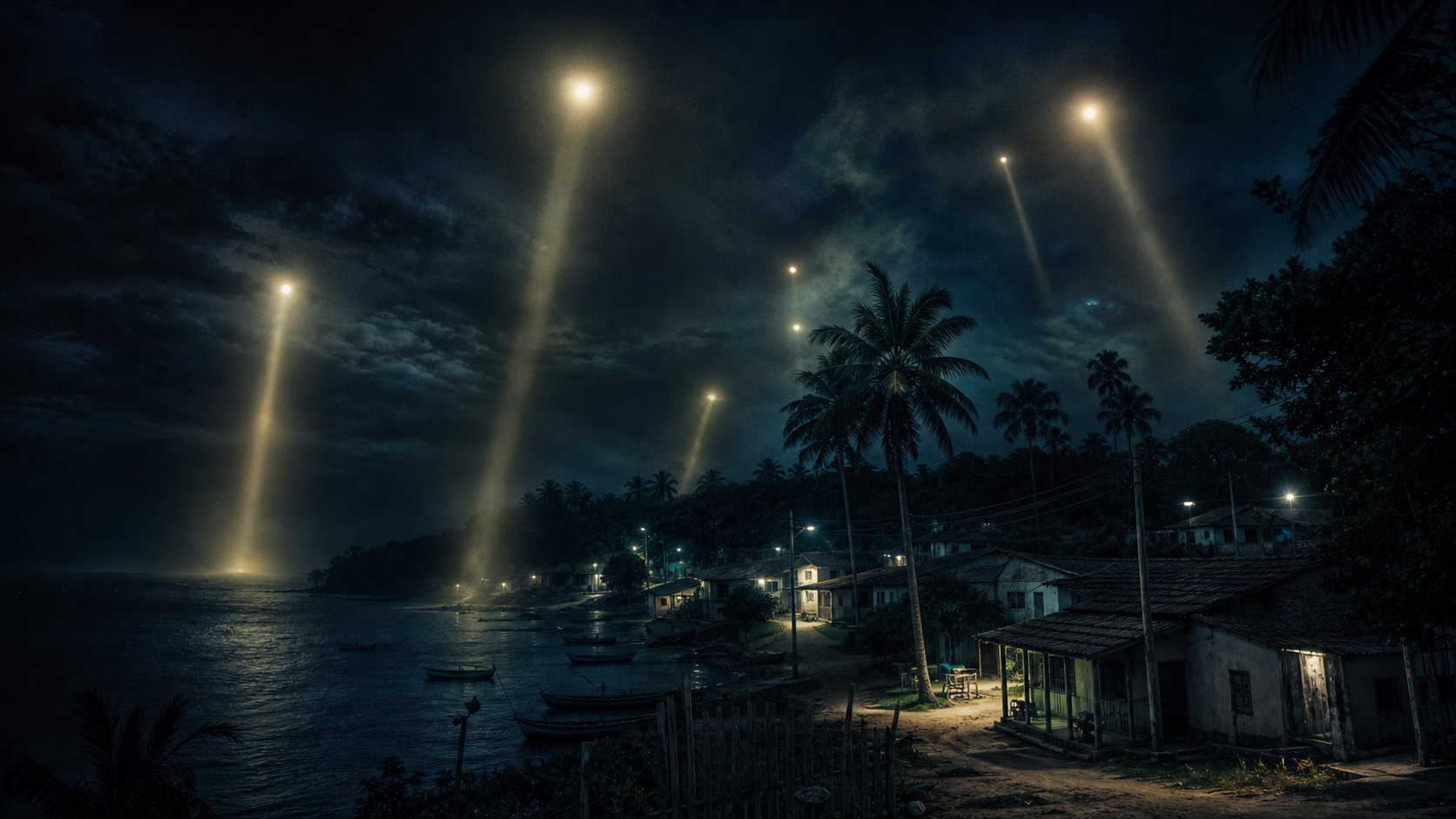
The Colares Flap: When the Lights Over Brazil Seemed to Hunt People
A Case That Refused to Stay in the Sky
Most UFO stories follow a familiar pattern: strange light, uncertain witnesses, blurry photographs, and a growing legend. The Colares UFO Flap, which unfolded in 1977 on a small island municipality in the Brazilian state of Pará, is different because it moved beyond mere lights in the sky. According to dozens of residents, the objects they called chupa-chupa—roughly, “sucker-sucker”—were not just watching them. They were allegedly targeting people.
That claim is what makes Colares endure. Reports described hovering craft or luminous objects that emitted beams of light, leaving puncture-like marks, dizziness, weakness, bleeding, and in some cases a profound sense of panic. Whether one interprets these accounts as a genuine encounter with an unknown phenomenon, a panic-driven mass interpretation of ordinary events, or something in between, the case stands as one of the strangest in modern UFO history.
What follows is the hard part: separating what was observed from what was inferred, and what was later amplified by memory, rumor, and the inevitable mythology that grows around any event that appears to resist explanation.
The Setting: A Remote Place With an Old Fear
Colares sits near the mouth of the Amazon, in a region where rivers, islands, and mangrove-lined waterways create a world that can feel isolated even today. In the late 1970s, that isolation mattered. Emergency services were limited, communication was slow, and the night sky over the water was expansive enough to turn every light into a potential omen.
The reported incidents began in a period when local residents were already alert to odd aerial phenomena. Small communities in remote regions often develop a practical intimacy with the sky: they know the difference between aircraft, weather, fishing lights, and the planet Venus. That familiarity is why the Colares reports matter. Witnesses were not describing a single confusing sighting from one anxious observer. They were describing a pattern that, at least in their minds, repeated over weeks.
The phenomenon was said to involve lights of varying colors and intensities, sometimes silent, sometimes moving with unnerving precision. People reported feeling as though they were being watched. Others claimed they were struck by beams that left burns or punctures. Some accounts described weakness after exposure, and the local fear grew severe enough that routines were altered and movement after dark became a risk.
What the Witnesses Said
Eyewitness testimony is the backbone of the Colares story, and also its most unstable foundation. The alleged attacks were reported by fishermen, farmers, housewives, and local officials. The accounts vary in detail, but several recurring themes appear:
- bright, low-flying lights or objects approaching homes or people
- beam-like emissions directed at victims
- small marks, often described as punctures or burns
- fatigue, dizziness, trembling, and fear following exposure
- a sense that the lights were intelligent or deliberately hostile
To modern readers, the phrase “beam attacks” sounds cinematic. But we should be careful. Witnesses in fear often use the language available to them. A concentrated flash, a reflective glare, insect bites mistaken for lesions, or a medical condition triggered by stress can become, in testimony, a coherent assault by something unseen. That does not mean the witnesses were lying. It means human beings are trying to make sense of experiences that arrive faster than explanation.
Still, the consistency across many accounts is the reason Colares remains more than a local curiosity. Investigators cannot dismiss the reports as one person’s dream if dozens of people independently describe similar events over the same period. The question becomes whether those similarities point to a single external cause or to a shared environment of fear and suggestion.
The Brazilian Military Steps In
One of the most important elements of the Colares case is the response from Brazilian authorities. The Brazilian Air Force reportedly launched an investigation, popularly associated with the code name Operação Prato—Operation Saucer. The very existence of a military inquiry lends the case a gravity that many UFO stories lack. Governments do not usually spend time chasing swamp rumors unless the rumors have become widespread enough to demand attention.
According to later accounts and declassified materials, military personnel collected testimonies and documented sightings in the region. Some reports suggest the investigators themselves observed unusual lights. That detail is important, but it should not be overstated. Military observation does not equal military confirmation. A trained observer can still encounter ambiguous stimuli, especially in unfamiliar terrain at night.
Even so, the fact that the military investigated tells us something substantial: Colares was not merely a campfire legend. It was a localized event serious enough to attract official scrutiny. Unfortunately, much of the documentary record appears incomplete, and that incompleteness has only strengthened the case’s aura of concealment.
Possible Explanations, None Satisfying
When a case becomes famous for being strange, the temptation is to leap directly to the extraordinary. But disciplined investigation starts with the ordinary and works outward.
One possibility is misidentification. In coastal and riverine areas, aircraft, flares, satellites, meteors, and even atmospheric reflections can appear uncanny under the wrong conditions. Small lights seen through humidity, smoke, or rain can seem to pulsate or maneuver. A beam of light from a boat or aircraft can look purposeful when it intersects with a frightened observer’s line of sight.
Another possibility is a cluster of medical or environmental causes. Skin lesions, weakness, or dizziness could have been interpreted through the lens of a frightening narrative once the story spread. Stress itself can produce physical symptoms, and a community convinced it is under attack can become hypervigilant, misreading ordinary injuries as evidence of an external agent.
Then there is the possibility that something genuinely unexplained occurred, but not necessarily something extraterrestrial. The phrase “unknown” is often the most honest conclusion, though it frustrates those who want a cleaner answer. Investigative humility requires admitting that a report can be credible without being solved.
As for the alien hypothesis, it remains possible only in the weakest evidentiary sense: not impossible, but unsupported by hard proof. No recovered craft, no unambiguous physical trace, no chain of custody for dramatic artifacts—just stories, some photographs, military attention, and a lot of unresolved questions.
Why Colares Still Matters
The Colares Flap persists because it sits at the intersection of fear, testimony, and authority. People say they were attacked. Officials took it seriously enough to investigate. Later researchers found fragments of documentation and a trail of interviews, but not the kind of evidence that closes a case.
That lingering uncertainty is precisely why it deserves attention. Paranormal cases often fail either because they are too thin or because they are absorbed into folklore. Colares resists both outcomes. It is substantial enough to matter, yet elusive enough to remain controversial.
In the archive of UFO history, Colares is unsettling not because it proves the extraordinary, but because it shows how quickly an ordinary community can become convinced that the sky itself has turned predatory.
That is the real investigative lesson. Whether the lights were machines, natural phenomena, hoaxes, or misperceptions magnified by fear, the people of Colares experienced something profound enough to change behavior and memory. A good investigator does not mock that. A good investigator asks what conditions allowed the story to form, why it spread so widely, and why it still survives when so many other cases have faded.
The Verdict, Such as It Is
If you are looking for a clean conclusion, Colares will not give it to you. The reports are too fragmentary, the evidence too inconsistent, and the historical record too incomplete. Yet dismissing the case as simple hysteria would also be too easy. Something happened in Colares that was serious enough to draw military attention and deep enough to leave a mark on local memory.
My assessment is cautious: the Colares Flap is best understood as a genuine mass experience of anomalous lights and frightening effects, filtered through fear, limited medical knowledge, and the absence of reliable public explanation. That may not satisfy believers or skeptics, but it is the most defensible position on the evidence currently available.
In other words, the mystery remains. And in Colares, the sky still earns its reputation.