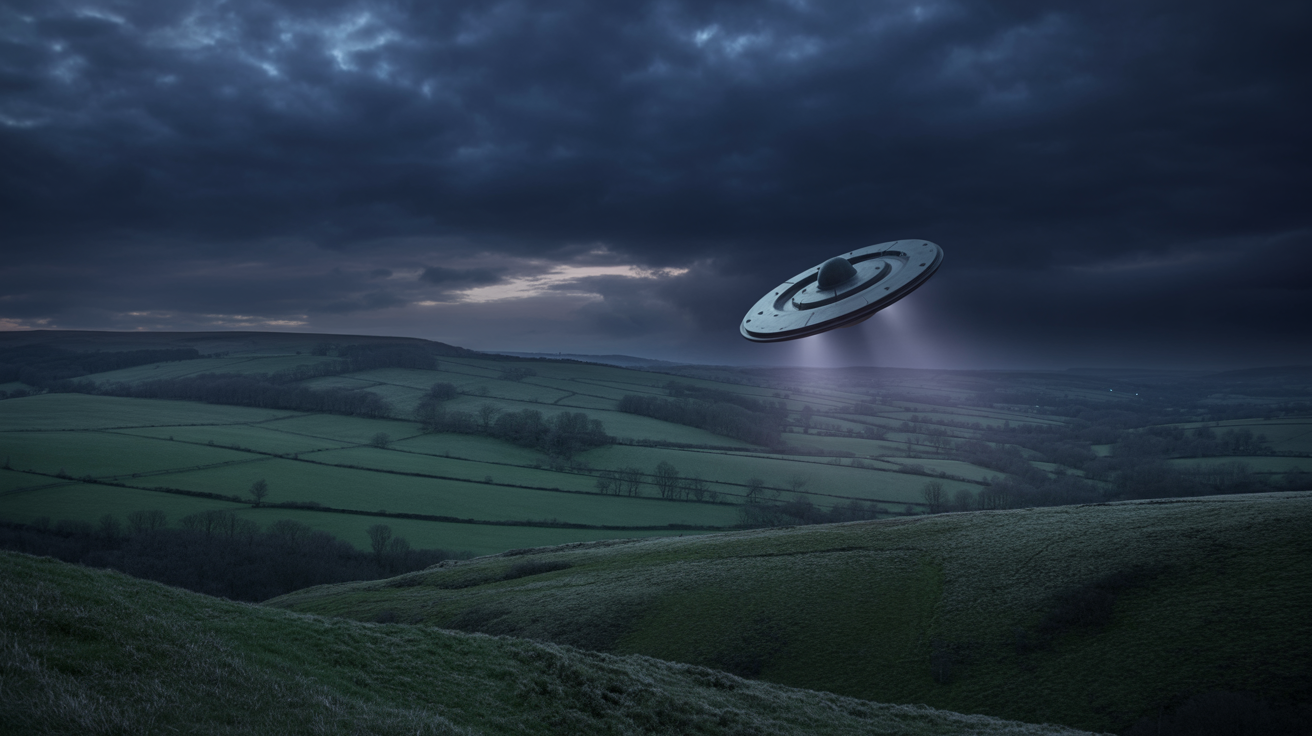
The Broad Haven Triangle: Wales's Most Concentrated UFO Flap
There are UFO sightings, and then there are UFO flaps — concentrated bursts of activity in a specific region over a compressed period of time that strain every conventional explanation simultaneously. The Broad Haven Triangle of 1977 belongs firmly in the second category. What unfolded in Pembrokeshire, Wales, during that year was not a single ambiguous light in the sky reported by a single ambiguous witness. It was a cascade of encounters, involving dozens of credible observers across a tight geographic cluster, that left investigators — including, quietly, the British Ministry of Defence — without a satisfying answer.
I spent time in the CIA tracking patterns. Anomalies cluster. When they cluster this tightly, you pay attention.
The Schoolchildren Who Started It All
The wave began in earnest on February 4, 1977, at Broad Haven Primary School. During a lunch break, a group of children reported seeing a large, cigar-shaped or saucer-shaped craft land in a field adjacent to the school grounds. The object, they said, was silver, elongated, and accompanied by a figure in a silver suit. The sighting lasted long enough for multiple children to observe it before it apparently rose and departed.
What makes this opening incident remarkable is not the sighting itself — children report strange things — but what the headmaster, Ralph Llewellyn, did next. Skeptical and methodical, he separated the children and had each one independently draw what they had seen. He expected the drawings to diverge wildly, the natural result of imagination and peer suggestion. Instead, the sketches were strikingly consistent. The same elongated shape. The same relative proportions. The same figure standing near the craft. Llewellyn, by his own account, was unsettled by the results.
The story reached the local press, and then something unusual happened: rather than dying down, the reports multiplied.
A Geography of Strangeness
Pembrokeshire's southwestern tip — the area roughly bounded by Broad Haven, Little Haven, and the Stack Rocks coastline — became what researchers would later call the Broad Haven Triangle. Over the following months, the encounters accumulated with a frequency that defied easy dismissal.
A hotel owner named Rosa Granville reported waking in the early hours to see an oval craft with a dome sitting in a field near her property. She described figures moving beneath it. A local farmer, Cyril John, reported a similar craft near his land. Two women driving near Ripperston Farm encountered a tall, helmeted figure standing in the road who simply stared at them before they accelerated away in terror. The Coombs family of Ripperston Farm became perhaps the most extensively documented witnesses of the entire flap, reporting repeated encounters over several months — craft hovering near their property, figures observed through windows, cattle behaving erratically, and electrical interference in their home.
The Coombs case attracted the attention of journalist Randall Jones Pugh and researcher F.W. Holiday, who documented the family's experiences in detail. What struck both investigators was the consistency of the family's accounts over time and the evident psychological toll the experiences were taking. These were not people seeking attention. They were, by most accounts, frightened.
The Ministry of Defence Takes Note
Here is where my former professional instincts engage most sharply. When a government agency quietly begins collecting reports on a phenomenon it publicly dismisses, that asymmetry is worth examining.
Documents released under the Freedom of Information Act confirm that the British Ministry of Defence was actively logging the Pembrokeshire reports during 1977. The volume of reports from such a concentrated area was sufficient to generate internal correspondence. The official position, then as now, was that no evidence of a threat to national security was identified. But the logging itself tells a different story about internal attitudes. You don't systematically document something you consider entirely worthless.
The proximity of the sightings to the Castlemartin military range and the RAF Brawdy installation — a facility that, during the Cold War, housed a significant NATO signals intelligence operation — has fueled speculation about whether some of the observed phenomena had terrestrial, classified origins. It is a hypothesis worth holding, though it struggles to account for the full range of reported encounters, particularly the humanoid figures, which don't map neatly onto any known experimental aircraft program of the era.
Applying the Pattern Recognition Framework
In intelligence analysis, we distinguish between noise and signal by looking for internal consistency across independent sources. The Broad Haven flap scores unusually well by this measure.
The witnesses were socially diverse — children, farmers, business owners, adult professionals — and largely unconnected to one another before their experiences. The geographic clustering is tight but not suspiciously so; it spans roughly fifteen miles of coastline and inland terrain. The temporal clustering — the bulk of major incidents occurring between February and the summer of 1977 — suggests either a genuine phenomenon with a natural arc, or a triggering event that initiated a social contagion. The schoolchildren's independent drawings remain the single most difficult piece of evidence to explain away through suggestion or fabrication.
The humanoid figure reports are the most troubling element for a skeptical framework. Lights in the sky have many explanations. Figures in silver suits standing in Welsh farm fields in the middle of the night have considerably fewer.
What We Can and Cannot Conclude
I want to be precise here, because precision matters more than drama.
We cannot conclude that extraterrestrial craft visited Pembrokeshire in 1977. The evidence does not support that conclusion with the certainty it would require. What we can conclude is that a significant number of credible witnesses, in a defined geographic area, over a defined period, reported experiences that have not been satisfactorily explained by any conventional hypothesis — not weather phenomena, not aircraft from nearby military installations, not mass hysteria, and not coordinated fabrication.
The Broad Haven Triangle is not famous the way Roswell is famous. It did not generate the same cultural gravity or the same decades of mythology. In some ways, that makes it more interesting. It has not been buried under layers of embellishment and counter-embellishment. The core record — the headmaster's drawings, the MoD files, the documented witness testimonies — sits relatively undisturbed, waiting for the serious analytical attention it has never quite received.
Wales in 1977 was not looking for a UFO wave. It got one anyway. And the question of what, exactly, descended on that stretch of Pembrokeshire coastline remains, nearly fifty years later, genuinely open.
That openness is not comfortable. But it is honest. And in this field, honesty is the only currency worth holding.
🛸 Video: The Broad Haven Triangle
A Knight Phenomena Investigation