The Bloop: A Deep-Ocean Mystery That Defied Explanation
During my years analyzing intelligence data at the CIA, I learned that the most compelling mysteries often hide in plain sight—or in this case, in the deepest, darkest corners of our oceans. The story of "The Bloop" is one such case that captivated scientists, cryptozoologists, and conspiracy theorists alike for over a decade.
The Discovery
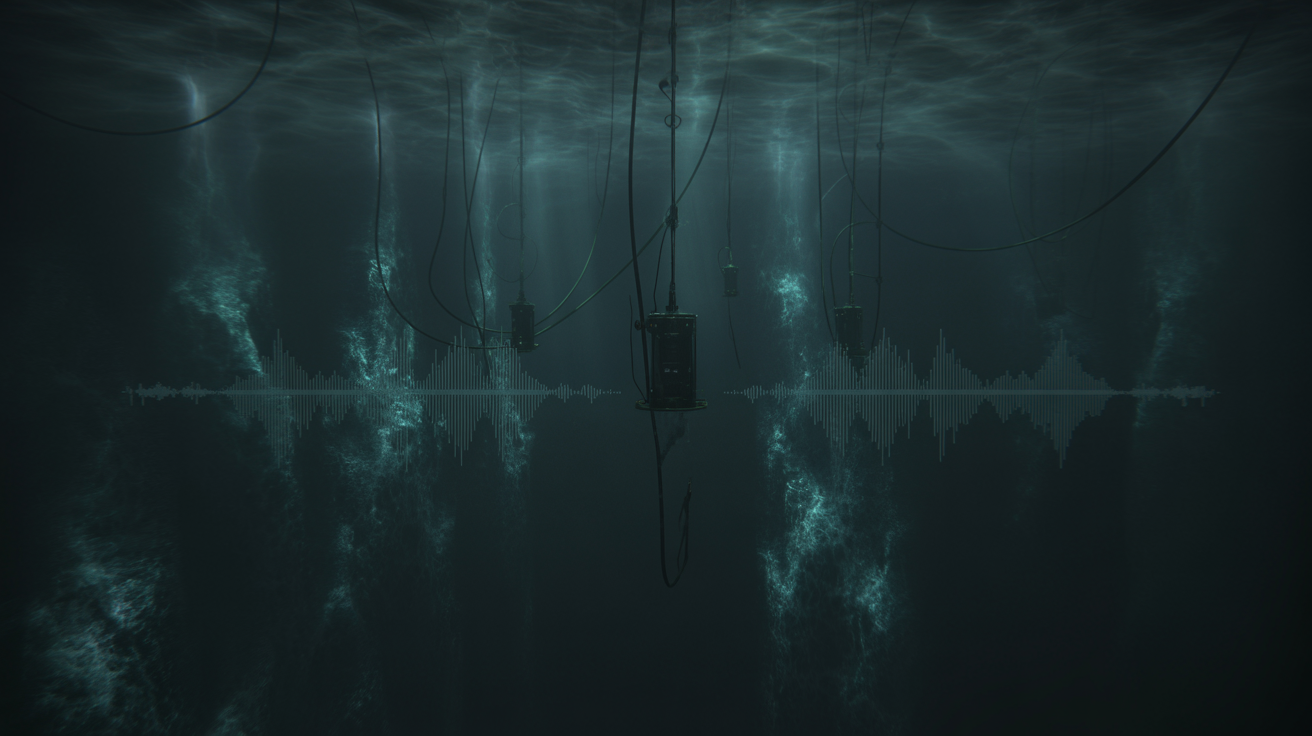
On the morning of May 19, 1997, the National Oceanic and Atmospheric Administration's (NOAA) Equatorial Pacific Ocean autonomous hydrophone array picked up something extraordinary. The sound, later dubbed "The Bloop," was an ultra-low frequency underwater sound detected by sensors over 5,000 kilometers apart. To put this in perspective, this was one of the loudest sounds ever recorded in the ocean—loud enough to be triangulated to a remote point in the South Pacific, approximately 50°S 100°W, roughly 1,750 kilometers west of the southern tip of South America.
The acoustic signature was unlike anything in NOAA's database. It rose rapidly in frequency over about one minute and was powerful enough to be detected on multiple sensors across the Pacific Ocean. The pattern suggested a biological source, but the sheer volume of the sound presented a problem: no known animal could produce something that loud.
The Cthulhu Connection
What made The Bloop particularly intriguing to mystery enthusiasts was its location. The coordinates placed it relatively close to the fictional location of R'lyeh, the sunken city from H.P. Lovecraft's horror stories, home to the cosmic entity Cthulhu. This coincidence fueled speculation about undiscovered deep-sea creatures of enormous size—perhaps even the legendary Kraken or some prehistoric survivor from the age of dinosaurs.
The biological theory wasn't entirely far-fetched. The blue whale, the largest known animal on Earth, produces sounds that can travel thousands of kilometers underwater. But The Bloop was significantly louder and had a different acoustic profile. If it was biological, the creature would need to be substantially larger than a blue whale—an unsettling prospect given that we've only explored about 5% of the ocean floor.
The Investigation
NOAA's Pacific Marine Environmental Laboratory continued monitoring for similar sounds. Between 1997 and 2012, researchers catalogued numerous unexplained underwater sounds: "Upsweep," "Whistle," "Julia," and "Slow Down," among others. Each had unique characteristics, and each defied immediate explanation. The ocean, it seemed, was far noisier and more mysterious than we'd imagined.
The intelligence analyst in me recognized a familiar pattern: limited data, multiple hypotheses, and the need for patient observation. Unlike tracking terrorist cells or analyzing satellite imagery, ocean acoustics required a different kind of patience. The deep ocean doesn't give up its secrets easily.
The Resolution
In 2005, NOAA began to develop a new theory. Researchers noticed that The Bloop's acoustic signature bore similarities to sounds produced by ice calving—the process of ice breaking off from glaciers or ice shelves. However, it wasn't until 2012 that NOAA officially confirmed this hypothesis. The sound was most likely produced by an "icequake," a seismic event caused by large icebergs cracking and fracturing as they break away from Antarctic ice shelves.
The location of The Bloop, while remote, was consistent with the drift patterns of Antarctic icebergs. The sound's intensity could be explained by the massive scale of ice fracturing—potentially involving icebergs the size of small countries. The underwater propagation of sound, combined with the unique acoustic properties of ice fracturing, created the mysterious signature that had puzzled scientists for 15 years.
What It Means
Some might view The Bloop's explanation as anticlimactic—no sea monsters, no undiscovered leviathans, just ice breaking in the Antarctic. But from an analytical perspective, the case reveals something more profound about how we approach mysteries.
First, it demonstrates the vast gaps in our understanding of Earth's oceans. We have better maps of Mars than we do of our own ocean floor. The fact that such a powerful sound could go unexplained for 15 years highlights how little we truly know about the deep ocean environment.
Second, The Bloop serves as a reminder of climate change's far-reaching effects. The increased frequency of ice-calving events in Antarctica isn't just creating mysterious sounds—it's a measurable indicator of warming polar regions. What began as an acoustic mystery became, in retrospect, another data point in understanding our changing planet.
The Unanswered Questions
While The Bloop has been explained, dozens of other underwater sounds remain mysteries. "Julia," detected in 1999, had a similar profile but occurred in a different location. "Slow Down," recorded multiple times between 1997 and 2001, gradually decreased in frequency over seven minutes—a pattern that still lacks a definitive explanation.
The ocean continues to produce sounds we can't explain. With only a fraction of the ocean floor mapped and explored, the possibility of undiscovered phenomena—geological, biological, or otherwise—remains very real. Modern hydrophone arrays are more sophisticated than ever, but they're also detecting more unexplained sounds, not fewer.
Final Analysis
The Bloop case taught me something I'd learned repeatedly in intelligence work: extraordinary claims require extraordinary evidence, but absence of evidence isn't evidence of absence. For 15 years, The Bloop remained unexplained not because scientists weren't looking, but because the ocean is vast, complex, and largely unexplored.
The next time you hear about a mysterious underwater sound or an unexplained oceanic phenomenon, remember The Bloop. Sometimes the truth is stranger than fiction—and sometimes it's exactly as strange as the evidence suggests, just waiting for the right explanation to emerge from the depths.
🌊 Video: The Bloop Deep Ocean
A Knight Phenomena Investigation