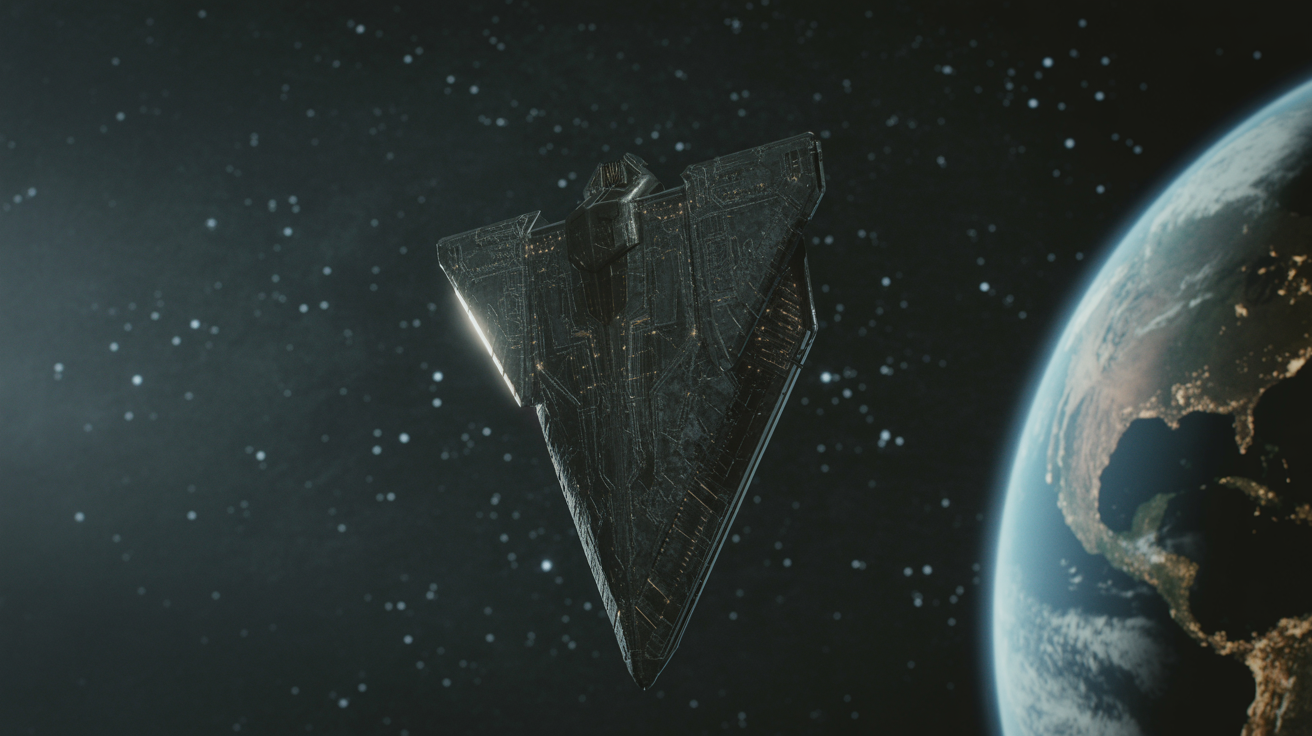
The Black Knight Satellite: Ancient Alien Surveillance or Space Debris?
The Discovery That Sparked Decades of Speculation
In 1960, the U.S. Navy detected an object in polar orbit—a trajectory no known satellite had achieved at that time. Neither American nor Soviet space programs claimed ownership. The object, later dubbed the "Black Knight Satellite," has since become one of the most enduring mysteries in ufology and space exploration.
During my years with the Agency, I learned that the most compelling mysteries often hide in plain sight, buried under layers of official explanations and public dismissal. The Black Knight phenomenon fits this pattern perfectly.
The Evidence: From Radio Signals to NASA Photographs
The story begins even earlier than 1960. In 1899, Nikola Tesla reported receiving strange radio signals he believed originated from space. In the 1920s, amateur radio operators detected unusual long-delayed echoes—signals that bounced back seconds or even minutes after transmission, suggesting reflection from an unknown object in high orbit.
The most tangible evidence emerged in 1998 during the STS-88 Space Shuttle mission. Astronauts photographed a dark, irregularly shaped object floating near the International Space Station. NASA officially identified it as a thermal blanket lost during an EVA. But the photographs show an object far larger and more structured than any thermal blanket—approximately 10 meters long with distinct geometric features.
The Intelligence Community's Silence
What troubles me most is the pattern of official responses. When pressed about the Black Knight, government agencies offer contradictory explanations: space debris, asteroid fragments, optical illusions, or equipment malfunctions. This scattershot approach mirrors tactics I witnessed during classified briefings—throw out multiple mundane explanations to muddy the waters and discourage further inquiry.
Declassified documents from Project Moon Dust and Operation Blue Fly—programs designed to retrieve foreign space objects—contain redacted references to "unidentified orbital objects" tracked during the 1960s. The timing aligns perfectly with the Black Knight sightings, yet these files remain heavily censored.
The Polar Orbit Anomaly
The object's polar orbit remains the most compelling technical detail. In 1960, achieving polar orbit required sophisticated guidance systems beyond the capabilities of both superpowers. If the Black Knight existed as described, it represented technology years ahead of its time. Either it was a classified military satellite—which seems unlikely given both sides denied ownership—or something else entirely.
My Assessment
After analyzing the available evidence through the lens of intelligence methodology, I find three possibilities: First, the Black Knight is a composite myth—multiple unrelated incidents woven into a single narrative. Second, it represents classified military technology from the Cold War era, now lost or forgotten in bureaucratic archives. Third, and most intriguing, it could be evidence of non-human surveillance technology, placed in orbit long before our space age began.
The truth likely lies in the classified files of the National Reconnaissance Office and NASA's restricted archives. Until those documents see daylight, the Black Knight Satellite remains what it has always been: a shadow in orbit, watching and waiting, its origins and purpose known only to those who placed it there—whoever, or whatever, they may be.
🛰️ Video: The Black Knight Satellite
A Knight Phenomena Investigation