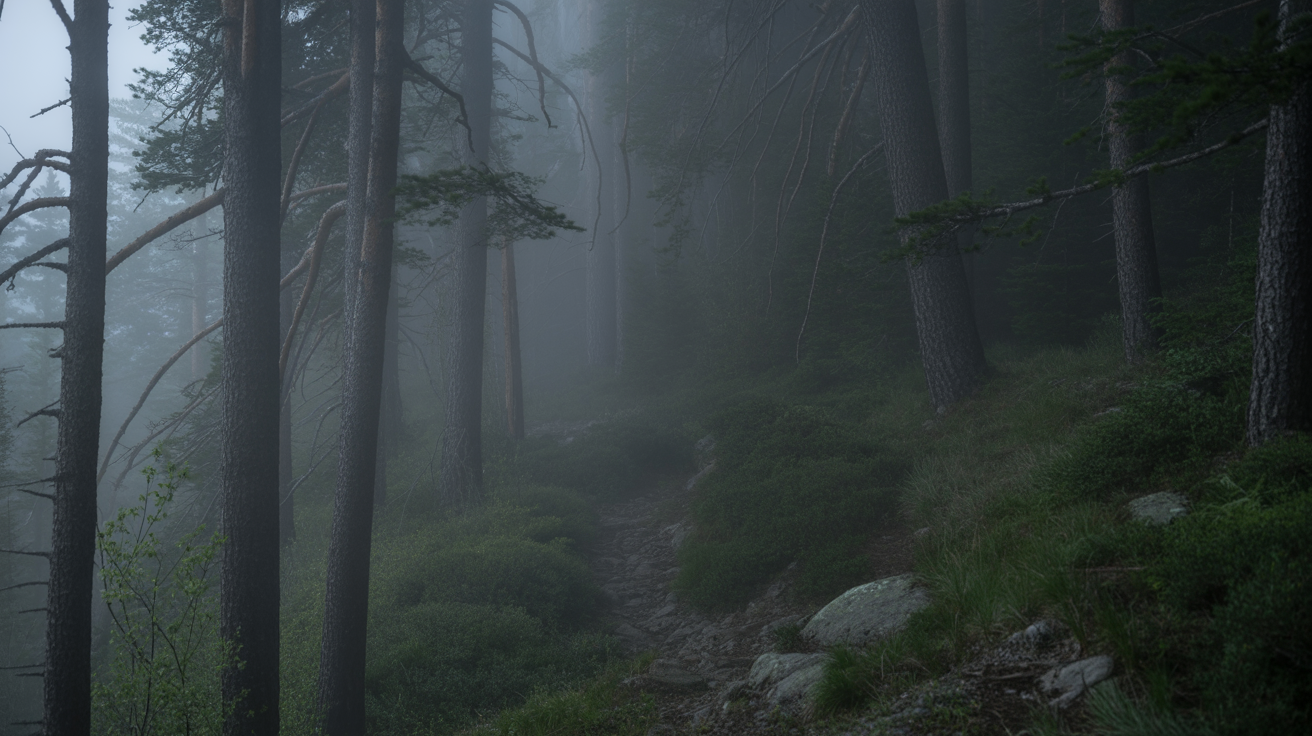
The Bennington Triangle: Five Vanished, Zero Answers, and Vermont's Darkest Corner
I've spent years analyzing patterns—first for the Agency, now for cases that don't fit neat categories. And I can tell you this: when multiple people disappear from the same geographic area within a compressed timeframe, it's either a serial predator or something environmental we don't yet understand. The Bennington Triangle offers neither explanation, and that's what makes it so deeply unsettling.
Between 1945 and 1950, five individuals vanished in the wilderness surrounding Glastenbury Mountain in southwestern Vermont. The cases share almost nothing in common except location and outcome: no bodies recovered, no credible evidence, no resolution. Just absence.
The Disappearances: A Timeline of Erasure
November 12, 1945: Middie Rivers
A 74-year-old hunting guide with decades of experience in these woods led a party of four hunters near the Long Trail. Rivers walked ahead to scout—he knew every ridge and hollow. He never returned. Searchers found no trace despite his bright red jacket and intimate knowledge of the terrain. A man doesn't simply evaporate in country he knows like his own hands.
December 1, 1946: Paula Welden
An 18-year-old Bennington College sophomore told her roommate she was going for a hike on the Long Trail. Multiple witnesses saw her walking the trail in a bright red parka. An elderly couple watched her round a bend. When they followed seconds later, she was gone. The FBI joined state police in one of the largest searches in Vermont history. They found nothing—not a scrap of fabric, not a footprint off-trail, nothing.
December 1, 1949: James Tetford
This case violates basic physics. Tetford, a veteran who lived at the Bennington Soldiers' Home, boarded a bus in St. Albans heading back to Bennington. Fourteen passengers saw him sleeping in his seat. His belongings remained on the luggage rack. When the bus arrived in Bennington, Tetford was gone. He vanished from a moving vehicle with witnesses present. I've reviewed the reports—there's no rational explanation for how a man exits a bus mid-route without anyone noticing.
October 12, 1950: Paul Jepson
An 8-year-old boy playing near his mother's pig farm. She checked on him frequently. In the span of minutes, he disappeared. Bloodhounds tracked his scent to a nearby highway, then lost it—suggesting he got into a vehicle. But no one reported seeing a child alone on the road. No ransom demand ever came. Searchers combed the area for weeks. Nothing.
October 28, 1950: Frieda Langer
An experienced hiker, 53 years old, was with her cousin near Somerset Reservoir when she slipped and fell into a stream. She told her cousin she'd return to camp to change clothes. She never arrived. This is a distance of less than half a mile through terrain she knew. Massive searches involving aircraft, dogs, and hundreds of volunteers found nothing. Then, seven months later, her body was discovered in an area that had been thoroughly searched multiple times. The body was too decomposed to determine cause of death. How does a corpse appear in a location already examined?
The Geographic Pattern
Author Joseph Citro coined the term "Bennington Triangle" in the 1980s, drawing parallels to the Bridgewater Triangle in Massachusetts. The area encompasses roughly 36 square miles of wilderness centered on Glastenbury Mountain. The region has a strange history: the town of Glastenbury was essentially abandoned by 1937 after its logging and charcoal industries collapsed. By 1950, the population had dwindled to single digits.
The terrain is unforgiving—dense forest, steep ravines, abandoned settlements. But experienced outdoorsmen like Middie Rivers don't get lost in familiar territory. College students in bright red parkas don't vanish on well-traveled trails in seconds. And people absolutely do not disappear from moving buses.
Theories: None Satisfactory
Serial Killer: The victims share no demographic profile. Different ages, genders, circumstances. The timeframe is compressed but not consistent with known serial predator patterns. And it doesn't explain Tetford's bus disappearance or Langer's body appearing in a searched area.
Wild Animal: Vermont has bears and, historically, catamounts (mountain lions). But predators leave evidence—blood, drag marks, scattered belongings. These cases left nothing. And animals don't abduct people from buses.
Disorientation/Exposure: Possible for some cases, but doesn't explain the lack of remains. Doesn't explain multiple witness accounts of people vanishing within seconds. Doesn't explain Tetford.
Voluntary Disappearance: An 8-year-old boy? A man on a bus who left his belongings? A guide in the middle of leading a hunting party? The theory collapses under scrutiny.
What the Evidence Actually Shows
I approach these cases the way I approached intelligence work: what can we verify, and what does the verified information tell us?
Verified: Five people disappeared in a concentrated geographic area within five years. Verified: Massive search efforts yielded almost no physical evidence. Verified: At least one body (Langer's) appeared in a previously searched location. Verified: Multiple witnesses observed at least two victims moments before they vanished.
What this suggests: Either we're dealing with an extraordinarily skilled predator who left no forensic trace in an era before DNA awareness, or there's an environmental factor we don't understand. The Tetford case alone defies conventional explanation.
The Silence After 1950
Here's what troubles me most: the disappearances stopped. Abruptly. After Frieda Langer's body was found in May 1951, the pattern ended. If this was a serial predator, they either died, were incarcerated for other crimes, or moved. If it was environmental, why the sudden cessation?
The area remains remote and heavily forested. Hikers still traverse the Long Trail through the region. But the cluster of vanishings never resumed.
Conclusion: The Unresolved Pattern
I've learned to be comfortable with uncertainty, but the Bennington Triangle cases resist even tentative conclusions. The disappearances are too varied to suggest a single cause, yet too concentrated to dismiss as coincidence.
What happened to Middie Rivers, Paula Welden, James Tetford, Paul Jepson, and Frieda Langer? The evidence doesn't provide answers—only the certainty that five people entered a specific area of Vermont and ceased to exist in any traceable way.
The woods around Glastenbury Mountain keep their secrets. And in the absence of evidence, all we're left with is the pattern itself: a cluster of erasures in a landscape that seems to have swallowed people whole.
Some mysteries don't resolve. They just stop.
🌲 Video: The Bennington Triangle Vermont
A Knight Phenomena Investigation