The Bélmez Faces: Spain's House of Screaming Walls
There is a particular kind of dread reserved for the familiar made wrong. Not the monster in the dark, but the face in the floor. The expression that wasn't there yesterday. The eyes that seem to follow you as you back out of the room.
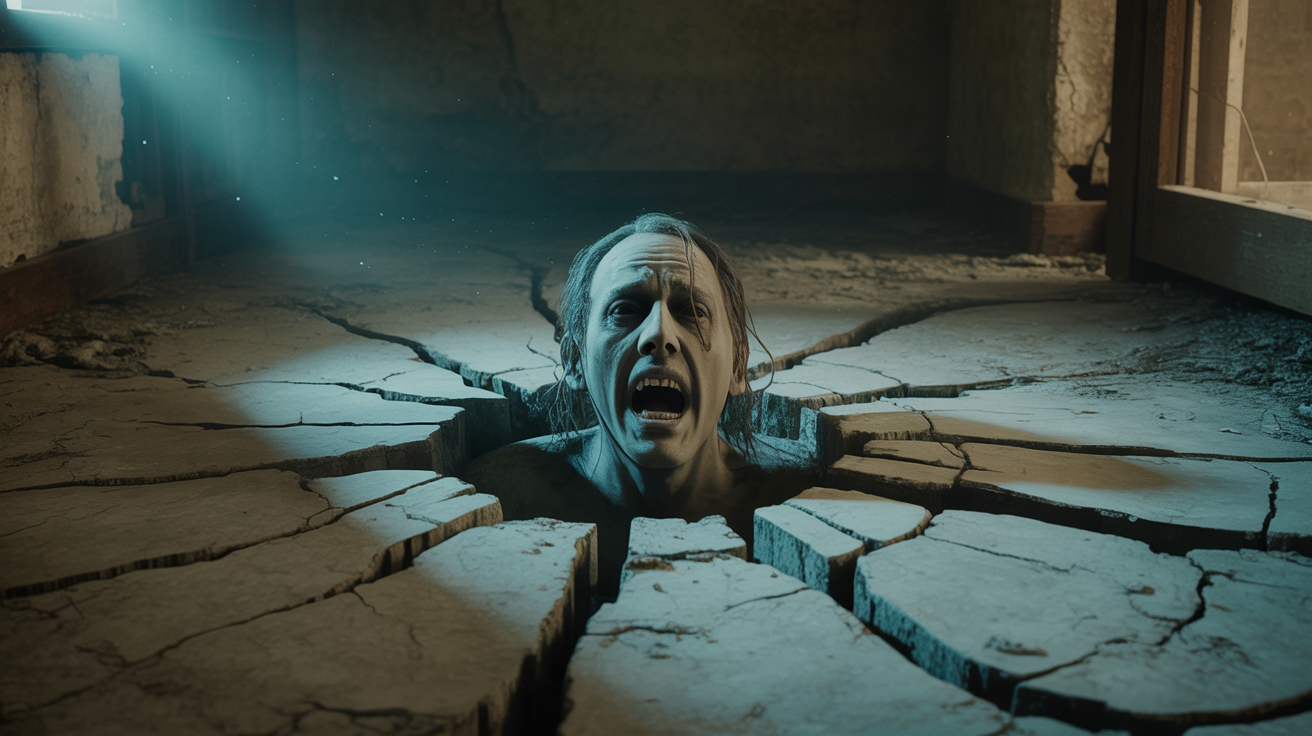
In August 1971, a woman named María Gómez Cámara noticed something on the concrete floor of her kitchen in Bélmez de la Moraleda — a small, sun-bleached village in the Jaén province of southern Spain. A shape had appeared in the cement. A human face. Hollow-eyed, mouth slightly open, staring upward from the ground as though pressing against the surface from below.
What happened next would consume the next five decades in argument, investigation, and genuine scientific bewilderment.
The Face That Would Not Die
María's husband, Juan Pereira, and their son Miguel did what any rational person would do. They took a pickaxe to the floor and destroyed it. Fresh concrete was poured. The kitchen was sealed and left to cure.
Within days, the face returned.
Word spread through Bélmez with the speed that only small towns can manage. The local mayor, recognizing both the cultural weight and the potential chaos, ordered the face cut from the floor entirely and preserved. The slab was removed and is still displayed today. But before the concrete had fully dried on the replacement floor, new faces began to appear — different faces, multiple faces, a shifting gallery of expressions that seemed to change configuration depending on when you looked.
The house at 5 Calle Real became an immediate pilgrimage site. Thousands of visitors arrived from across Spain and eventually from across Europe. The Pereira family, by most accounts a modest and deeply unsettled household, had not sought attention. María reportedly found the faces deeply disturbing and wanted them gone. That detail matters. It is the detail that separates this case from the long tradition of religious image apparitions carefully cultivated for tourism and devotion.
What the Investigators Found
The case attracted serious scrutiny almost immediately. In 1971, the floor was sealed for three months under the supervision of researchers from the Spanish National Research Council. Microphones were placed beneath the concrete. What the recordings captured — described by investigators as voices, moans, and fragmented human sounds — has never been fully explained, though the recordings themselves remain contested in terms of their chain of custody and interpretation.
More compelling, at least from an evidentiary standpoint, was the excavation conducted beneath the kitchen floor. Workers discovered human skeletal remains — multiple individuals, some showing signs of having been buried without heads. The site sat in a region with a documented history of Moorish settlement and subsequent Christian reconquest, periods during which summary executions and mass burials were not uncommon. The bones were removed and given a proper burial. The faces did not stop appearing.
Chemical analysis of the faces themselves produced results that investigators found difficult to dismiss. Studies conducted in the 1990s by researchers including Professor Hans Bender of the University of Freiburg — one of Europe's most respected parapsychologists — and later by teams using more modern spectroscopic analysis found no evidence of applied pigment, paint, or dye in the formations. The faces appeared to be intrinsic to the concrete itself, with the darker tones resulting from variations in the material's composition rather than any surface application.
Crucially, the faces were also observed to change. Photographs taken weeks apart showed alterations in expression — mouths that had been closed appearing open, eyes shifting in their orientation. These changes were documented by multiple independent observers, not just the family.
The Theories
The Fraud Hypothesis is the first place any serious investigator must begin. The timing — a slow August in a poor rural village, the sudden arrival of tourists and media — creates an obvious motive. But the fraud hypothesis runs into several problems. The chemical analyses found no paint or applied substance. The faces appeared in a sealed room under observation. And María Gómez, by every account from neighbors and investigators who knew her, was a woman who wanted the faces gone, not a woman running a scheme. She reportedly wept when new faces appeared. She died in 2004, and the faces continued appearing in the house afterward.
The Geological and Chemical Hypothesis proposes that mineral deposits in the groundwater, combined with the specific composition of the local concrete mix, could produce organic-looking patterns through a process of differential oxidation or mineral migration. This is not an unreasonable starting point. Pareidolia — the human brain's tendency to find faces in random patterns — would then do the rest of the work. The problem is that the faces documented at Bélmez are not ambiguous cloud-shapes requiring imaginative interpretation. They are detailed, recognizable human faces with distinct features. And the documented changes in expression are harder to attribute to passive mineral migration.
The Psychic Impression Hypothesis, favored by parapsychological researchers, suggests that the traumatic history of the site — the mass burial, the violence implied by the decapitated remains — left some form of residual energy imprinted in the physical material of the location. This falls into the category of what researchers call a place memory or stone tape phenomenon, the idea that certain materials can record and replay emotional or psychic events the way magnetic tape records sound. It is an elegant theory. It is also entirely without a confirmed physical mechanism.
The Ongoing Manifestation Hypothesis — the one that keeps serious investigators returning — simply notes that the phenomena have continued across more than fifty years, through multiple owners, multiple floor replacements, and the death of the original witness. Whatever is happening in that house in Bélmez, it does not appear to require the Pereira family to sustain it.
The Case Today
The house remains open to visitors. New faces have been reported as recently as the 2010s. The original slab, the first face that María's husband tried to destroy with a pickaxe, is preserved and displayed. Researchers continue to visit. No consensus has been reached.
Bélmez de la Moraleda has leaned into its identity as the village of the faces — there is a small museum, guided tours, a local economy built around the mystery. Skeptics point to this as evidence of sustained motivation to perpetuate the story. Believers point to the chemical analyses and the documented changes as evidence that something genuinely anomalous is occurring.
Knight's Assessment
I spent twenty years at the Agency learning to distinguish between cases where the evidence is thin and the story is compelling, and cases where the evidence itself is the problem — where it refuses to resolve cleanly no matter how hard you push it. Bélmez is the second kind of case.
The fraud hypothesis is the correct place to start, and I understand why many investigators stop there. But the chemical analyses are not nothing. The sealed-room observations are not nothing. The continued manifestations after the original family's involvement ended are not nothing. A good analyst does not dismiss inconvenient data because it complicates the preferred explanation.
What I find most striking about Bélmez is the detail that the faces change. Static anomalies — a stain, a mineral deposit, a pattern in wood grain — do not change expression over weeks. If that observation is accurate, and multiple independent witnesses suggest it is, then we are dealing with something that does not fit neatly into any existing framework, geological, psychological, or paranormal.
I don't know what is happening in that kitchen in Andalusia. After fifty years of investigation, neither does anyone else. And in my experience, that kind of sustained, documented uncertainty is itself a form of evidence — evidence that the question is real, even if the answer remains out of reach.
The faces are still there. They are still watching. And we still don't know why.
😱 Video: The Belmez Faces Spains
A Knight Phenomena Investigation