The Belgian UFO Wave: What the Evidence Actually Shows
When a Mystery Becomes a Case File
The Belgian UFO wave is one of the more disciplined cases in modern anomaly reporting, not because it produced a definitive answer, but because it left behind an unusually thick record: civilian testimony, police reports, military involvement, press attention, and later technical scrutiny. Between late 1989 and the spring of 1990, Belgium experienced a sustained series of sightings that were often described as large, silent, triangular objects with lights at the corners. The pattern was familiar enough to attract public fascination, but the case is worth revisiting for a different reason: it is one of the rare UFO episodes where the question is not whether people reported something, but what those reports can actually support once separated from rumor, embellishment, and later mythology.
The core lesson here is methodological. A mystery becomes compelling only when the evidence can survive contact with time, memory, and replication. In the Belgian case, the evidence includes credible witnesses and official interest, but it also includes gaps, uncertainty, and one famous image that was later admitted to be a hoax. That combination makes the case more interesting, not less. It gives us a chance to examine how extraordinary claims are built, how they spread, and how quickly public perception can outrun the underlying record.
The Wave Begins: Reports, Patterns, and Public Attention
The first phase of the Belgian wave emerged in the autumn of 1989 and intensified into 1990. Multiple witnesses across Belgium reported unusual aerial objects, often triangular or polygonal in shape, sometimes described as black, silent, and low enough to be seen in detail. The reports came from civilians, police officers, and other observers who believed they had seen something outside ordinary aircraft traffic. The fact that the reports clustered geographically and temporally gave the phenomenon momentum. It was not a one-off sighting that could be dismissed as isolated misidentification; it was a series of claims that appeared to reinforce one another.
The most famous common elements were the triangle shape and the lighting arrangement, often described as three bright lights at the corners and a larger central light or dark mass. Witnesses frequently emphasized the absence of sound, which is typical in many UFO narratives because silence helps distinguish an object from conventional aviation experience. But silence alone is not proof. At night, distance and scale are notoriously difficult to judge. A distant helicopter, conventional aircraft viewed head-on, or even atmospheric effects can create a strong impression of controlled movement and structured geometry. In intelligence work, the first task is always to ask whether the observer had the information needed to support the conclusion they reached.
That does not mean the reports should be dismissed reflexively. It means they should be weighed. What made Belgium unusual was the willingness of authorities to take the reports seriously enough to examine them publicly rather than bury them in ridicule. That openness created a better record than most UFO cases have, but it did not eliminate the central problem: eyewitness confidence is not the same thing as objective identification.
SOBEPS and the Civilian Record
A major role in the Belgian case was played by SOBEPS, the Belgian Society for the Study of Space Phenomena. SOBEPS collected witness accounts, documented locations, and helped shape the public understanding of the wave. Its involvement matters because organized civilian investigation can preserve data that would otherwise evaporate. In many mystery cases, the record is thin because no one gathers the information in time. In Belgium, that did not happen. The result was a much denser archive of testimony than is usual for this kind of event.
At the same time, a civilian organization is not a neutral instrument in the intelligence sense. It may begin with curiosity, but it also tends to select for unusual reports and to amplify the significance of patterns that may or may not be meaningful. That is not a criticism of earnest investigators; it is a recognition of the human tendency to search for coherence. Once a triangular object becomes the leading frame of reference, later sightings are more likely to be interpreted through that lens. This is how case narratives harden. The initial observations are one thing; the shared storyline that develops around them is another.
Belgium’s UFO wave therefore sits in a space familiar to analysts: a mixed-source file with a real phenomenon in the sense that people really did report seeing something, but with uncertain inference about what that something was. The reports were genuine. The interpretation remained unresolved.
The Military Dimension: Colonel Wilfried De Brouwer and the F-16 Intercepts
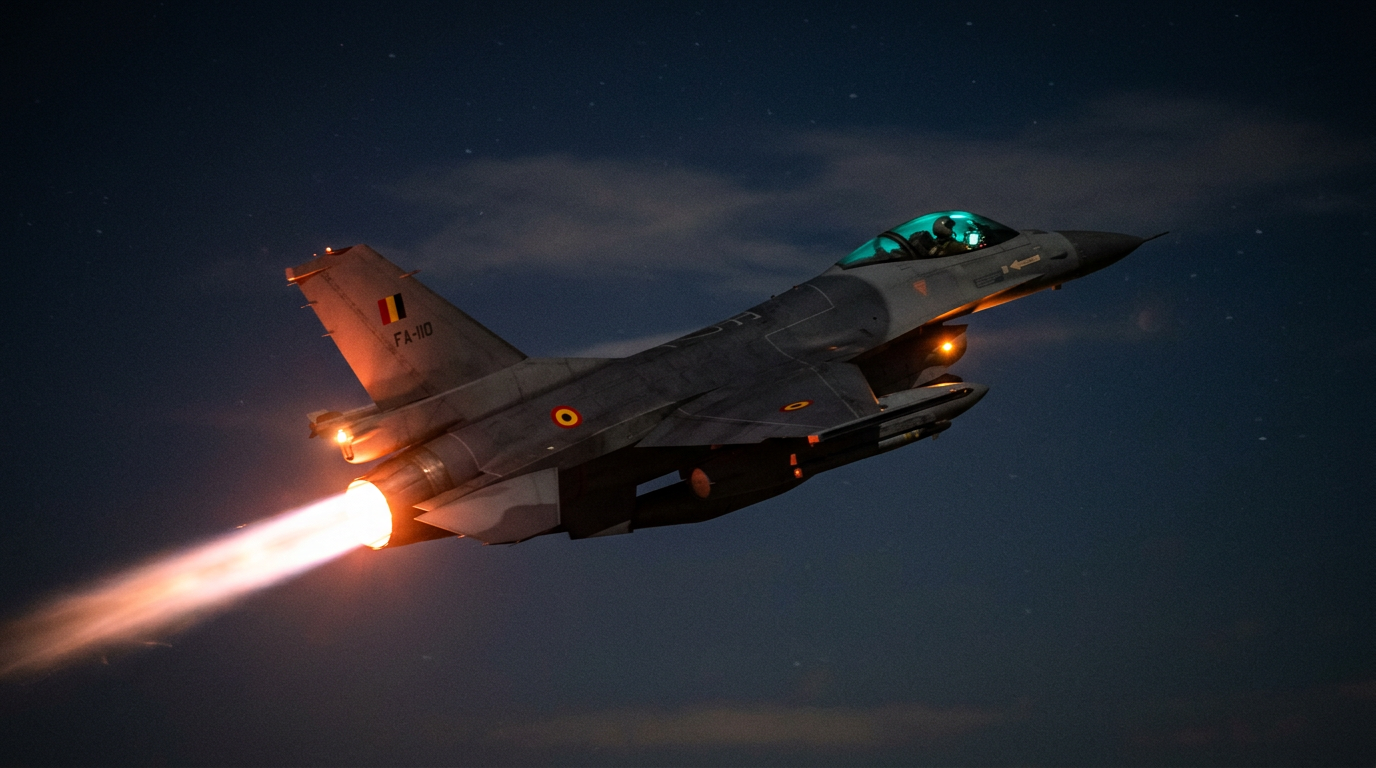
The involvement of the Belgian Air Force is the aspect of the case that most often gets cited as evidence of something extraordinary. Colonel Wilfried De Brouwer became closely associated with the official response and later spoke publicly about the military’s interest in the wave. The significance of his role is not that the military declared the objects extraterrestrial; it did not. The significance is that the military did not simply ignore the reports. Belgian authorities treated the sightings as operationally relevant enough to investigate them.
The most discussed event occurred on 30 March 1990, when Belgian F-16s were scrambled to intercept a reported unknown target. Radar data, according to later accounts, indicated a contact that changed altitude and speed in ways that appeared unusual. This is the point in the story where the case becomes famous among UFO researchers: a supposed visual report, followed by military radar interest, followed by intercept attempts. It is an elegant narrative because it appears to progress from subjective observation to objective instrumentation.
But radar data must be handled carefully. A radar return is not automatically a solid object in the sky; it is a signal that may represent an aircraft, a weather effect, ground clutter, interference, or a processing artifact. In the Belgian case, the F-16 pursuit data were widely discussed, and the episode was presented as a remarkable demonstration that something real had been tracked. Yet the existence of unusual radar behavior does not by itself identify the target. It only tells us that the system registered something worth investigating. Analysts know that sensors can be informative and misleading at the same time.
That does not make the Belgian military response unimportant. It means the response confirms seriousness, not conclusion. The F-16 intercepts show that the phenomenon had enough apparent credibility to engage military resources. They do not prove the objects were exotic in origin. The distinction matters.
Radar Lock, Tracking, and the Limits of Instrumentation
The phrase most often repeated in popular retellings is “radar lock,” which suggests a stable and compelling tracking solution. In practice, radar tracking is more complex. A contact can be acquired, lost, reacquired, or confused with another return. High-speed changes on a display can reflect real target movement, but they can also be influenced by the geometry of interception, system limitations, or errors in interpretation. The Belgian case remains interesting precisely because it sits at the boundary between credible concern and incomplete certainty.
For an intelligence analyst, the question is not whether the data are exciting. It is whether they are reproducible, corroborated by independent systems, and consistent with known physics and operational context. The Belgian record is suggestive, but it is not dispositive. That is why the case remains open in the public imagination: it contains enough technical language to imply precision, but not enough published raw data to close the argument decisively.
There is also a broader issue. Military data often acquire an aura of finality because they are associated with trained personnel and sophisticated equipment. In reality, military systems are operated by humans, interpreted by humans, and embedded in imperfect environments. The presence of radar does not end uncertainty; it only changes its character. In Belgium, the radar aspect elevated the mystery, but it did not eliminate ambiguity.
The Petit-Rechain Photograph: Famous, Then Discredited
No discussion of the Belgian wave is complete without the Petit-Rechain photograph. Taken in 1990 and long treated as a central visual artifact of the case, the image appeared to show a triangular object with bright lights, reinforcing the dominant witness description. For years, it circulated as one of the strongest pieces of alleged visual evidence for the Belgian UFO wave. It became part of the case’s public identity.
Then, in 2011, the individual who had presented the photograph admitted that it was a hoax. That admission is important not merely because it removes one image from the evidentiary pile, but because it exposes a recurring problem in anomaly cases: once a compelling image enters the record, it can reshape the story around it. A photograph has rhetorical power. People trust what appears to freeze reality. But a photograph is also easy to stage, easy to misattribute, and easy to overread. In the Belgian case, the Petit-Rechain image did not just illustrate the story; for many observers, it became the story. Its later discrediting therefore had a corrective value far beyond the image itself.
The hoax does not erase the rest of the case. That is another important point. A fraudulent or staged image can contaminate perception, but it does not automatically invalidate all witness reports or all sensor data. It does, however, demand stricter standards. If one of the most iconic pieces of evidence fails, the burden shifts back to the underlying reports. What remains after the photo is removed is more modest and more uncertain: a wave of sightings, a military response, and a number of reports that still resist simple dismissal but also resist decisive identification.
What the Case Can and Cannot Prove
The Belgian UFO wave is often presented as a near-solved case for whichever side is telling the story. For believers, it is proof that something unusual was present in the Belgian sky and that authorities took it seriously. For skeptics, it is an example of mass suggestion, misperception, and the amplifying power of a dramatic narrative. Both positions overstate what the record actually supports.
What the case can establish with confidence is narrower. First, there were multiple reports from credible-seeming witnesses over a defined period. Second, civilian and military channels both treated the reports as significant enough to document and investigate. Third, the wave included an iconic photograph that was later admitted to be a hoax. Fourth, the available public evidence does not provide a definitive identification of the objects reported. That is the cleanest analytical summary available.
What the case cannot establish is also clear. It cannot prove extraterrestrial origin. It cannot prove a secret weapon. It cannot prove that every witness saw the same thing. It cannot prove that the radar data, standing alone, describe a single physical craft of extraordinary performance. Those claims exceed the evidence.
Analytical Conclusion
The Belgian UFO wave endures because it sits at the intersection of serious witness testimony, official attention, and incomplete resolution. It is not a frivolous case. It deserves study because it produced a structured response and a substantial archive. But seriousness is not the same as certainty. The existence of a military intercept, or of radar tracks that appear unusual, does not automatically validate the most exotic interpretations. Nor does the exposure of a famous photo as a hoax collapse the entire episode into fraud. Reality is usually messier than either camp prefers.
My assessment is straightforward: the Belgian wave remains an unresolved incident cluster, not a solved revelation. It may reflect a mixture of misidentifications, atmospheric or sensor anomalies, and a small number of genuinely puzzling observations that were never fully reconstructed. That is enough to keep the case alive in the historical record. It is not enough to elevate it beyond ambiguity.
In intelligence terms, the proper verdict is not “aliens,” and not “nothing happened.” The proper verdict is that something was reported, something was tracked, and much of the story was later shaped by assumption, repetition, and a photograph that turned out not to be what people thought it was. That, in the end, is often how mysteries really look: less like a final answer, and more like the residue left behind when certainty fails.