The Baigong Pipes: Strange Metal Tubes in the Mountain, or a Geological Illusion?
Introduction
In the canon of modern mysteries, some cases are dramatic because people vanish, lights appear, or messages arrive from nowhere. The Baigong Pipes are stranger in a quieter way. They are physical, measurable, and sitting in plain view: a cluster of pipe-like formations near a mountain in Qinghai Province, China, first pushed into the international mystery circuit in the early 2000s. To believers, they were evidence of a forgotten technology, perhaps even proof that intelligence once visited Earth. To skeptics, they were a case study in how geology can imitate engineering when the evidence is viewed through a sensational lens.
This is the kind of mystery I like best: one with enough hard material to demand an explanation, but enough ambiguity to invite overreach. That is where the line between investigation and mythology gets interesting. The Baigong Pipes deserve that line of scrutiny.
Where the Story Begins
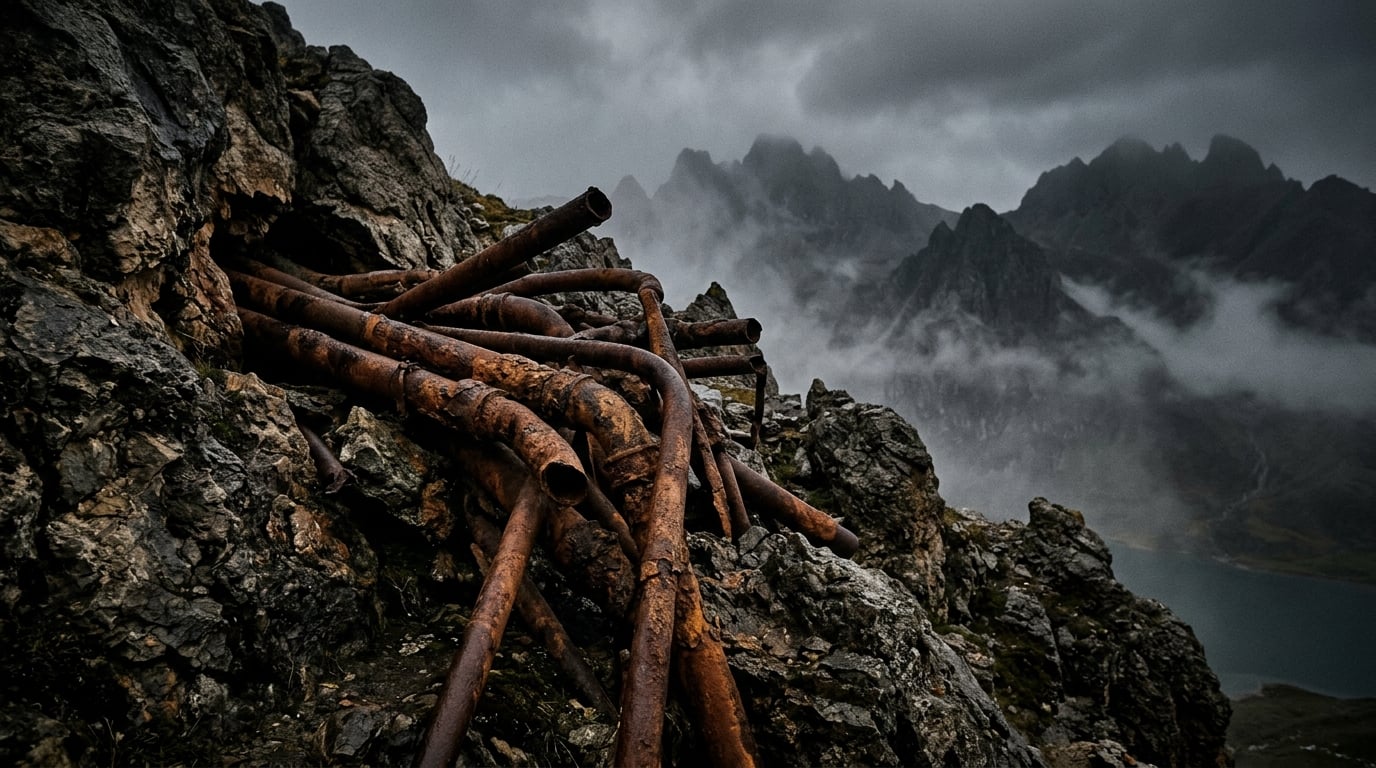
The site most often cited is near Mount Baigong, close to Delingha in Qinghai, not far from the salt-rich waters of Qarhan. The tubes appear in and around a small cave and on the shoreline near a lake. Some are partially embedded in rock. Others extend from slopes or lie scattered nearby. Their appearance is undeniably unusual. Many look like short, rusted cylinders with consistent diameters. Some reports claim a handful have hollow cores. Others say they are almost completely mineralized. That visual ambiguity is the heart of the case.
The story reached wider audiences after Chinese local media and later international outlets framed the tubes as a possible archaeological anomaly. Once that happened, the case became vulnerable to the usual escalation. A curiosity becomes a mystery. A mystery becomes evidence. Evidence becomes a theory. And theory, if it survives long enough online, becomes certainty.
But before we get to aliens and lost civilizations, we need to ask the first question an investigator asks: what exactly is the object, and how was it described by people who actually examined it?
What the Tubes Are Said to Look Like
Descriptions of the Baigong Pipes vary, sometimes dramatically. In some accounts they are metal pipes of uniform shape, rising from rock at odd angles. In others they are “rusted” tubes of varying size, with some embedded in sedimentary layers and others scattered in surrounding soil. Photos show what appear to be pipe fragments and rod-like structures with iron staining. That visual resemblance is the problem and the clue at the same time.
Humans are excellent at recognizing manufactured forms. We spot straight lines, repeated diameters, and right angles almost instinctively. That evolutionary skill can also misfire. Mineral deposits, petrified roots, volcanic conduits, and weathered sedimentary structures can all produce forms that look artificial at a glance. A pipe-like object is not necessarily a pipe. It is only a pipe if the evidence supports manufacture.
That distinction matters because the Baigong site has become a magnet for claims that outpace the data. Some reports suggested the tubes contain high amounts of iron oxide and silica. Others pointed to traces of titanium, calcium, and other elements. But elemental composition alone does not prove industrial origin. Nature can concentrate minerals in deceptively regular ways, especially in chemically active environments.
The Geological Explanation: Why Nature Likes Straight Lines Too
The strongest skeptical case begins with geology. The region around Baigong sits in a complex environment of sedimentary deposits, mineral-rich waters, and long-term chemical alteration. In such settings, tubular forms can arise through several natural processes. Fossilized roots can leave cylindrical voids later filled with minerals. Tree root casts can harden into stone. Fractures in rock can become conduits for mineral-rich fluids, forming rods or pipes of iron oxide and calcite. Erosion can then reveal those structures in ways that look engineered.
One of the most important clues is the apparent scale and distribution of the pipes. An actual technological installation would usually produce a system with consistent functional logic: intake, output, uniform material quality, and a relationship to a process. The Baigong material, as publicly described, does not show that kind of coherence. Instead, it appears scattered, irregular, and mixed with evidence of natural geological activity. That is more consistent with mineralization than with a factory or utility system.
There is also the matter of context. No associated workshops, habitation layers, tools, slag heaps, inscriptions, or clear infrastructure have been found that would support a large-scale engineering culture in the immediate area. If these were ancient pipes, the rest of the system should exist somewhere in the archaeological record. So far, it has not.
Why Mineral Deposits Can Fool the Eye
Pipe-like mineral formations are not rare in principle. In iron-rich environments, groundwater can deposit oxides along channels and cracks, creating tubular masses. When these structures weather out of surrounding stone, they can appear remarkably regular. The phenomenon is not as visually dramatic as a UFO landing, but it is much more common and much more plausible.
The Baigong case also suffers from selective framing. Photos that emphasize straight edges and cylindrical profiles circulate widely, while images showing irregularity and surrounding geological context get less attention. That is a familiar pattern in anomalous claims. The visual argument is persuasive until you ask what the camera is leaving out.
The Ancient Technology Theory
The more sensational interpretation is that the Baigong Pipes are remnants of an ancient technological system, perhaps linked to a forgotten civilization. Some writers have suggested they were a water supply, a heating system, or even evidence of a nonhuman intelligence. These claims are dramatic, but they face a basic burden of proof: a machine is not just a strange object. A machine is a system that solves a problem through design.
To support the ancient-technology theory, investigators would need consistent metallurgy, machining marks, joins, standardized dimensions, and archaeological context. They would need datable evidence showing the structures predate modern industry. They would need more than odd shapes in a remote landscape. At present, that standard has not been met in any widely accepted scientific sense.
Could an unknown ancient culture have constructed something in the region? Of course, that possibility can never be ruled out absolutely. But possibility is not probability. A good investigator separates what could be true from what the evidence currently supports. Right now, the evidence leans heavily toward natural formation and mineralization, not advanced engineering.
The Extraterrestrial Theory
Where ancient technology becomes too pedestrian, extraterrestrial intervention is often waiting in the wings. The leap is easy: if the pipes look artificial and no known civilization can explain them, then perhaps they were built by visitors. The problem is that the alien hypothesis tends to explain everything and nothing at once. It fills gaps with a more mysterious gap.
In investigative work, the alien theory usually fails the economy test. It requires assumptions about advanced travel, site selection, construction purpose, and why no unambiguous technological signature remains. If an intelligence had the means to cross interstellar distances, why leave behind an ambiguous mineralized tube formation that can be interpreted in multiple ways? The hypothesis becomes less plausible the more one asks practical questions.
That does not mean the public fascination is irrational. It means the human mind is tuned to narrative completion. When confronted with an object that seems engineered but lacks a clear origin, we naturally look upward, backward, or outward for the answer.
What the Available Evidence Actually Supports
The most defensible conclusion is cautious and, to some readers, unsatisfying. The Baigong Pipes are a genuine anomaly in the sense that they are unusual and not fully explained in popular accounts. But “unexplained” is not the same as “unexplained by science.” It often just means the story was told faster than the analysis.
Several points matter here. First, the objects are in a geologically active, mineral-rich environment. Second, tubular mineral formations are known to occur naturally. Third, public descriptions of the site are inconsistent and often filtered through sensational reporting. Fourth, no consensus archaeological evidence has established an advanced manufacturing origin. Taken together, those factors make a natural explanation far more likely than an exotic one.
Still, the case is not trivial. If the site has not been studied exhaustively, then a careful mineralogical survey, high-resolution imaging, and independent sampling would be worthwhile. Serious investigation is not an enemy of skepticism; it is how skepticism earns its keep.
Questions That Still Matter
Several practical questions remain open. Are all of the tube-like objects from the same geological process, or are there multiple formations being grouped together under one label? What is the precise chemical composition of the best-preserved specimens? Do the surrounding layers show evidence of long-term hydrothermal activity? Have the samples been handled and interpreted consistently across studies? These are not glamorous questions, but they are the questions that separate investigation from folklore.
There is also a reporting question. In many mystery cases, the first viral description becomes the dominant one, even if later analysis softens or contradicts it. The Baigong Pipes may be one of those cases where the legend has become more stable than the science. Once that happens, the job of the investigator is to peel the legend back carefully, not to mock it, and not to accommodate it beyond the evidence.
Why the Baigong Pipes Endure
So why do the Baigong Pipes keep attracting attention? Because they occupy a sweet spot in the mystery ecosystem. They are visually striking, geographically remote, and suggestive of human design without offering a satisfying explanation. That combination is powerful. It invites speculation from archaeologists, alternative historians, and the UFO crowd alike.
There is also a deeper reason. We want proof that the world contains more history than the textbooks allow. We want signs that civilizations rose and vanished, that knowledge was lost, that the Earth still holds secrets not yet catalogued. Sometimes that desire uncovers real gaps in our understanding. Sometimes it creates a story where geology is enough.
The Baigong Pipes may not be an ancient machine. They may not be alien hardware. But they are an excellent reminder that nature can build forms so strange, so ordered, and so suggestive that our first instinct is to assign intention. That instinct is not a flaw. It is the beginning of inquiry.
Conclusion
After weighing the claims, the most credible explanation for the Baigong Pipes is a natural one: mineralized tubular formations shaped by geology, erosion, and groundwater chemistry in a harsh environment rich in iron and other deposits. That answer lacks drama, but it fits the known facts better than the alternatives.
At the same time, the case remains a useful reminder that skepticism is not dismissal. Anomalies deserve examination because not every strange object is mundane, and not every reported mystery survives contact with evidence. The Baigong Pipes sit in that difficult middle ground where imagination runs ahead of proof. For me, that is exactly where the real investigation begins.
Not every mystery ends with a revelation. Some end with a better question: how often do we mistake the strange architecture of the Earth for the work of someone else?
The Baigong Pipes are compelling not because they prove an impossible story, but because they show how easily a natural formation can wear the mask of design.
🔧 Video: The Baigong Pipes Strange
A Knight Phenomena Investigation