The Atacama Humanoid: A Six-Inch Skeleton That Shook the Boundaries of Science
A Find That Shouldn't Exist
In the intelligence world, we have a phrase for evidence that doesn't fit the established framework: an anomaly. Most anomalies, when properly investigated, resolve into something mundane. A misread signal. A corrupted data point. A human error somewhere in the chain. But occasionally — rarely, and with great significance — an anomaly holds. It refuses to collapse into the ordinary. The Atacama Humanoid is one of those cases.
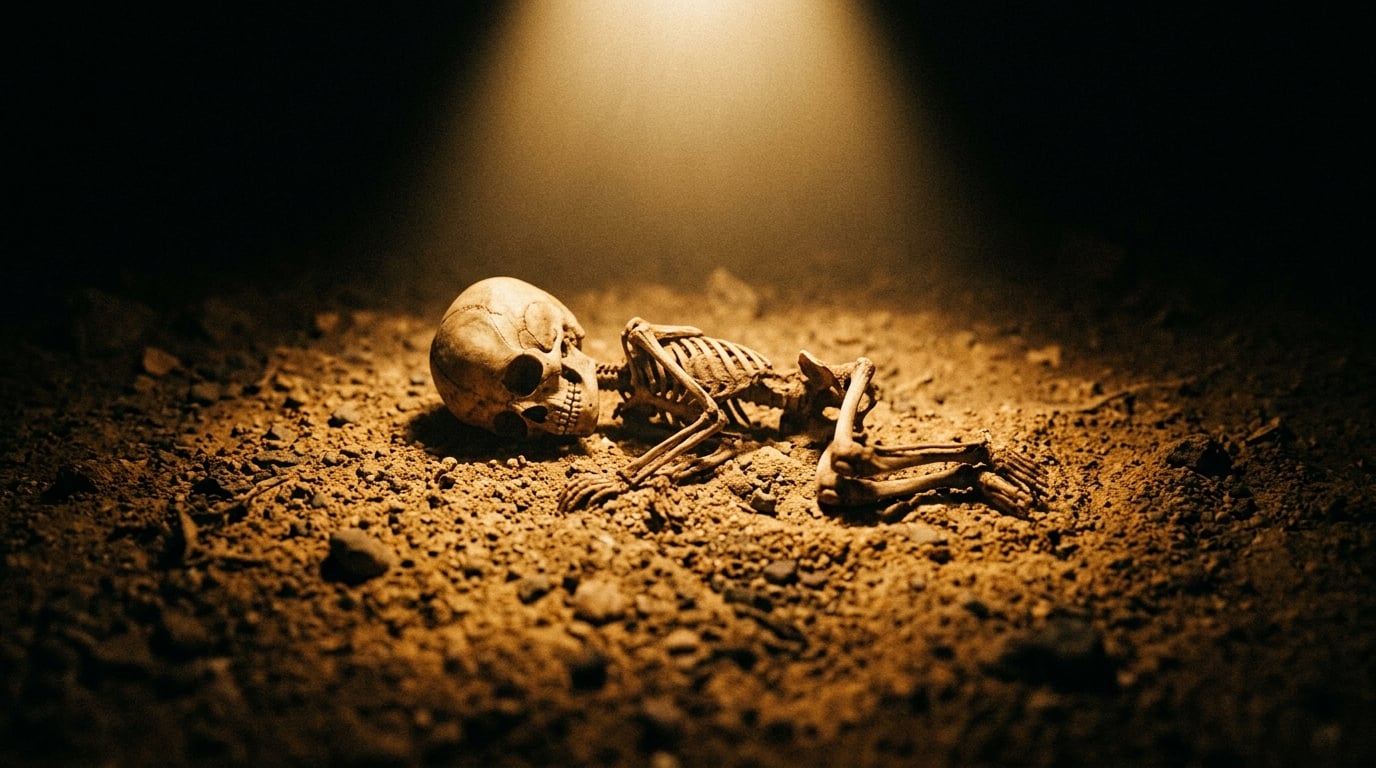
In 2003, in the abandoned nitrate mining town of La Noria in Chile's Atacama Desert, a man named Oscar Muñoz made a discovery while searching for valuables in the ruins. Wrapped in a white cloth, tucked behind a church, was a tiny mummified figure. Six inches long. Humanoid in shape. With a rigid, elongated skull, ten pairs of ribs instead of the standard twelve, and bones with the density of a six-year-old child — despite its minuscule size. Whatever this was, it had not been a fetus. Its skeletal development told a different story entirely.
Muñoz sold the specimen. It passed through private hands, eventually reaching Spanish businessman Ramon Navia-Osorio, who funded an independent documentary investigation. The figure was nicknamed Ata. And when footage of it circulated in the early 2010s, the internet did what the internet does — it exploded with speculation. Alien. Hybrid. Government cover-up. The usual cascade.
But I'm not interested in the noise. I'm interested in what the science actually found — and why that science became its own controversy.
The Anatomy of an Anomaly
Before we get to the DNA, let's establish what made Ata so unusual in the first place. Because the physical characteristics alone warranted serious scientific attention, regardless of any exotic explanation.
Stanford University's Dr. Garry Nolan, an immunologist and one of the most credentialed researchers to engage with this case, examined Ata in detail. His findings, published in the journal Genome Research in 2018, confirmed several striking features. The skeleton had only ten pairs of ribs — a rare anomaly in humans. The skull was elongated and hardened in a way inconsistent with a premature infant. The bone density suggested a developmental age of six to eight years at time of death, yet the total body length was six inches. These features, taken together, do not describe a normal human fetus or premature birth.
Nolan himself stated publicly that when he first examined the X-rays, he was, in his words, stunned. He expected to debunk the specimen quickly. Instead, he found himself looking at something genuinely puzzling.
The elongated skull — technically called turricephaly — is a known condition, caused by premature fusion of cranial sutures. But combined with the rib count anomaly, the bone density, and the overall morphology, the clustering of rare conditions in a single specimen raised legitimate scientific eyebrows. In intelligence analysis, we call this pattern stacking. One anomaly is noise. Multiple correlated anomalies are a signal.
The DNA Results — and the Controversy They Sparked
Here is where the case becomes genuinely complex, and where I want you to pay close attention — because the media coverage of the 2018 DNA findings was, in my assessment, significantly oversimplified.
Nolan's team extracted and sequenced Ata's DNA. The results confirmed human origin. Female. Likely of Chilean or broader South American Indigenous descent. Mitochondrial DNA placed her ancestry in a population consistent with the region. On the surface, case closed. Human. Explained. Move along.
Except that's not quite what the paper said.
The genome analysis identified an extraordinary number of mutations — at least 64 rare gene variants associated with skeletal development, bone density, and growth. Mutations in genes like COL1A1, COL2A1, and FLNB, among others. These are genes linked to conditions like dwarfism, scoliosis, and skeletal dysplasia. The researchers proposed that a combination of these rare mutations, acting together, could theoretically account for Ata's unusual physical characteristics.
The word theoretically is doing a lot of work in that sentence.
Critics within the scientific community pushed back. Dr. Emery Smith and others noted that the proposed genetic explanation required an improbable convergence of multiple rare mutations simultaneously expressing in a single individual — a scenario that, while not impossible, has no documented precedent in medical literature. You don't simply stack that many rare skeletal mutations and produce a living organism, even briefly. The genetics explained the DNA origin. They did not, in the view of several researchers, fully explain the physical form.
There was also the matter of age. Nolan's team estimated Ata died between 40 and 500 years ago based on radiocarbon dating — a range so wide it tells us almost nothing useful. A subsequent independent analysis suggested a more recent date, possibly within the last century. The dating question matters because it affects how we interpret the context of the find entirely.
The Ethical Dimension
I want to pause here and acknowledge something that often gets lost in the excitement of anomalous cases: the human cost of how this specimen was handled.
Ata, whatever her origin, was almost certainly a human child. She was found in a burial context — wrapped in cloth, placed deliberately. She deserved the dignity afforded to human remains. Instead, she spent years in private hands, was displayed in a documentary, and became the subject of global speculation before any formal scientific or ethical review occurred.
Chilean authorities and Indigenous rights advocates raised legitimate concerns about the handling of what may be ancestral remains. The 2018 paper itself acknowledged these concerns. This is not a minor footnote. In my years analyzing intelligence cases, I've seen how the rush to exploit an anomaly — before proper protocols are established — consistently corrupts the evidentiary chain. The same principle applies here. The way Ata was handled compromised both the science and the ethics of the investigation.
That said, the scientific questions she raised remain unresolved. And unresolved questions deserve continued, rigorous, ethical investigation.
What the Intelligence Framework Tells Us
Let me apply the analytical methodology I used at the Agency to what we actually know.
Confirmed facts: Ata is human. Female. Of South American Indigenous descent. She had multiple rare skeletal mutations. She had ten rib pairs. Her bone density was inconsistent with fetal development. She was found in a burial context in northern Chile.
Unconfirmed but plausible: That a rare combination of genetic mutations produced her unusual morphology. That she was a stillbirth or very short-lived infant with severe skeletal dysplasia.
Unresolved: Whether the proposed genetic explanation is sufficient to account for all observed physical characteristics. The precise date of death. Whether additional specimens exist in the region.
Unknown: The full circumstances of her life and death. Whether the burial context indicates she was recognized as human by those who buried her, or something else entirely.
Notice what is not on that list. Extraterrestrial origin is not supported by any evidence in this case. The DNA is unambiguously terrestrial human. I state that clearly because responsible investigation requires it. But the absence of an alien explanation does not mean the case is closed. Human biology produced something here that science has not yet fully explained to the satisfaction of all researchers involved.
La Noria and the Desert That Keeps Secrets
There is one more layer to this case that I find analytically significant, and it has nothing to do with genetics.
La Noria is not just any location. It is one of the most historically documented ghost towns in Chile, a former nitrate mining settlement with a cemetery whose graves were reportedly disturbed repeatedly over the decades — by looters, by poverty, by the desperate economics of a region that never recovered from the collapse of the nitrate industry. Bodies were exhumed. Remains were scattered. The burial context in which Ata was found was already compromised before Muñoz arrived.
This matters because it means we cannot reconstruct the original burial with any confidence. We don't know how long she had been in that specific location. We don't know if she was moved from elsewhere. The provenance of the find is, from an evidentiary standpoint, deeply imperfect.
In intelligence terms, this is a degraded source. The information may still be valid, but the chain of custody is broken, and that limits what conclusions we can draw with confidence.
The Verdict — For Now
The Atacama Humanoid is a human child with an extraordinary clustering of rare genetic mutations that produced a body unlike any documented in medical history. That is the most defensible conclusion the evidence currently supports.
It is also an incomplete conclusion. The genetic explanation proposed in 2018 remains contested. The physical characteristics have not been fully replicated or explained in any living or deceased patient with comparable mutations. The dating is imprecise. The provenance is compromised.
What Ata represents, in the end, is a reminder that human biology is stranger and more variable than our models account for — and that the boundary between the explainable and the unexplained is not always where we assume it to be. She was not an alien. But she was not ordinary either. And in the space between those two statements, the real investigation continues.
I'll be watching the science. You should be too.
Steven Knight is a former CIA analyst and founder of Knight Phenomena. His investigations apply intelligence methodology to the world's most enduring mysteries.
💀 Video: The Atacama Humanoid Six
A Knight Phenomena Investigation