The Aokigahara Forest: Japan’s Silent Labyrinth of Death, Myth, and Misread Evidence
In intelligence work, the first rule is simple: separate the signal from the noise. In the case of Aokigahara Forest, the noise is overwhelming. The Sea of Trees has been cast as cursed ground, a supernatural trap, a place where compasses fail, spirits linger, and the dead call out to the living. But when you strip away the folklore and examine the documented record, a different picture emerges: a dense volcanic forest with a tragic human history, a powerful symbolic function in Japanese culture, and a modern reputation amplified by media repetition.
This is not a ghost story in the conventional sense. It is a case study in how location, culture, and publicity can combine to create a mystery more durable than any single event. The forest is real. The deaths are real. The legend is real in its social consequences. But the supernatural claims? Those require evidence, not atmosphere.
Historical Background: A Forest Built on Fire
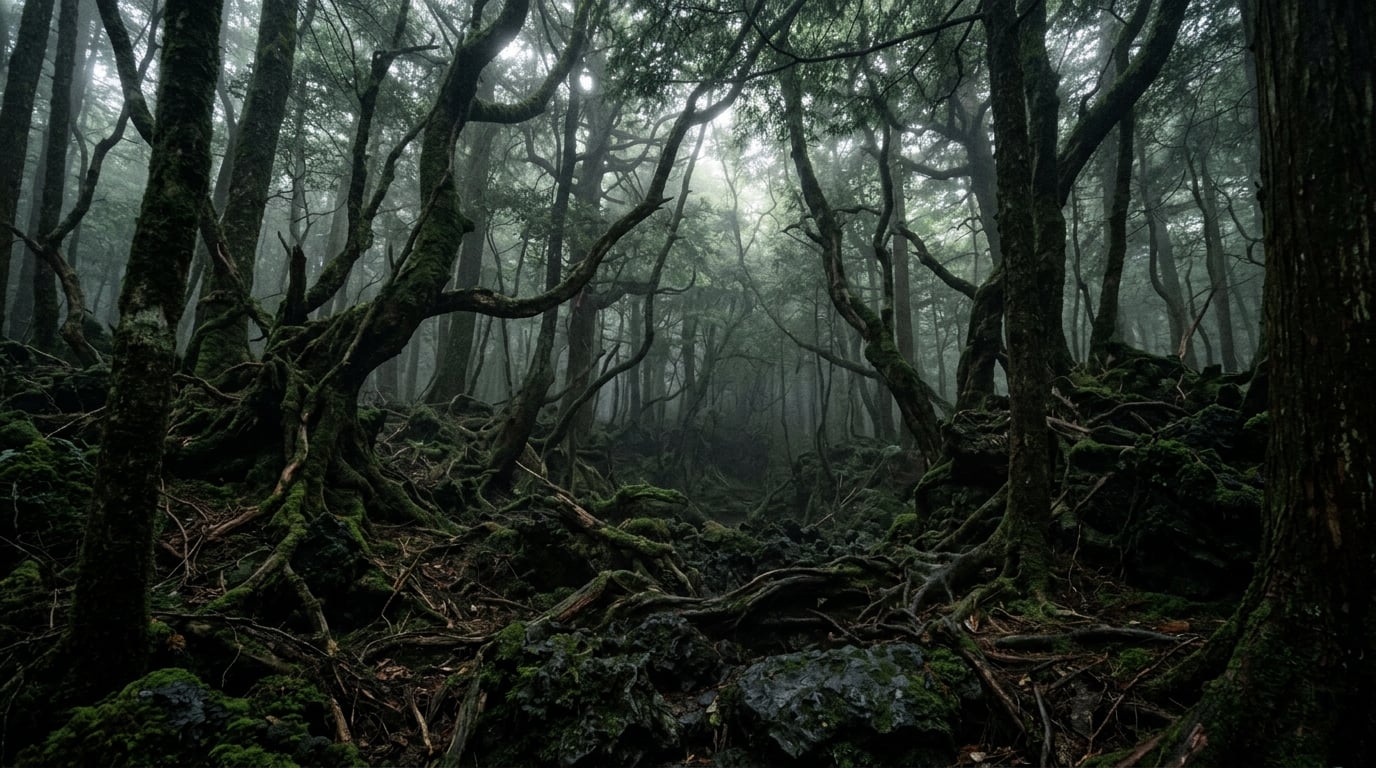
Aokigahara sits on the northwest base of Mount Fuji, growing across lava flows left by the catastrophic Jōgan eruption of 864 CE. That origin matters. The ground is rugged, porous, and irregular. The forest’s dense canopy blocks sunlight. The undergrowth is thick in some areas and strangely open in others, creating an environment that feels disorienting even in daylight. The terrain is not merely scenic; it is structurally difficult.
Long before modern tourism and internet folklore, local tradition associated the area with hardship and death. Japanese mountain regions often carry spiritual significance, and the border between the living and the dead has long been expressed through landscape. In some accounts, Aokigahara’s reputation was reinforced by historical hardship, including periods of famine when families were rumored to have abandoned elderly relatives or children in the mountains. Those stories are debated and often difficult to verify. As with many oral traditions, the line between social memory and literal fact is blurred.
What is clear is that by the 20th century, the forest had developed a grim association with suicide. That association became self-reinforcing. Once a location becomes known as a place of death, vulnerable people sometimes choose it precisely because of that reputation. In intelligence terms, this is a feedback loop: publicity creates expectation, expectation creates behavior, and behavior deepens publicity.
What Witnesses Say: The Forest as Experience, Not Evidence
Visitors consistently describe Aokigahara in sensory terms. The forest is quiet, but not silent. The sound of wind is softened by the dense trees. GPS signals can be unreliable in some areas. Trail markers matter. Straying from marked paths is easy. People who enter without preparation can become confused, anxious, or physically lost. Those are not paranormal observations. They are operational facts.
Witness accounts frequently mention the psychological effect of the place. Some report a feeling of pressure, sadness, or unease. I do not dismiss those reactions. Human cognition is deeply responsive to environment. A forest associated with death, entered under solemn expectations, will shape perception. If a person already feels distressed, the setting may intensify that state. But that is not evidence of haunting; it is evidence of context.
“A place can feel haunted because human beings arrive there carrying fear, grief, and expectation. That is not the same as proving a supernatural cause.”
There are also accounts from search-and-rescue personnel, park workers, and volunteers who have encountered the tragic reality directly: personal belongings, notes, and the aftermath of suicides or attempted suicides. These accounts are sobering, but they do not support a ghost narrative. They support a public health and safety narrative.
The “Suicide Forest” Reputation: Real, Harmful, and Amplified
Aokigahara’s international reputation as a suicide site became especially pronounced in the late 20th and early 21st centuries. Media coverage, documentaries, and sensational articles often fixed on the most lurid details, sometimes with little regard for the people and families affected. This matters because public narratives can be self-fulfilling. If a forest is repeatedly framed as a place where people go to die, that frame may influence the behavior of the vulnerable.
Japanese authorities and local organizations have taken measures to discourage suicide in the area, including signage encouraging visitors to seek help and contact support services. That is the correct response: prevention, not mythology. The tragedy should be treated as a mental health and societal issue, not entertainment.
Some online sources claim that the forest has “countless” deaths or that no one can truly enter without risking spiritual contamination. Those claims are typically ungrounded. Exact figures are difficult to confirm because official reporting and historical practices vary, and governments sometimes avoid publishing detailed suicide-location statistics to prevent imitation. But difficulty of verification is not the same as proof of supernatural influence.
The Evidence Claimed by Paranormal Enthusiasts
Like most enduring mysteries, Aokigahara attracts a familiar set of alleged anomalies. They deserve to be cataloged carefully.
- Compass anomalies: Some claim compasses behave erratically due to the volcanic ground. The plausible explanation is local magnetic interference from mineral deposits, terrain, and human error in interpretation. A compass issue is a navigation problem, not a ghost.
- Disembodied voices: Dense forest acoustics, wind patterns, and suggestion can produce the impression of voices or movement. Humans are pattern-recognition machines. We hear agency where there may be only sound.
- “Cursed” feeling: Emotional impressions are not evidence. They are data about the witness, not the phenomenon.
- Abandoned objects and markers: In an area associated with self-harm, these are tragic but expected indicators of human activity, not signs of paranormal architecture.
There are also internet legends about bodies hanging from trees, tape markers leading off-trail, and “white handprints” or other spectral signs. Many such claims are either exaggerated, secondhand, or presented without provenance. In investigative terms, provenance is everything. A claim without sourcing is atmospheric decoration.
Official Explanations: Geology, Geography, and Human Behavior
The official and scientific explanations for the forest’s reputation are neither glamorous nor mysterious, but they are persuasive.
1. Geology Creates the Environment
The forest grew over lava fields. That origin creates uneven ground, unusual root structures, and sections where the terrain can become confusing. The lava base also influences local magnetics in limited ways. Nothing here requires a paranormal hypothesis.
2. The Forest Encourages Disorientation
Dense canopy, limited sightlines, and patchy trail systems can make navigation difficult, especially for inexperienced hikers. A person who leaves the trail can quickly lose orientation. Panic then amplifies error.
3. Social Reputation Reinforces Use
Once the forest became known as a suicide site, it acquired a tragic identity that could attract vulnerable individuals. This is a documented phenomenon in public health: notoriety can influence method and location choice.
4. Media Sensationalism Distorts Perception
Repeated depictions of Aokigahara as sinister or supernatural create a narrative magnet. Viewers remember the mood more than the facts. Over time, the legend becomes stronger than the record.
Documentary Trail: What Can Be Verified
From an intelligence perspective, the first task is to locate durable, verifiable points in the record. Here is what holds up:
- The forest is a real volcanic ecosystem on Mount Fuji’s slopes.
- Its terrain is difficult and can be disorienting.
- It has a documented association with suicide and prevention efforts.
- Authorities and local groups have actively tried to reduce deaths and discourage exploitation.
- Many sensational claims about supernatural activity are unsupported by primary evidence.
What does not hold up is the leap from difficult geography and human tragedy to supernatural certainty. That leap is emotional, not analytical.
One should also be careful with the popular notion that the forest is uniquely “evil.” In my experience, places do not generate evil in abstraction. Human beings carry intention, despair, and delusion into places. The place then absorbs the meaning we assign to it.
“When a location becomes a repository for human despair, people begin to mistake the accumulation of tragedy for evidence of the occult.”
The Role of Folklore and Cultural Memory
Any serious investigation of Aokigahara must account for Japanese cultural context. Mountain landscapes in Japan often occupy liminal symbolic space. Forests, shrines, and high places can be associated with spiritual transition, purification, or danger. Western reporting sometimes flattens these cultural layers into a simplistic “haunted forest” trope. That is lazy analysis.
Folklore can persist because it organizes fear into narrative. It does not need to be literally true to be socially powerful. In that sense, Aokigahara is not just a forest; it is a vessel for meanings that shift across generations. It holds grief, caution, taboo, and modern media mythology all at once.
That symbolic density is why paranormal interpretations flourish. People enter the forest expecting silence and death, then interpret ordinary sensations through a supernatural lens. The environment becomes a mirror.
Why the Mystery Persists
There are three reasons Aokigahara remains compelling.
- First: It is visually unsettling. Dense woodland has an immediate cinematic quality.
- Second: It is genuinely tied to death and prevention, which gives the legend real emotional weight.
- Third: The internet rewards extremity. A dark place described soberly gets fewer clicks than a cursed place described theatrically.
That combination is powerful. It turns tragedy into folklore and folklore into commerce. Over time, the forest’s image is less the product of direct observation than of repeated retelling.
If you want the hard truth, here it is: the forest is scary because it is easy to get lost in, easy to project onto, and associated with real human suffering. No ghost is required for that. In fact, introducing ghosts can distract from the actual problem.
Field Notes: How an Analyst Reads the Case
My methodology on cases like this is straightforward. I ask four questions:
- What can be independently verified?
- What claims are repeated but not sourced?
- What plausible non-paranormal explanations exist?
- What motive exists for exaggeration, mythmaking, or sensational reporting?
Applied to Aokigahara, the answer is consistent. The evidence supports a tragic, psychologically charged landscape shaped by geology, history, and modern publicity. The evidence does not support a robust paranormal conclusion. The strongest claims for haunting are anecdotal and heavily expectation-driven.
There is one more point worth making. In every mystery, the human urge is to transform discomfort into narrative. But the investigator’s job is to resist that urge until the evidence compels it. Here, it does not.
The Knight Assessment
Aokigahara is not a supernatural anomaly. It is a place where geology created a difficult environment, history layered the site with symbolism, and modern media turned tragedy into legend. The forest’s reputation is real, but reputation is not proof.
My conclusion is measured and, I think, unavoidable: the “mystery” of Aokigahara is primarily a human one. The forest reflects the consequences of isolation, despair, cultural memory, and sensational storytelling. The paranormal claims fail because they do not survive scrutiny. What remains is darker, in a way, than a ghost story: a reminder that myths can form around genuine suffering and then obscure it.
That is the pattern worth remembering. Not because it is mysterious in the occult sense, but because it is entirely human.