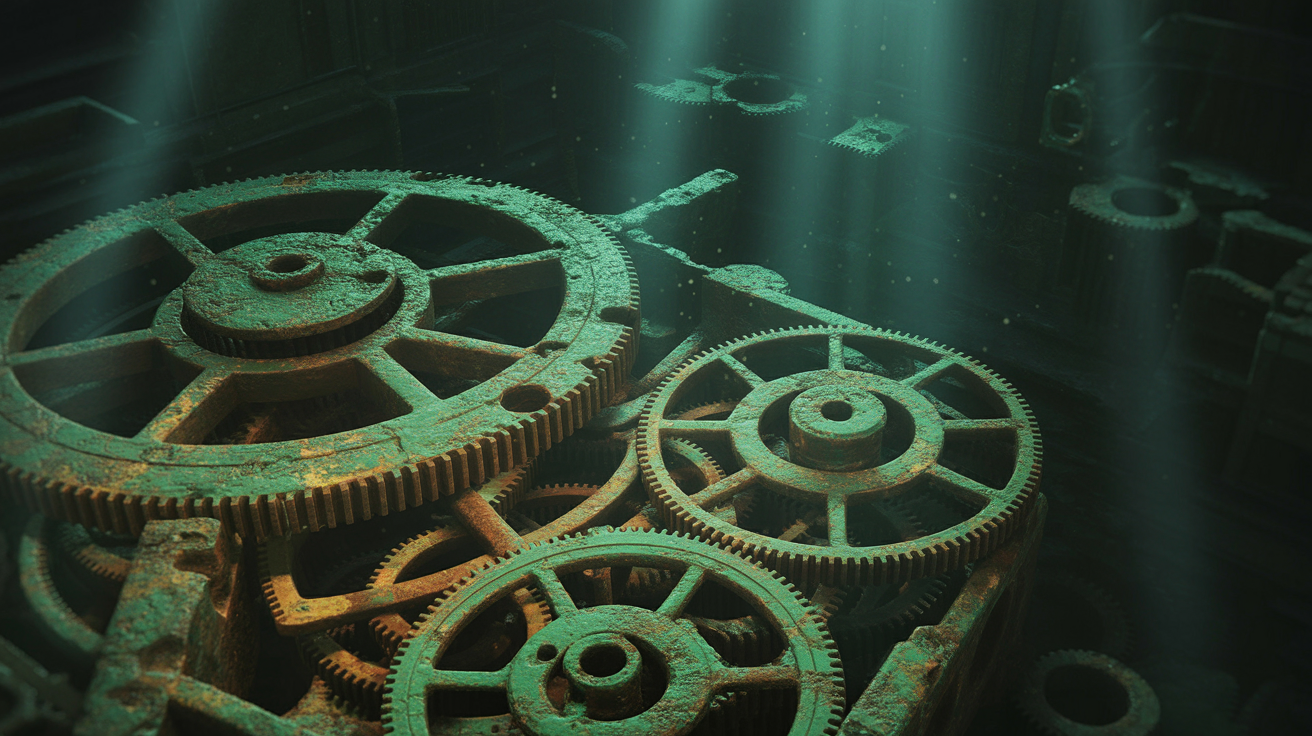
The Antikythera Mechanism: The Machine That Rewrites Ancient History
Discovery in the Deep
In 1901, sponge divers working off the coast of the Greek island of Antikythera made a discovery that looked, at first, like little more than corroded wreckage. Mixed among statues, pottery, and ship timbers were lumps of bronze that seemed unremarkable until scholars began to notice gear teeth embedded inside the metal.
That is where the story shifts from archaeology to investigation. In intelligence work, the first credible anomaly is often the most important one. A single detail that does not fit the expected pattern can change the entire assessment. The Antikythera fragments did exactly that. They were not decorative. They were mechanical. And they belonged to a world we had underestimated.
A Machine in an Age of Bronze
Modern imaging and reconstruction revealed a device made of dozens of precision-cut bronze gears housed in a wooden box with engraved dials and pointers. This was not a simple calculator. It was an analog computer, designed to model the heavens with surprising sophistication. The mechanism could track the movements of the Sun and Moon, predict eclipses, and keep pace with complex calendar cycles used in the ancient Greek world.
Several functions are now supported by strong evidence:
- Tracking the Metonic cycle of 19 years
- Calculating the Saros cycle for eclipse prediction
- Displaying lunar phases and lunar motion
- Mapping calendar and astronomical dates on multiple dials
That level of engineering did not appear from nowhere. It implies a tradition of craftsmanship, mathematical knowledge, and precision tooling that leaves a very different picture of the ancient world than the one many people inherited in school.
What the Evidence Actually Shows
As with any good mystery, the temptation is to fill in the blanks with speculation. The responsible approach is narrower. The surviving fragments, CT scans, and inscriptions tell us what the device did with enough confidence to be compelling, even if parts of its exact operation remain debated.
Researchers have identified gear trains that correspond to lunar anomalies and calendar corrections. The famous back dials likely organized long astronomical cycles, while the front face probably showed the positions of celestial bodies against the zodiac. In practical terms, the user could turn a crank and receive a mechanically generated model of the sky.
That is extraordinary, but not supernatural. From a CIA analyst's perspective, this matters. The first question is not how miraculous the artifact appears. The first question is what can be verified. Here, the verification is solid: the object was real, the gears were real, the inscriptions were real, and the mechanical functions were real. The only remaining mystery is how much of this knowledge was common in its time, and how much was lost later.
When an artifact is this advanced, the real mystery is not whether it worked. The mystery is why history forgot how to build it.
Who Built It?
No one has identified the maker with certainty. That uncertainty is part of the appeal. Some scholars link the mechanism to the intellectual environment of Rhodes, a center of astronomy and engineering in the Hellenistic period. Others point to the work of Hipparchus, whose theories of lunar motion could have informed the design. The names matter less than the network of knowledge behind them.
Devices like this do not emerge from isolation. They require metalworkers capable of cutting fine gears, mathematicians able to translate celestial cycles into mechanical ratios, and patrons willing to fund serious research. In other words, the mechanism points to an ecosystem of advanced scientific thought, not a lone genius working in a vacuum.
That is a lesson intelligence analysts know well. A capability is never just a capability. It is also an infrastructure problem. Who funded it? Who built the tools? Who taught the apprentices? Who preserved the method? The Antikythera Mechanism raises all of those questions at once.
Why It Vanished From History
One of the most unsettling aspects of the Antikythera Mechanism is not what it proves, but what it suggests about the fragility of knowledge. If ancient craftsmen could create such a device, why did no industrial tradition follow from it? Why did this branch of precision engineering not survive into the medieval world in a visible, continuous line?
The answer is probably not a single catastrophic loss. History rarely works that neatly. More likely, it was a slow unraveling: wars, political collapse, shifting patronage, library destruction, and the normal drift of practical knowledge away from specialized hands. A technology can disappear not because it was impossible, but because the conditions that sustained it were fragile.
That is an important distinction. The Antikythera Mechanism does not require aliens, lost supercivilizations, or fantasy to be astonishing. It becomes even more interesting when treated as evidence of real human achievement, later obscured by time.
The Case Against Overreach
Every mystery attracts exaggeration. Some want to turn the mechanism into proof of a hidden golden age. Others flatten it into a lucky oddity. Both positions miss the point.
The strongest interpretation is also the most disciplined: this was an exceptional machine from a sophisticated scientific culture, preserved by accident and recovered in fragments. We do not need to inflate it to respect it. In fact, the evidence is stronger when we resist the urge to make it more mysterious than it already is.
Still, there are unresolved questions worth keeping on the table:
- Was the Antikythera Mechanism unique, or simply the survivor of a larger class of devices?
- How widespread was precision gear-making in the ancient world?
- What texts, workshops, or teaching traditions supported this level of engineering?
- How much scientific knowledge was lost in the centuries that followed?
A Final Assessment
If this case crossed my desk in an intelligence environment, I would file it as a confirmed anomaly with major historical implications. The object is genuine. The sophistication is genuine. The surprise is not. The surprise is ours, because we assumed the ancient world was less technologically capable than the evidence now shows.
That is why the Antikythera Mechanism remains one of the most compelling mysteries on the record. It does not ask us to suspend reason. It asks us to update our assumptions. And in the world of investigation, that is often the hardest task of all.
The machine from Antikythera survives as a reminder that history is not a straight line of progress. Knowledge can surge, vanish, and reappear. Sometimes the past is not primitive at all. Sometimes it is simply waiting for us to catch up.
⚙️ Video: The Antikythera Mechanism The
A Knight Phenomena Investigation