The Amber Room: The World’s Most Beautiful Missing Treasure
Background: A Chamber Built to Impress Empires
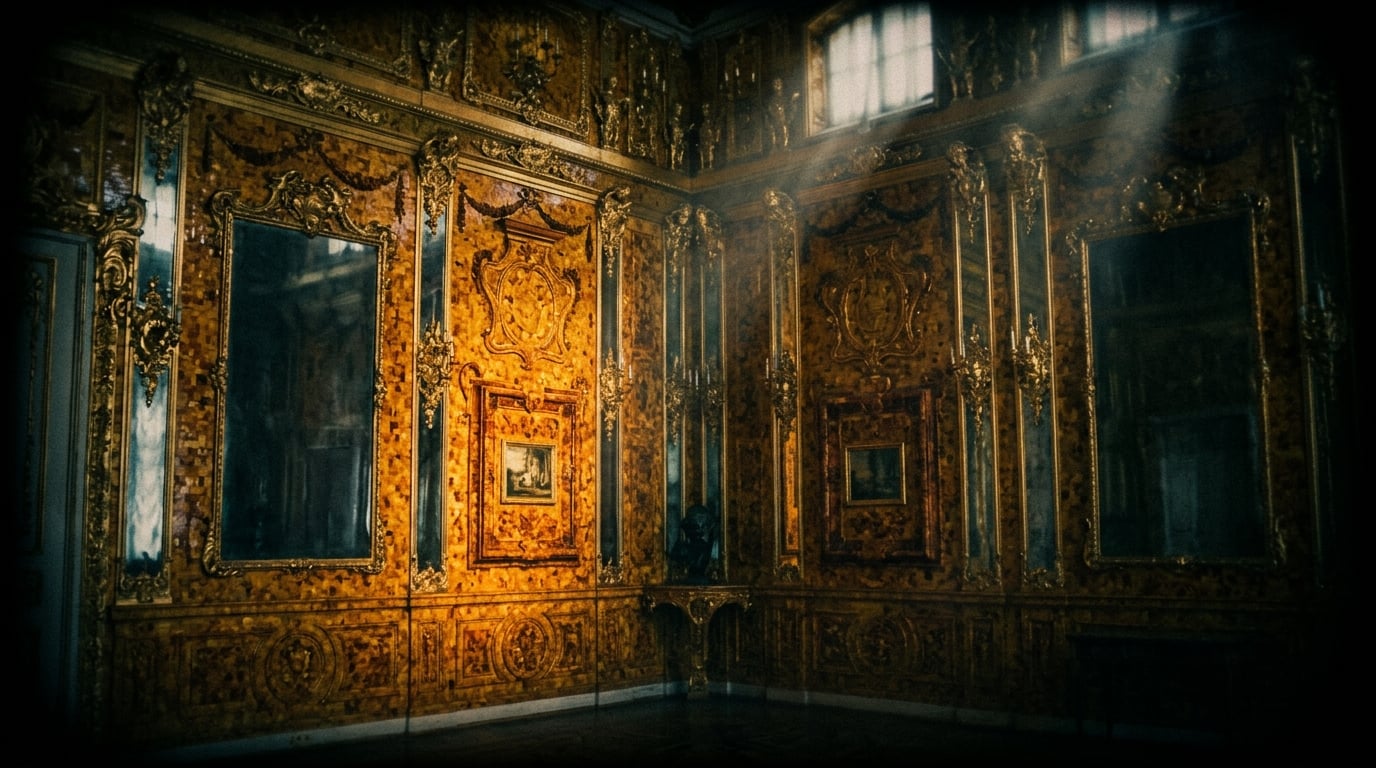
The Amber Room was never just a decorative interior. It was an architectural statement, a diplomatic gift, and eventually a symbol of cultural loss so complete that it took on a life of its own. The room began in Prussia in the early 1700s, designed with amber panels, gold leaf, mirrors, and intricate detailing intended to dazzle any visitor who entered it. In 1716, it was gifted to Peter the Great by Prussia’s King Frederick William I, a gesture that served politics as much as beauty. The room was later installed in the Catherine Palace near Saint Petersburg, where it became one of the most famous interiors in Europe.
For more than two centuries, the Amber Room was admired as a masterpiece of craftsmanship. Then the Second World War changed everything. When Nazi forces advanced into Soviet territory in 1941, the palace was looted. Soviet curators tried to protect the room by covering the panels, but the amber was fragile and difficult to move. The Germans stripped the chamber, packed it into crates, and shipped it west. After that, the record becomes cloudy, and cloudiness is where modern mystery often begins.
The Disappearance: What We Know, and What We Only Suspect
The strongest factual anchor in the case is simple: the Amber Room was removed from the Catherine Palace by German forces and taken to Königsberg, then the capital of East Prussia. Photographs, inventories, and wartime accounts confirm that the panels were dismantled and transported. By 1944, the room was installed, at least temporarily, in the castle at Königsberg. Then the Allied bombing campaign intensified, the city was battered, and the trail began to break apart.
Here is where the case diverges into competing narratives. The official Soviet and later German position for many years leaned toward destruction: the room was likely lost in the firestorms that consumed Königsberg or destroyed during the fighting that followed. That explanation is plausible. War is a highly efficient destroyer of evidence. Buildings burn, archives are lost, witnesses die, and cargo is misfiled, hidden, or looted again. In the twentieth century, many supposed mysteries were really the result of a bureaucracy collapsing under artillery fire.
And yet the Amber Room refused to stay neatly buried in that explanation.
Witness Accounts and the Evidence Trail
Postwar testimony produced a loose chain of claims that kept the search alive. Some witnesses said the room remained in Königsberg Castle until late in the war. Others suggested it was removed again before the city was bombed. A number of accounts pointed toward hidden storage sites in mines, salt caverns, or bunkers across Germany and occupied Europe. The problem is that many of these statements were secondhand, inconsistent, or made years after the fact, when memory had already been reshaped by rumor, guilt, and publicity.
There were also practical clues. German officials moved enormous quantities of looted art during the war, and not all of it was cataloged with the discipline one would expect from a modern museum. Transport routes shifted constantly. Paperwork was destroyed. Units that had handled cultural property often did not survive intact. That does not prove the Amber Room survived, but it does explain why so many investigators kept finding gaps rather than answers.
One of the most persistent leads involved Königsberg Castle itself. Some researchers argued that if the room had not left the city, then its remains might still be buried under postwar rubble. Others examined the possibility that the panels were loaded onto a ship before the Soviet advance, only for that vessel to sink in the Baltic. The difficulty is that for every theory, there is usually a competing inconvenience: incomplete logs, contradictory testimony, or a lack of physical evidence.
What makes the Amber Room case endure is not one dramatic clue, but the accumulation of unanswered questions surrounding a very real theft. Once the panels were removed from the Catherine Palace, the historical record turned fragmented, and fragmentation is the natural habitat of legend.
Official Explanations Versus the Anomalies
The most conventional explanation is also the one historians tend to favor: the Amber Room was destroyed in Königsberg. The castle was heavily damaged, and the fighting in East Prussia was brutal. If the room was still in the castle, fire and shelling could easily have reduced it to ash, resin, and twisted metal. In a war zone, especially one approaching collapse, valuable objects can vanish without leaving a recoverable trace.
But there are anomalies, and they matter. First, no definitive destruction record has ever surfaced. There is no universally accepted document stating that the Amber Room was burned, shattered, or recovered in ruins. Second, the postwar Soviet search was broad but not exhaustive, and the geopolitical climate of the Cold War made cooperation difficult. Third, the room’s fame created incentives for false leads. Some people sold hope, others sold access, and some may have genuinely believed they had found a trace of the treasure when they had only found fragments of another story.
Then there is the matter of timing. The final months of the war produced frantic movement across East Prussia. Artworks were relocated, concealed, and sometimes forgotten in the rush. If the Amber Room left Königsberg, it could have been split apart and dispersed. Amber panels are not a single monolithic object; they are transportable, breakable, and, in the wrong circumstances, easy to conceal. That makes the room both more findable and more vulnerable to irreversible loss.
One often-overlooked point is that the Amber Room was not merely stolen once. It was stolen from one empire, then stolen from its thieves by the collapse of war. In intelligence terms, that matters. When an object passes through multiple hands during a chaotic period, the number of possible exit routes increases, but the quality of the evidence decreases. The chain of custody becomes a chain of ruptures.
My Analytical Read: Follow the Incentives, Not the Legends
When I examine a case like this, I try to remove the romance before looking at the residue. The romantic version of the Amber Room is seductive: a legendary treasure hidden in a bunker, waiting for the right investigator to unlock the door. The analytical version is less dramatic but more likely. A valuable, fragile object was dismantled in wartime, moved through an unstable transport network, then lost to destruction, looting, or quiet dispersal. Most so-called mysteries end not with a grand revelation, but with a series of small failures that add up to disappearance.
From a former intelligence perspective, the first question is always motivation. Who benefited from moving the room? The Nazis benefited from display value and ideological theft. Local military administrators benefited from control over assets. Black market intermediaries benefited from selling fragments. Soviet authorities benefited from reclaiming a symbol of cultural humiliation. Each of these actors had reasons to obscure the truth or simplify it.
The second question is capability. Could the room have been hidden successfully? Yes. Could it have been destroyed without a clear record? Also yes. Could it have been split into parts and dispersed through private collections? That remains possible, though difficult to prove. The amber panels were valuable enough to steal, but awkward enough to create problems for anyone trying to move them clandestinely. In that sense, the room sits at the intersection of art, war, and logistics.
And the third question is the one that usually matters most: what evidence would change my mind? A wartime transport manifest, a direct witness statement from someone who physically handled the panels, or the discovery of identifiable fragments in a verified cache would all carry weight. Absent that, I see a case dominated by plausible destruction, surrounded by a halo of unresolved leads. That is not sensational, but it is honest.
Why the Mystery Still Matters
The Amber Room continues to fascinate because it is more than a missing artifact. It represents the vulnerability of culture in wartime and the ease with which history can be erased by violence. Unlike a ghost story, this case does not depend on belief in the supernatural. It depends on the ordinary, devastating machinery of conflict: theft, fire, relocation, and silence.
At the same time, the mystery has not vanished entirely. Small fragments of the original room have surfaced over the years, and reconstruction efforts in Russia eventually recreated the chamber in meticulous detail. That restored room is beautiful, but it is also an admission: the original may be gone for good, or it may still exist in pieces, separated from the story that made it famous.
That uncertainty is why investigators still circle the case. Not because the Amber Room necessarily survives in a secret vault, but because the historical record leaves enough room for doubt to remain alive. For a mystery to endure, it does not need to be impossible. It only needs to be incomplete.
Conclusion: A Treasure Lost to War, Not Wonder
After weighing the evidence, I think the most probable explanation is still that the Amber Room was destroyed in the final destruction of Königsberg or in the chaotic months that followed. But probability is not certainty. The absence of a conclusive destruction record leaves a narrow opening for other possibilities, and narrow openings are where serious researchers continue to work.
If the Amber Room survives anywhere, it is likely not as a complete chamber waiting beneath some cinematic trapdoor. It is more likely as fragments: a panel in a private collection, an ornament misidentified in an archive, a cached section of wood and amber hidden by someone who never came forward. That is not as dramatic as legend, but it is closer to how history usually hides its secrets.
The Amber Room remains one of the great missing objects of the twentieth century because it sits at the intersection of fact and inference. We know it was stolen. We know it reached Königsberg. We do not know with certainty what happened next. For an investigator, that is enough to keep the file open.
🏆 Video: The Amber Room The
A Knight Phenomena Investigation