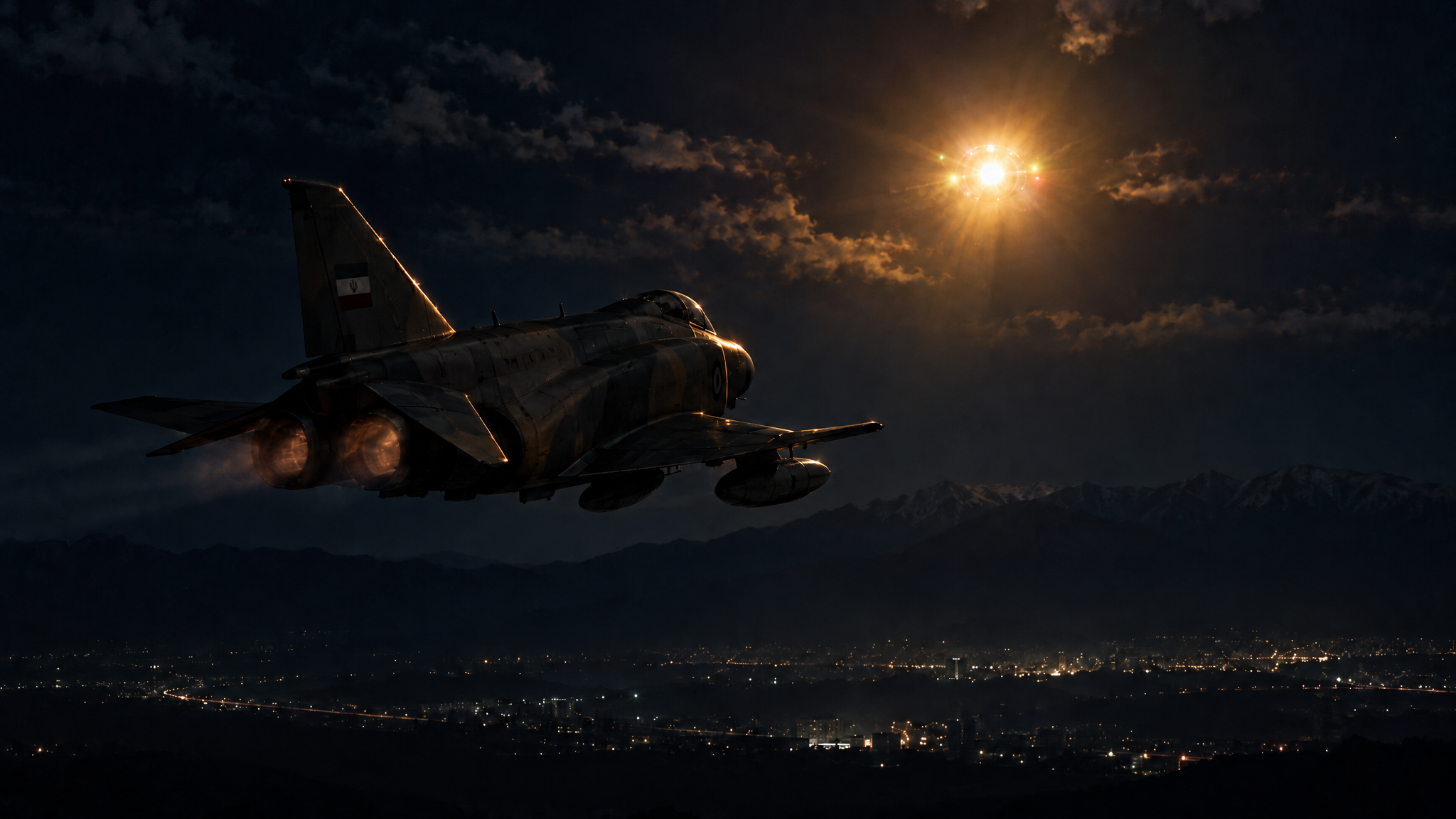
The Tehran UFO Incident: When Iran's Air Force Encountered the Impossible
In my years as an analyst, I learned to distrust any report that depends on a single witness, a single sensor, or a single moment. The Tehran incident of September 1976 has none of those weaknesses. It involves civilians, military pilots, air traffic controllers, ground radar, airborne radar, and a formal U.S. intelligence assessment written within days. It is a thoroughly documented case, and it is still unresolved.
The Document That Started It All
The core of this case is a declassified Defense Intelligence Agency memorandum, dated September 1976 and titled with a routine report designation. It was prepared from information passed by the U.S. defense attaché's office in Tehran. At the time, Iran was ruled by Shah Mohammad Reza Pahlavi and was a close American military partner. U.S. advisers were embedded with the Imperial Iranian Air Force, which flew American-built F-4 Phantom IIs.
The report was circulated to the CIA, the State Department, the White House, and the National Security Agency, among others. Retired Air Force Lt. Col. Roland Evans' name is often associated with the format of such reports, but what matters is the structure. The DIA document was graded well by its own criteria. It named the sources, the sensors, the timing, and the sequence. Later analysts have pointed out that it met nearly every standard of a credible field report.
The Night of September 18–19, 1976
Around 12:30 a.m. on September 19, the Mehrabad Airport command post in Tehran began receiving telephone calls from residents of the Shemiran district in the north of the city. They reported a strange object in the sky. The callers described something brighter than a star.
The duty officer, a general, looked outside and saw an object he described as a star, but one that behaved unusually. He decided to take the matter seriously and ordered an F-4 Phantom to be scrambled from Shahrokhi Air Force Base to investigate. This is an important detail. The scramble was a deliberate military decision, not a reaction to a rumor.
The First Intercept
The first F-4 took off about 1:30 a.m. and headed for the object, which was roughly 70 miles away at that point. The DIA report describes the object as flashing with colored lights, bright enough to be seen from that distance. The pilot approached to within about 25 nautical miles.
At that point the crew reportedly lost all instrumentation and communications. The report states that the aircraft's UHF radio and its intercom failed. The pilot broke off the approach and turned away. According to the account, when the aircraft turned away from the object, instruments and communications were restored. The pilot's flight was not simply an inconvenient failure; the loss occurred precisely during the approach and resolved precisely during the retreat.
The Second Phantom
A second F-4 was launched at about 1:40 a.m. This crew obtained a radar lock on the object at 27 nautical miles, at a position on the nose of the aircraft. The radar return was roughly the size of a 707 tanker aircraft, though the visual brightness suggested something very different. The object's brightness was such that its actual shape could not be determined.
As the Phantom closed in, the object was said to speed up and maintain separation. The range on the radar stayed at about 25 nautical miles. This is the part analysts find notable. The target was not simply sitting still. It was managing distance.
The Object That Released an Object
The most dramatic moment is documented in the report. As the second Phantom closed, another bright object separated from the primary one and headed straight toward the F-4 at high speed. The pilot decided to fire an AIM-9 heat-seeking missile at it. At that instant, according to the report, his weapons control panel went dead, and he lost communications as well.
The pilot attempted a sharp turn and dive to evade the object. The secondary object was said to fall in behind the aircraft, trailing it for some distance, and then it turned away and rejoined the parent object. The crew reported that the object then moved off.
Shortly afterward, a third object was described as separating from the primary and descending slowly toward the ground. The crew watched it, expecting an explosion or impact. Instead it settled on the ground and illuminated the area in a radius of two to three kilometers.
Landing and the Ground Search
The crew marked the approximate location, in a dry lakebed area near the mountains. They then returned to base. They reported that as they flew nearer to the landing site, communications and instruments functioned normally again.
The following morning the crew was taken by helicopter to the area. They found nothing at the lakebed. But they did locate a house with a garden near the area where the light had been seen. Locals there reported that they had heard a loud noise during the night and seen a bright light. The details of the inquiry were included in the DIA report, though no physical evidence was recovered.
Why Analysts Took It Seriously
The assessment is what makes this report famous. In the DIA document, the evaluators grade the information on multiple criteria, and the conclusion has been quoted for decades. The case was noted as being exceptional because:
First, the object was seen by multiple witnesses in different locations and at different altitudes. Second, the sightings were confirmed by radar, both ground and airborne. Third, the electromagnetic interference effects were reported by multiple aircraft. Fourth, the witnesses were trained military observers with a clear reason to be accurate.
Those factors give the report an unusual credibility rating. It is not proof of anything extraordinary, but it is the kind of file that cannot easily be dismissed.
The Skeptical Case
Honest analysis requires weighing the alternatives. Astronomer and skeptic Philip Klass proposed that the initial sighting was the planet Jupiter, which was bright in the sky that night. Others have suggested that the first Phantom crew was misled by a bright star or planet and that the later events were the consequence of expectation and stress.
There is some merit here. Jupiter was indeed prominent that night, and pilots can be fooled by bright celestial objects, especially at night. The initial citizen calls could plausibly have been triggered by a bright planet. Notably, the first F-4 crew reportedly never got near the object, which is consistent with chasing a celestial body that appears to recede.
But the Jupiter explanation does not easily account for the radar return on the second aircraft, the reported object separation, or the weapons control failure. Skeptics have responded that radar anomalies and instrument glitches can have mundane causes, and that the later parts of the account were retold after the event. That is a fair point. The report is a secondhand summary, and the original pilot debriefs are not available to us in full.
Later Testimony
In 2007, retired Iranian Air Force Brig. Gen. Parviz Jafari, who was the pilot of the second Phantom, spoke at a press conference at the National Press Club in Washington, D.C., alongside other former military officials. He reaffirmed the essential elements of the story: the loss of instruments, the object's behavior, and the failure of the weapons panel. He maintained the account had never changed.
Consistent testimony over thirty years is not proof. Memory is unreliable and stories can harden over time. Still, it matters that the principal witness never retracted anything.
An Analyst's Conclusion
When I look at the Tehran case, I separate it into layers. The first layer, a bright light seen by civilians, can be explained by Jupiter or something similar. The second layer, the radar contact and the reported electromagnetic effects, cannot be dismissed as easily. The third layer, the object separation and the landing, rests largely on pilot testimony, and that is where the evidence becomes thinner.
What the case demonstrates is something intelligence professionals know well. A well-documented event is not the same as an explained event. The DIA file shows that, in 1976, the U.S. government received a credible report from a trusted ally, circulated it widely, and never offered a public explanation. The question that remains is a narrow and honest one: what did two trained Iranian crews encounter that night, and why did both lose their systems at the point of closest approach? Until the original records are released, the answer remains open. That is not a conclusion that satisfies anyone, but it is the one the evidence allows.