The Tarim Basin Mummies: Ancient Caucasians in the Heart of China's Forbidden Desert
The Desert That Shouldn't Have Secrets
The Taklamakan Desert in China's Xinjiang region is not a place that invites exploration. Its name translates, depending on the source, as either "you go in, you don't come out" or "the place of no return." Temperatures swing from brutal summer heat to killing winter cold. Sand dunes rise to 300 meters. There is almost no water. For most of recorded history, it has been treated as a void — a geographic obstacle between civilizations rather than a place where civilization itself might have taken root.
That assumption collapsed in the early twentieth century, and has been collapsing further ever since.
Beginning with Swedish explorer Sven Hedin's expeditions in the 1890s and accelerating through systematic excavations in the 1970s and 1980s, archaeologists working the Tarim Basin — the vast depression the Taklamakan occupies — began recovering mummies. Not a handful. Thousands. Preserved by the extreme aridity of the desert, many in extraordinary condition: skin intact, hair still colored, clothing still woven. The oldest date to approximately 2000 BCE. Some push closer to 4000 years ago.
None of that is particularly shocking. Deserts preserve bodies. What is shocking is what these people looked like.
The Evidence That Rewrites the Map
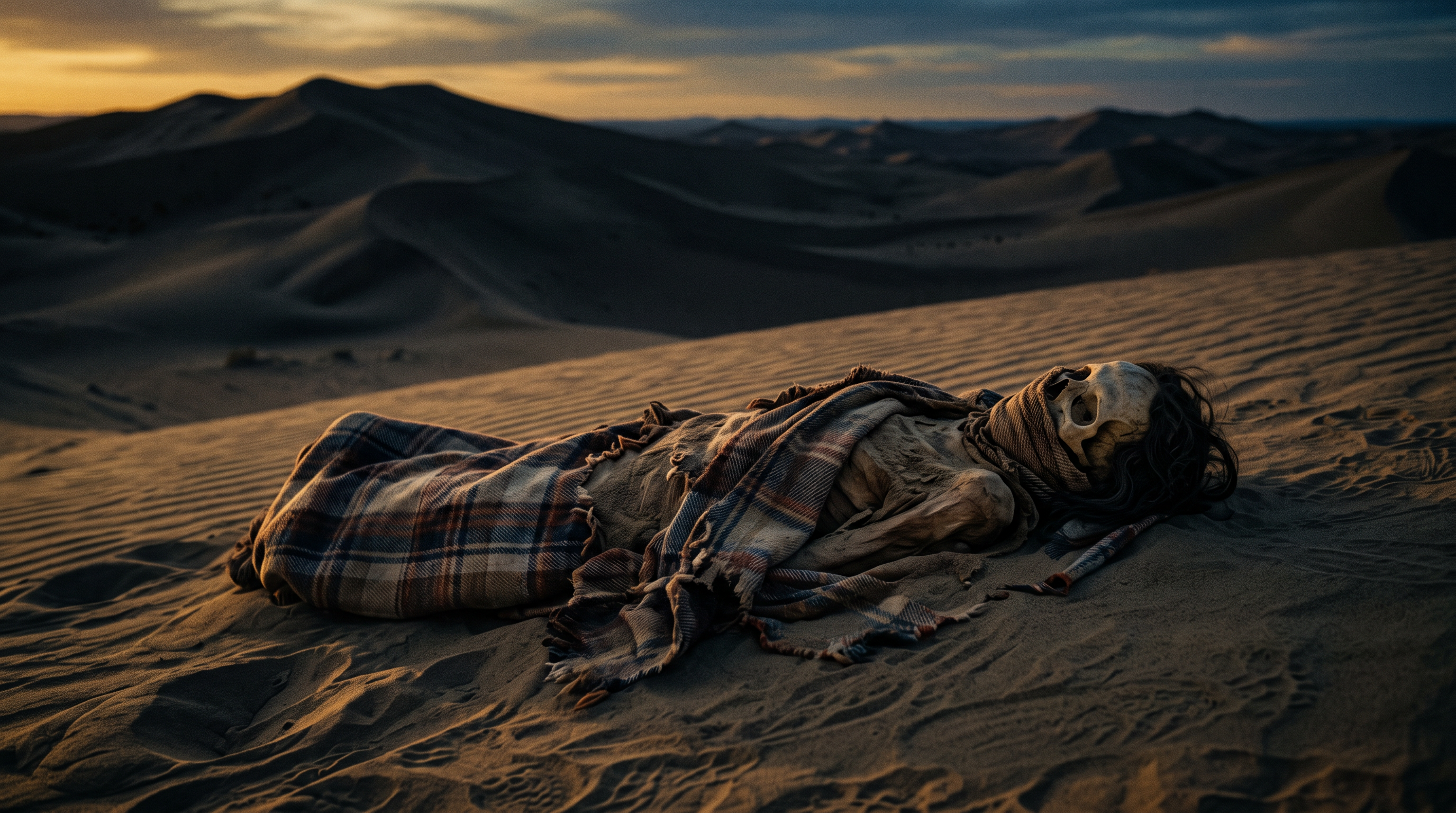
The Tarim mummies are not East Asian in appearance. They are, by every physical and genetic measure, Western Eurasian — what we would colloquially call Caucasian. They are tall, frequently exceeding six feet. Their hair is brown, auburn, and blonde. Their facial features — high-bridged noses, deep-set eyes, prominent brow ridges — align with populations from the Pontic Steppe, the Caucasus, or even Western Europe. One of the most famous specimens, a woman recovered from the site of Xiaohe and nicknamed "the Beauty of Loulan," has auburn hair, a narrow face, and features that would not look out of place in modern-day Scandinavia. She died roughly 3,800 years ago in the middle of China.
Their clothing compounds the mystery. The textiles recovered from Tarim burial sites include plaid and tartan-like weaves — patterns historically associated with Celtic cultures in Western Europe. The wool, the dyes, the weaving techniques: all point west, not east. Some mummies were buried wearing felt boots, long woolen coats, and pointed hats that bear striking resemblance to the dress of Scythian and Indo-European steppe cultures.
For decades, Chinese authorities restricted access to the mummies and the excavation data. Foreign researchers were denied samples. Publication was suppressed or delayed. The political sensitivity was not hard to read: Xinjiang is home to the Uyghur people, a Turkic ethnic group with a long-running and often violent independence movement. Archaeological evidence suggesting that the region's earliest inhabitants were not Han Chinese — that the land had a pre-Chinese history rooted in a completely different genetic lineage — was not a narrative Beijing was eager to amplify.
What the DNA Actually Says
In 2021, a landmark genetic study published in Nature by a team including researchers from Harvard, the Max Planck Institute, and several Chinese universities finally cracked the question open with hard data. The team analyzed ancient DNA from 13 of the oldest Tarim mummies — those dating to approximately 2000 BCE — and compared it against a broad database of ancient and modern populations.
The results were unambiguous and, depending on your prior assumptions, either clarifying or deeply strange. The Tarim mummies were not migrants from the west. They were not a mixed population that had traveled the early Silk Road. They were genetically isolated — a population with no close relatives in any known ancient or modern group. The researchers identified them as descendants of the Ancient North Eurasians, a ghost population that contributed genetics to both Western Eurasian and Native American lineages but largely disappeared from the record thousands of years ago.
In plain terms: these people were not travelers. They were not colonists from Europe or the steppe. They were a remnant population — possibly one of the last surviving pockets of an ancient human group that had been isolated in the Tarim Basin for an extraordinarily long time, maintaining their genetic distinctiveness while the world around them changed.
"They were a people who had no business being where they were found — and yet the evidence is unambiguous. They were there, they were distinct, and they built a culture sophisticated enough to survive in one of the world's most lethal environments for centuries."
The Tocharian Connection
There is a linguistic dimension to this that intelligence analysts would recognize as a corroborating signal — a second data stream that independently points in the same direction. The Tarim Basin was, in the first millennium CE, home to a people called the Tocharians, known from manuscripts discovered in the region in the early twentieth century. The Tocharian languages are Indo-European — related to Sanskrit, Latin, and Greek — but they represent one of the easternmost branches of that family ever documented. Linguists have long puzzled over how an Indo-European language ended up so far east, so isolated from its relatives.
The mummies don't prove the Tocharians were their direct descendants. The chronological gap is significant. But the geographic overlap is not coincidental. The Tarim Basin appears to have been, for millennia, a refuge for populations that were genetically and culturally distinct from their neighbors — a pocket of preserved difference in a desert that killed everything else.
What Remains Unresolved
The 2021 DNA study answered the migration question but opened others. If the oldest Tarim mummies were a genetically isolated remnant population, where did they come from originally? The Ancient North Eurasian lineage they carry was widespread across Eurasia during the Ice Age and its immediate aftermath. At some point, this group — or a branch of it — moved into the Tarim Basin and stayed. When? Why? What happened to them when the later Bronze Age populations arrived?
The archaeological record suggests cultural continuity at some sites spanning centuries, followed by abrupt abandonment. The site of Xiaohe, where the Beauty of Loulan was found, shows evidence of a thriving community that simply stopped. No signs of violent destruction. No gradual decline visible in the stratigraphy. The people were there, and then they were not.
Access to the full mummy collection remains restricted. Chinese authorities have been selectively cooperative with international researchers — enough to allow the 2021 study, not enough to permit the kind of comprehensive analysis that would settle remaining questions about population continuity, cultural transmission, and the full chronological range of the Tarim people.
The Larger Implication
In my years analyzing intelligence, one of the first things you learn is that absence of evidence is not evidence of absence — but deliberate restriction of access to evidence is itself a data point. The Chinese government's long management of the Tarim mummy narrative tells you something about what they believe the evidence implies. Governments do not suppress archaeology that confirms their preferred history.
What the Tarim Basin mummies ultimately demonstrate is that human prehistory was more complex, more mobile, and more surprising than any map we've drawn of it. A genetically distinct people, physically European in appearance, built a culture in the heart of Asia's most forbidding desert four thousand years ago — and left almost no trace in the historical record beyond their preserved bodies and the textiles wrapped around them.
That is not a mystery that has been solved. It is a mystery that has been partially illuminated, with the most interesting questions still waiting in the sand.